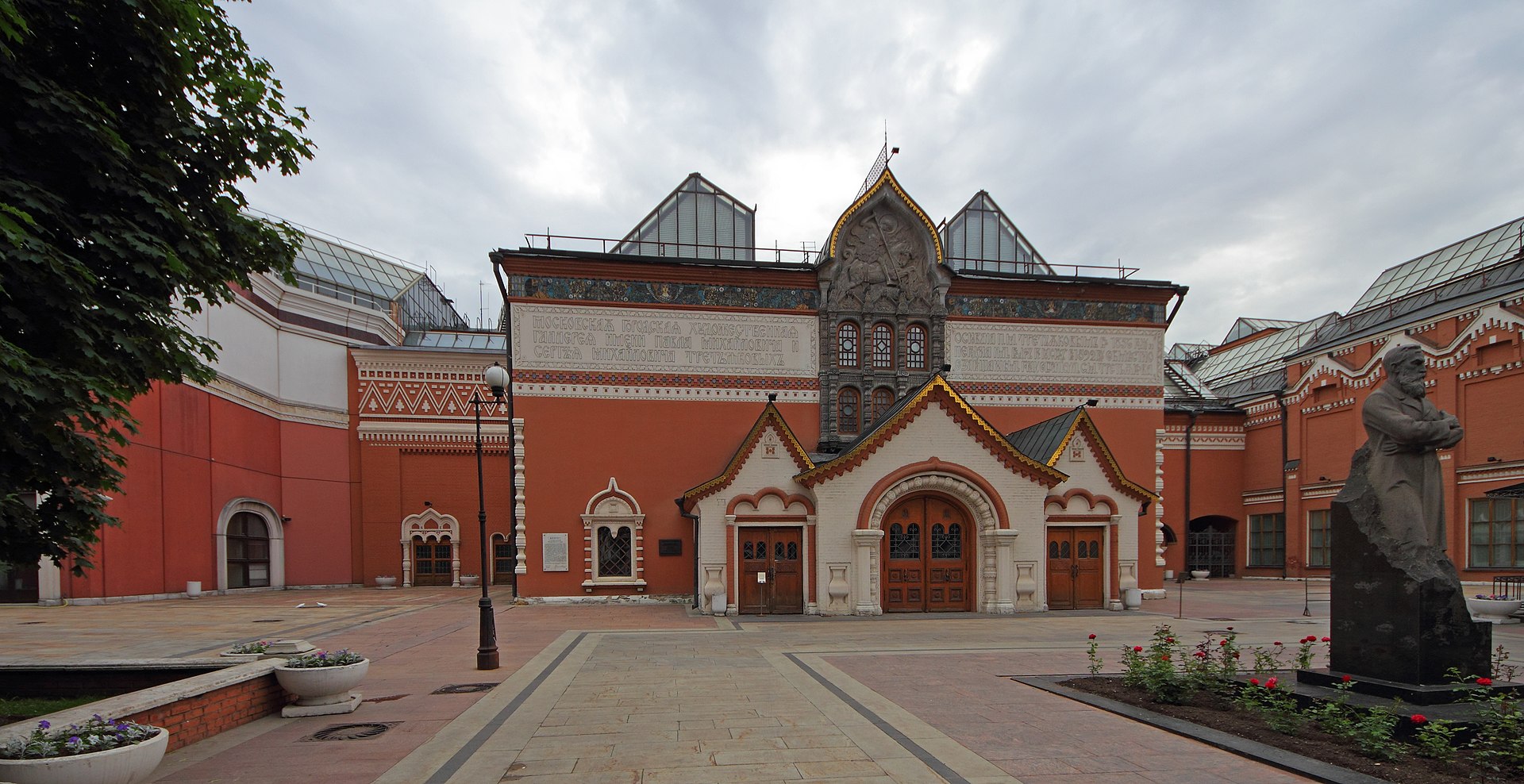
The State Tretyakov Gallery in Moscow is one of Russia’s foremost art museums, housing a comprehensive collection of Russian fine art from the 11th century to the present. Founded by the merchant and collector Pavel Tretyakov in 1856, the gallery was intended to make Russian art accessible to the public. Today, it displays over 180,000 works, including icons, portraits, and avant-garde pieces, serving as both a cultural landmark and educational institution.
Key Facts
- Materials
- Brick, Stone, Plaster
- Civilization
- Russian Empire; Russian Federation
- Date(s)
- Gallery founded: 1856; Current building completed: 1904
- Condition
- Operational national museum
- Original Function
- Private art collection, public exhibition
- Key Figures
- Pavel Tretyakov, Viktor Vasnetsov, Ilya Repin
Founding by Pavel Tretyakov
1856-1892Pavel Tretyakov began collecting works by contemporary Russian artists, aiming to create a national gallery that reflected Russia’s artistic heritage. He opened the collection to the public in 1892.
Construction of the Gallery Building
1902-1904A dedicated building was designed by architect Viktor Vasnetsov to house the expanding collection. The Neo-Russian style architecture became a landmark in itself.
Soviet Era Transformation
1918-1991After the Russian Revolution, the gallery was nationalized and expanded with works from private collections across Russia, establishing it as the premier repository of Russian art.
Modern Museum and Expansion
1991-presentThe gallery continues to display its core collection while expanding exhibition space, offering educational programs, and hosting temporary exhibitions from national and international artists.
Cultural Significance
The Tretyakov Gallery represents the heart of Russian visual culture, preserving and showcasing the evolution of Russian art from religious iconography to modern avant-garde works. It embodies national identity and artistic achievement, making it central to Moscow’s and Russia’s cultural life.
Interpretive Notes
Scholarly debates and areas of uncertainty
Scholars debate the interpretation of certain avant-garde pieces in the collection and the extent to which Soviet-era acquisitions altered the original curatorial vision of Pavel Tretyakov. The gallery’s approach to modern restoration techniques is also occasionally contested.
Visiting Information
Entry Rules
Paid admission required. Security screening is mandatory. Certain works or rooms may be temporarily closed for conservation or temporary exhibitions.
Best Times to Visit
Weekday mornings to avoid crowds. Late afternoons are less busy than midday. Major Russian holidays may attract larger visitor numbers.
Photography
Personal photography allowed without flash in most areas. Tripods and commercial photography require a permit. Flash photography is prohibited in galleries containing delicate artworks.
Preservation Notes
Visitors must not touch artworks. Climate control and lighting are strictly regulated to preserve paintings and icons. Follow all marked paths and staff instructions.
Nearby POIs
11 shown- Peter the Great Statue0.8 km
- Cathedral of Christ the Saviour1 km
- Cathedral of the Dormition1.1 km
- Pushkin State Museum of Fine Arts1.1 km
- Kremlin1.2 km
- Cathedral of Vasily the Blessed1.2 km
- Multimedia Art Museum1.4 km
- Lenin's Mausoleum1.4 km
- State Historical Museum1.6 km
- Cathedral of Our Lady of Kazan1.6 km
- Tagansky Protected Command Point1.8 km
Sources & Further Reading
- [1]The Tretyakov Gallery: A Guide to Russian Art — Maria Petrova. Moscow Art Press (2010)
- [2]Pavel Tretyakov and the Russian Art Collection — Viktor Bilibin. Russian Museum Studies (2005)
Key Facts
- Materials
- Brick, Stone, Plaster
- Civilization
- Russian Empire; Russian Federation
- Date(s)
- Gallery founded: 1856; Current building completed: 1904
- Condition
- Operational national museum
- Original Function
- Private art collection, public exhibition
- Key Figures
- Pavel Tretyakov, Viktor Vasnetsov, Ilya Repin
Nearby POIs
11 shown- Peter the Great Statue0.8 km
- Cathedral of Christ the Saviour1 km
- Cathedral of the Dormition1.1 km
- Pushkin State Museum of Fine Arts1.1 km
- Kremlin1.2 km
- Cathedral of Vasily the Blessed1.2 km
- Multimedia Art Museum1.4 km
- Lenin's Mausoleum1.4 km
- State Historical Museum1.6 km
- Cathedral of Our Lady of Kazan1.6 km
- Tagansky Protected Command Point1.8 km