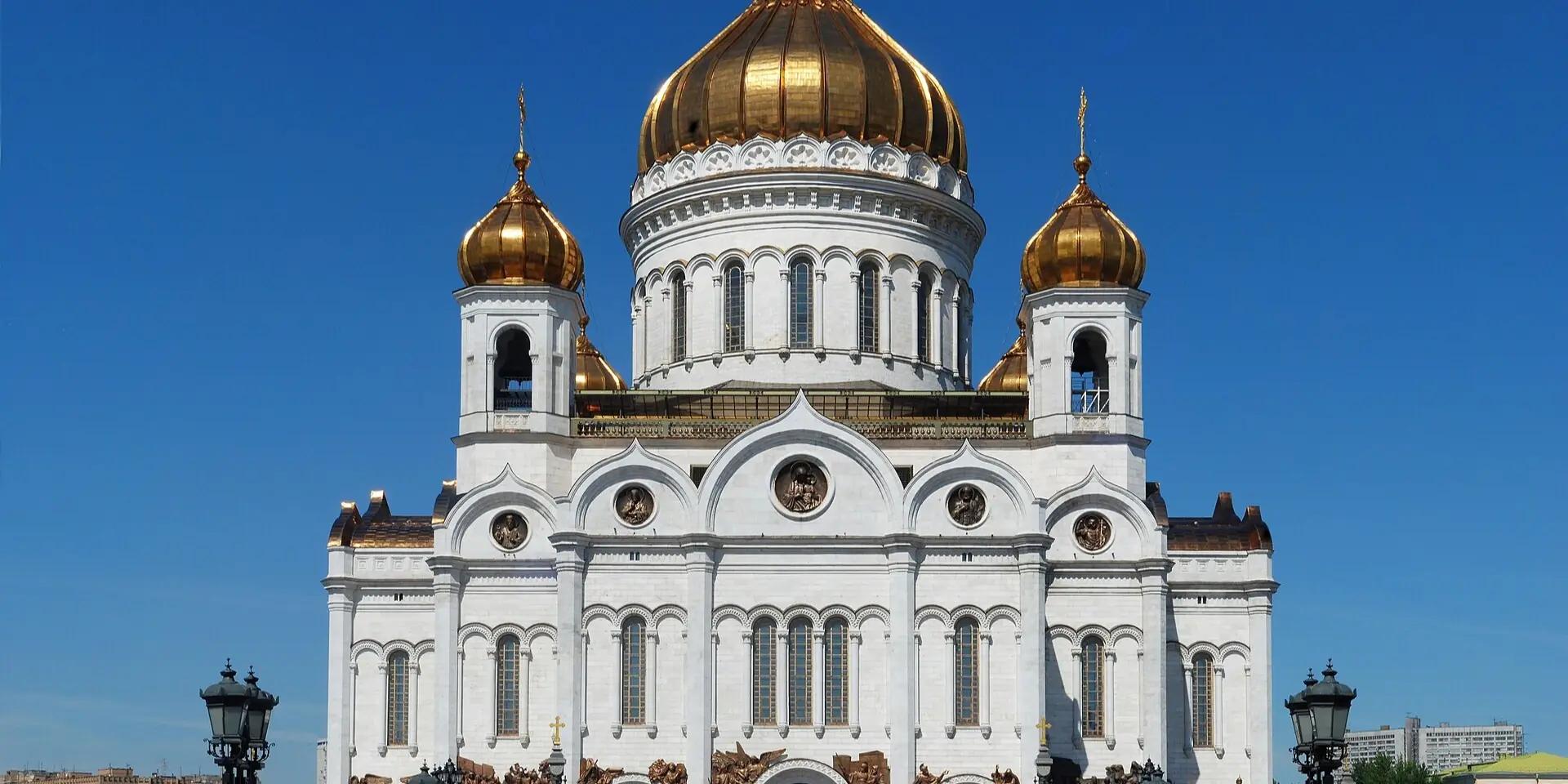
The Cathedral of Christ the Saviour in Moscow is the tallest Orthodox Christian church in the world, originally commissioned after the defeat of Napoleon in 1812. The first cathedral was completed in 1883 but demolished in 1931 during the Soviet era. The current cathedral, rebuilt between 1995 and 2000, faithfully reproduces the original design and serves as a functioning church, ceremonial center, and prominent cultural landmark.
Key Facts
- Materials
- Marble, Granite, Brick, Gilded domes
- Civilization
- Russian Empire; Russian Federation
- Date(s)
- Original: 1839-1883; Reconstruction: 1995-2000
- Condition
- Fully restored, operational cathedral
- Original Function
- Orthodox Christian cathedral commemorating victory over Napoleon
- Key Figures
- Alexander I, Kuzma Petrov-Vodkin (iconography), Patriarch Alexy II
Original Construction
1839-1883Commissioned after the Napoleonic Wars, the cathedral was designed by architect Konstantin Thon. It became the main church of the Russian Empire, hosting coronations, ceremonies, and religious events.
Demolition During Soviet Era
1931The original cathedral was demolished under Stalin to make way for the unbuilt Palace of the Soviets. Foundations remained for decades, and the site was temporarily occupied by the Moskva Pool, an open-air swimming pool.
Reconstruction
1995-2000Following the fall of the Soviet Union, the cathedral was reconstructed using the original plans and archival photographs. The rebuilding included modern engineering techniques while maintaining historical accuracy.
Modern Role
2000-presentThe cathedral functions as an active church, hosting religious services, national ceremonies, and cultural events. It is also a major tourist destination and symbol of Russia’s religious revival.
Cultural Significance
The Cathedral of Christ the Saviour symbolizes Russian national resilience, religious identity, and cultural revival following the Soviet period. Its reconstruction represents both historical memory and contemporary national pride.
Interpretive Notes
Scholarly debates and areas of uncertainty
Debates focus on the fidelity of the reconstruction, the integration of modern materials, and whether the rebuilding accurately reflects the original 19th-century architectural and artistic details.
Visiting Information
Entry Rules
Free admission to the main cathedral areas; paid access for guided tours of upper galleries. Respectful attire required. Security screening in place.
Best Times to Visit
Weekday mornings for smaller crowds. Religious holidays draw large attendance, so check the calendar if you wish to avoid congestion.
Photography
Personal photography allowed without flash in most areas. Tripods, flash, and commercial photography require a permit. Photography may be restricted during religious services.
Preservation Notes
Visitors must stay on marked paths, avoid touching icons or surfaces, and follow all staff instructions. Restoration work may occasionally restrict access to parts of the cathedral.
Nearby POIs
11 shown- Pushkin State Museum of Fine Arts0.3 km
- Multimedia Art Museum0.5 km
- Peter the Great Statue0.7 km
- Tretyakov Gallery1 km
- Cathedral of the Dormition1 km
- Kremlin1.1 km
- Lenin's Mausoleum1.4 km
- Cathedral of Vasily the Blessed1.4 km
- State Historical Museum1.4 km
- Cathedral of Our Lady of Kazan1.5 km
- The Garage Museum1.9 km
Sources & Further Reading
- [1]The Cathedral of Christ the Saviour: History and Reconstruction — Elena Smirnova. Moscow Cultural Press (2012)
- [2]Orthodox Architecture in Modern Russia — Vladimir Petrov. Russian Museum Studies (2005)
Key Facts
- Materials
- Marble, Granite, Brick, Gilded domes
- Civilization
- Russian Empire; Russian Federation
- Date(s)
- Original: 1839-1883; Reconstruction: 1995-2000
- Condition
- Fully restored, operational cathedral
- Original Function
- Orthodox Christian cathedral commemorating victory over Napoleon
- Key Figures
- Alexander I, Kuzma Petrov-Vodkin (iconography), Patriarch Alexy II
Nearby POIs
11 shown- Pushkin State Museum of Fine Arts0.3 km
- Multimedia Art Museum0.5 km
- Peter the Great Statue0.7 km
- Tretyakov Gallery1 km
- Cathedral of the Dormition1 km
- Kremlin1.1 km
- Lenin's Mausoleum1.4 km
- Cathedral of Vasily the Blessed1.4 km
- State Historical Museum1.4 km
- Cathedral of Our Lady of Kazan1.5 km
- The Garage Museum1.9 km