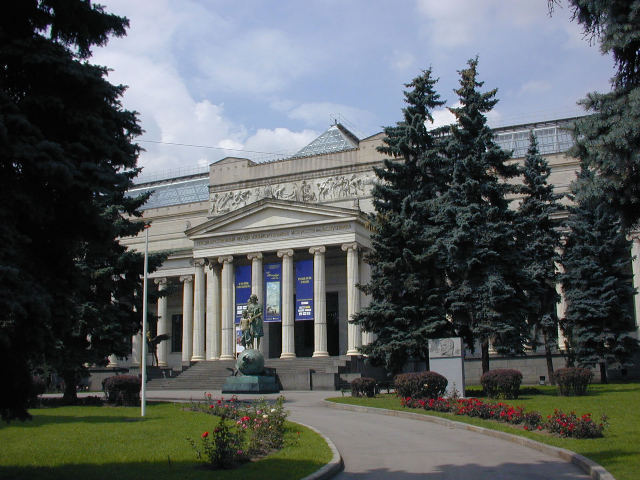
The Pushkin State Museum of Fine Arts is Moscow’s leading art museum, housing a vast collection of European, ancient, and modern artworks. Established in 1912 and inspired by the collections of European masters, the museum became a central institution for art study and public exhibitions in Russia. The museum features permanent collections as well as temporary exhibitions, educational programs, and research initiatives, making it a hub for art appreciation and scholarship.
Key Facts
- Materials
- Brick, Concrete, Plaster, Stone
- Civilization
- Russian Empire; Russian Federation
- Date(s)
- Foundation: 1912; Main building completed: 1913-1914
- Condition
- Fully operational museum
- Original Function
- National art museum for European and classical collections
- Key Figures
- Ivan Tsvetaev (founder), Alexander Benois, Various European artists represented in the collection
Founding and Early Years
1912-1914Founded by Ivan Tsvetaev, the museum was established to house European art collections and serve as an educational institution. The main building was constructed in the neoclassical style, with galleries designed for optimal display of artworks.
Soviet Era
1917-1991During the Soviet period, the museum expanded its collection through state acquisitions and transfers from private collections. It became a center for public art education and international exhibitions, while navigating ideological constraints.
Modern Development
1991-presentAfter the Soviet Union’s dissolution, the museum modernized facilities, digitized collections, and hosted international exhibitions. Restoration projects improved gallery spaces, making it a premier destination for art lovers in Moscow.
Cultural Significance
The Pushkin Museum is a major cultural and educational institution in Russia, fostering appreciation of European, classical, and modern art. It has influenced art scholarship, public taste, and museum practices throughout the country.
Interpretive Notes
Scholarly debates and areas of uncertainty
Debates focus on the provenance of artworks acquired during the Soviet era, particularly items from private or religious collections, as well as the representation of Russian versus foreign art in the museum’s narrative.
Visiting Information
Entry Rules
Paid admission required for permanent collections and temporary exhibitions. Security screening in place. Certain galleries may have restricted access during exhibitions or restoration.
Best Times to Visit
Weekday mornings to avoid crowds. Late afternoons or evenings during special exhibitions can offer quieter experiences.
Photography
Personal photography allowed in most galleries without flash. Tripods, flash, and commercial photography require a permit.
Preservation Notes
Visitors must follow marked paths, avoid touching artworks, and comply with staff instructions. Some exhibits may be temporarily closed for conservation.
Nearby POIs
11 shown- Cathedral of Christ the Saviour0.3 km
- Multimedia Art Museum0.8 km
- Cathedral of the Dormition0.8 km
- Kremlin0.9 km
- Peter the Great Statue1 km
- Tretyakov Gallery1.1 km
- Lenin's Mausoleum1.2 km
- State Historical Museum1.2 km
- Cathedral of Vasily the Blessed1.2 km
- Cathedral of Our Lady of Kazan1.3 km
- Bolshoi Theatre1.7 km
Sources & Further Reading
- [1]The Pushkin State Museum of Fine Arts: History and Collections — Maria Ivanova. Moscow Art Press (2015)
- [2]Russian Museums in the 20th Century — Alexander Petrov. Russian Cultural Studies (2008)
Key Facts
- Materials
- Brick, Concrete, Plaster, Stone
- Civilization
- Russian Empire; Russian Federation
- Date(s)
- Foundation: 1912; Main building completed: 1913-1914
- Condition
- Fully operational museum
- Original Function
- National art museum for European and classical collections
- Key Figures
- Ivan Tsvetaev (founder), Alexander Benois, Various European artists represented in the collection
Nearby POIs
11 shown- Cathedral of Christ the Saviour0.3 km
- Multimedia Art Museum0.8 km
- Cathedral of the Dormition0.8 km
- Kremlin0.9 km
- Peter the Great Statue1 km
- Tretyakov Gallery1.1 km
- Lenin's Mausoleum1.2 km
- State Historical Museum1.2 km
- Cathedral of Vasily the Blessed1.2 km
- Cathedral of Our Lady of Kazan1.3 km
- Bolshoi Theatre1.7 km