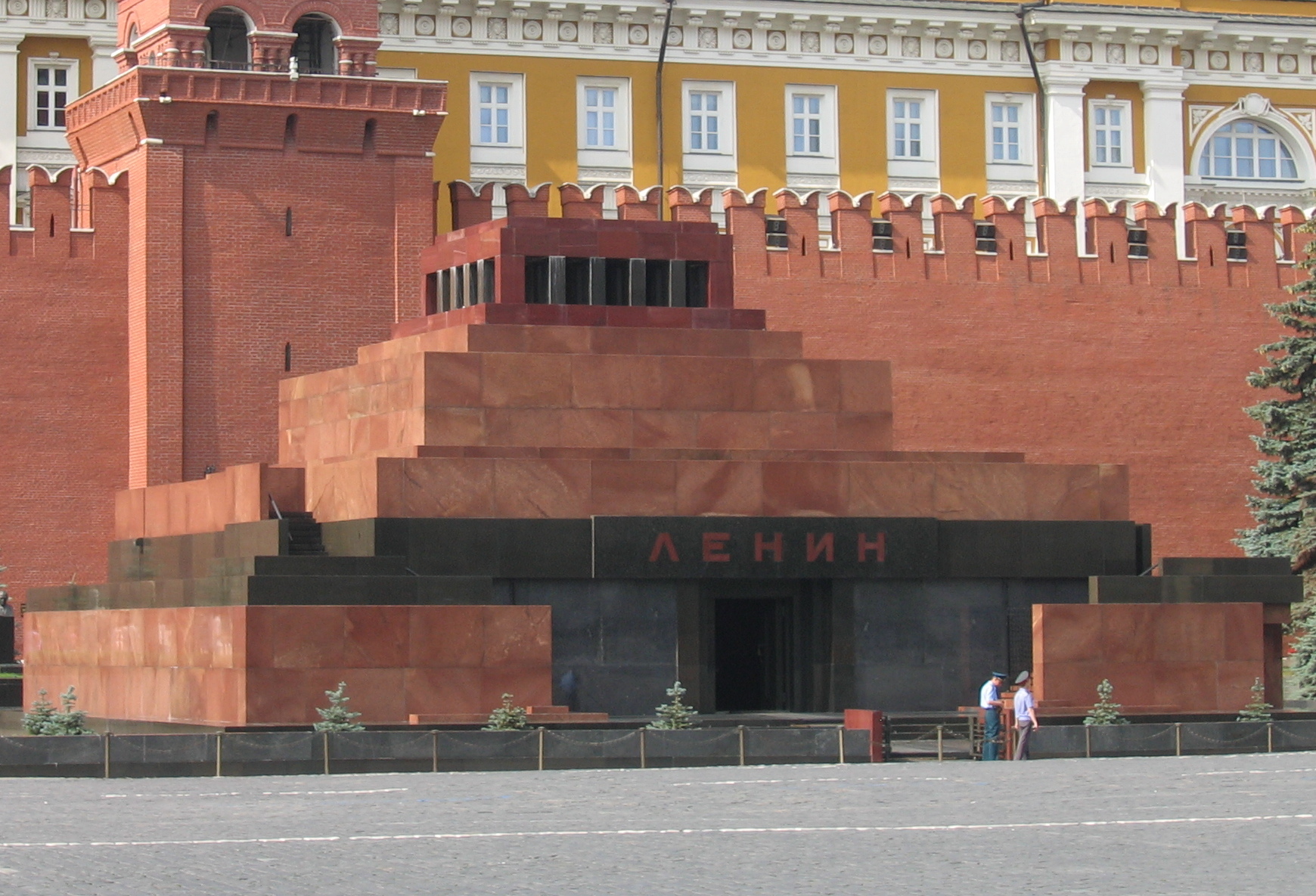
Lenin's Mausoleum, located in Red Square, Moscow, is the final resting place of Vladimir Lenin, the founder of the Soviet Union. Completed in 1930, the mausoleum serves as both a historical site and a symbol of Soviet-era politics and ideology. The structure houses Lenin’s embalmed body on public display, attracting visitors interested in Russian history, revolutionary heritage, and political culture.
Key Facts
- Materials
- Granite, Marble, Concrete
- Civilization
- Soviet Union; Russian Federation
- Date(s)
- 1924 (temporary), 1930 (current structure)
- Condition
- Operational, maintained for public viewing
- Original Function
- Public memorial for Vladimir Lenin
- Key Figures
- Vladimir Lenin, Alexey Shchusev (architect)
Temporary Tomb and Early Display
1924Following Lenin’s death in January 1924, a temporary wooden mausoleum was constructed on Red Square to house his body for public viewing. This site quickly became a focal point for Soviet commemorations.
Permanent Mausoleum Construction
1929-1930Architect Alexey Shchusev designed the current granite and marble structure in a stepped pyramid style. Completed in 1930, the mausoleum combined modernist and neoclassical elements and became an iconic symbol of Soviet architecture.
Soviet Era Ceremonial Role
1930-1991The mausoleum served as a site for state ceremonies, military parades, and official commemorations. It was a central feature during annual May Day and Revolution Day celebrations on Red Square.
Post-Soviet Era
1991-presentThe mausoleum continues to be open for public viewing under Russian Federation authority, maintained by a dedicated team. It functions as a historical and cultural site while preserving Lenin’s body according to traditional embalming methods.
Cultural Significance
Lenin’s Mausoleum is a key symbol of Soviet history and revolutionary heritage, reflecting the political and cultural influence of Lenin and the Soviet regime. It remains a site of education, memory, and tourism in Moscow.
Interpretive Notes
Scholarly debates and areas of uncertainty
Debates focus on the ethical and political implications of displaying Lenin’s embalmed body, the mausoleum’s architectural symbolism, and discussions over whether it should remain a public site in contemporary Russia.
Visiting Information
Entry Rules
Free entry; visitors must adhere to strict security protocols, remain silent, and follow staff instructions. Bags and cameras are not allowed inside.
Best Times to Visit
Weekday mornings to avoid long queues. Entry may be limited during public holidays or state events.
Photography
Photography and videography are strictly prohibited inside the mausoleum. Mobile phones must be silenced, and visitors must maintain decorum.
Preservation Notes
Visitors must remain on designated pathways and observe all rules. The embalmed body is carefully maintained by a dedicated preservation team, and no touching or approaching the sarcophagus is allowed.
Nearby POIs
11 shown- Cathedral of Our Lady of Kazan0.2 km
- State Historical Museum0.2 km
- Cathedral of Vasily the Blessed0.2 km
- Kremlin0.3 km
- Cathedral of the Dormition0.4 km
- Bolshoi Theatre0.7 km
- Pushkin State Museum of Fine Arts1.2 km
- Cathedral of Christ the Saviour1.4 km
- Tretyakov Gallery1.4 km
- Moscow Museum of Modern Art1.5 km
- Peter the Great Statue1.8 km
Sources & Further Reading
- [1]Lenin’s Mausoleum: History and Architecture — Sergey Ivanov. Moscow Architectural Press (2008)
- [2]Red Square and Soviet Monuments — Olga Petrova. Russian Museum Studies (2012)
Key Facts
- Materials
- Granite, Marble, Concrete
- Civilization
- Soviet Union; Russian Federation
- Date(s)
- 1924 (temporary), 1930 (current structure)
- Condition
- Operational, maintained for public viewing
- Original Function
- Public memorial for Vladimir Lenin
- Key Figures
- Vladimir Lenin, Alexey Shchusev (architect)
Nearby POIs
11 shown- Cathedral of Our Lady of Kazan0.2 km
- State Historical Museum0.2 km
- Cathedral of Vasily the Blessed0.2 km
- Kremlin0.3 km
- Cathedral of the Dormition0.4 km
- Bolshoi Theatre0.7 km
- Pushkin State Museum of Fine Arts1.2 km
- Cathedral of Christ the Saviour1.4 km
- Tretyakov Gallery1.4 km
- Moscow Museum of Modern Art1.5 km
- Peter the Great Statue1.8 km