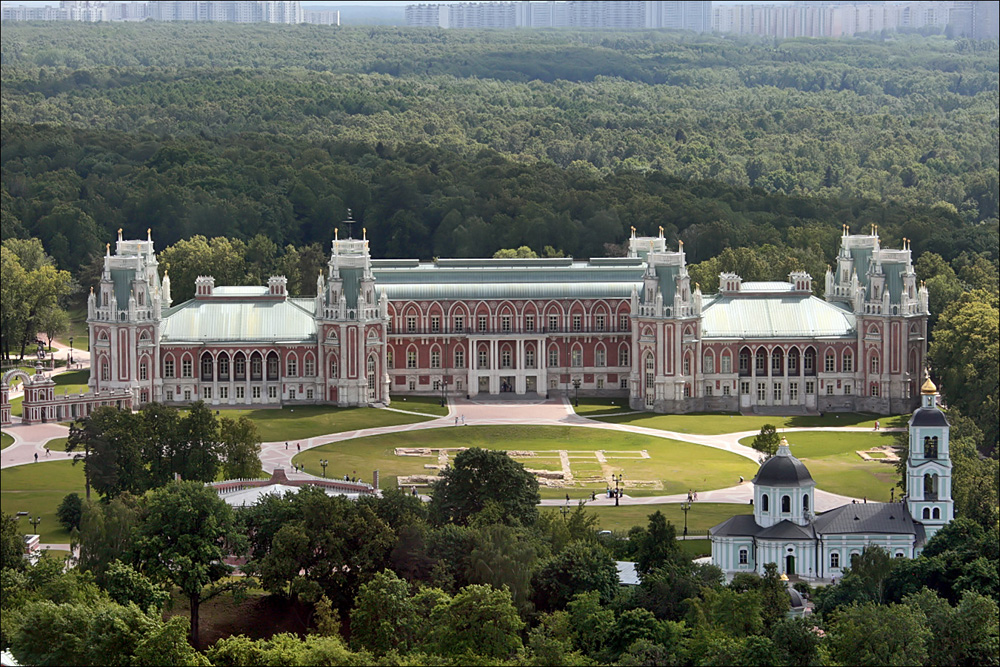
Tsaritsyno Palace is a grand architectural and park complex in southern Moscow, commissioned by Ekaterina the Great in the late 18th century. The palace was designed by architect Vasily Bazhenov and later modified by Matvey Kazakov, blending Gothic revival and Russian neoclassical styles. Though originally unfinished during Ekaterina’s reign, the palace and surrounding park have been extensively restored and now serve as a museum and cultural venue, hosting exhibitions, concerts, and public events.
Key Facts
- Materials
- Brick, Stone, Plaster, Wood
- Civilization
- Russian Empire; Russian Federation
- Date(s)
- 1775-1796 (construction interrupted; restoration completed 2005)
- Condition
- Restored, operational museum and cultural site
- Original Function
- Imperial residence
- Key Figures
- Ekaterina the Great, Vasily Bazhenov, Matvey Kazakov
Commissioning and Design
1775-1785Ekaterina the Great commissioned the complex to serve as a suburban imperial residence. Bazhenov designed a grand Gothic Revival palace with extensive gardens and ponds. Construction faced technical challenges and remained incomplete by Ekaterina’s death.
Modification and Decline
1785-19th centuryMatvey Kazakov modified Bazhenov’s designs to simplify construction. After the imperial family abandoned plans to use it as a residence, the palace fell into neglect, with many structures deteriorating over the centuries.
Restoration and Public Use
2000s-presentComprehensive restoration was carried out in the early 21st century, preserving the Gothic Revival and classical architectural elements. Today, Tsaritsyno functions as a museum, cultural venue, and landscaped public park, hosting exhibitions and performances.
Cultural Significance
Tsaritsyno Palace reflects Ekaterina the Great’s vision of imperial grandeur and the evolution of Russian Gothic Revival architecture. Its combination of architecture, landscaping, and public access has made it a significant cultural and recreational site in Moscow.
Interpretive Notes
Scholarly debates and areas of uncertainty
Scholars debate the fidelity of modern restorations to the original 18th-century designs, as well as the interpretation of Bazhenov’s and Kazakov’s architectural intentions in the completed complex.
Visiting Information
Entry Rules
Paid admission for palace interiors. Grounds and park open to the public. Certain halls may be closed for private events or restoration work.
Best Times to Visit
Weekday mornings or late afternoons for fewer crowds. Spring and summer offer access to the full park and garden landscape.
Photography
Personal photography allowed without flash. Tripods, commercial photography, and flash are prohibited inside palace interiors.
Preservation Notes
Visitors must follow designated pathways and not touch artworks or architectural details. Restoration projects may restrict access to some areas temporarily.
Nearby POIs
11 shown- Kolomenskoye4.8 km
- State Darwin Museum11.3 km
- The Garage Museum13.5 km
- Tagansky Protected Command Point14.2 km
- Peter the Great Statue14.5 km
- Tretyakov Gallery14.5 km
- Novodevichy Convent14.7 km
- Multimedia Art Museum15 km
- Cathedral of Christ the Saviour15.1 km
- Pushkin State Museum of Fine Arts15.4 km
- Kuskovo Estate Museum15.5 km
Sources & Further Reading
- [1]Tsaritsyno Palace and Park: Architecture and Restoration — Elena Petrova. Moscow Architectural Press (2010)
- [2]Russian Palaces of the 18th Century — Alexei Shchusev. Russian Museum Studies (2005)
Key Facts
- Materials
- Brick, Stone, Plaster, Wood
- Civilization
- Russian Empire; Russian Federation
- Date(s)
- 1775-1796 (construction interrupted; restoration completed 2005)
- Condition
- Restored, operational museum and cultural site
- Original Function
- Imperial residence
- Key Figures
- Ekaterina the Great, Vasily Bazhenov, Matvey Kazakov
Nearby POIs
11 shown- Kolomenskoye4.8 km
- State Darwin Museum11.3 km
- The Garage Museum13.5 km
- Tagansky Protected Command Point14.2 km
- Peter the Great Statue14.5 km
- Tretyakov Gallery14.5 km
- Novodevichy Convent14.7 km
- Multimedia Art Museum15 km
- Cathedral of Christ the Saviour15.1 km
- Pushkin State Museum of Fine Arts15.4 km
- Kuskovo Estate Museum15.5 km