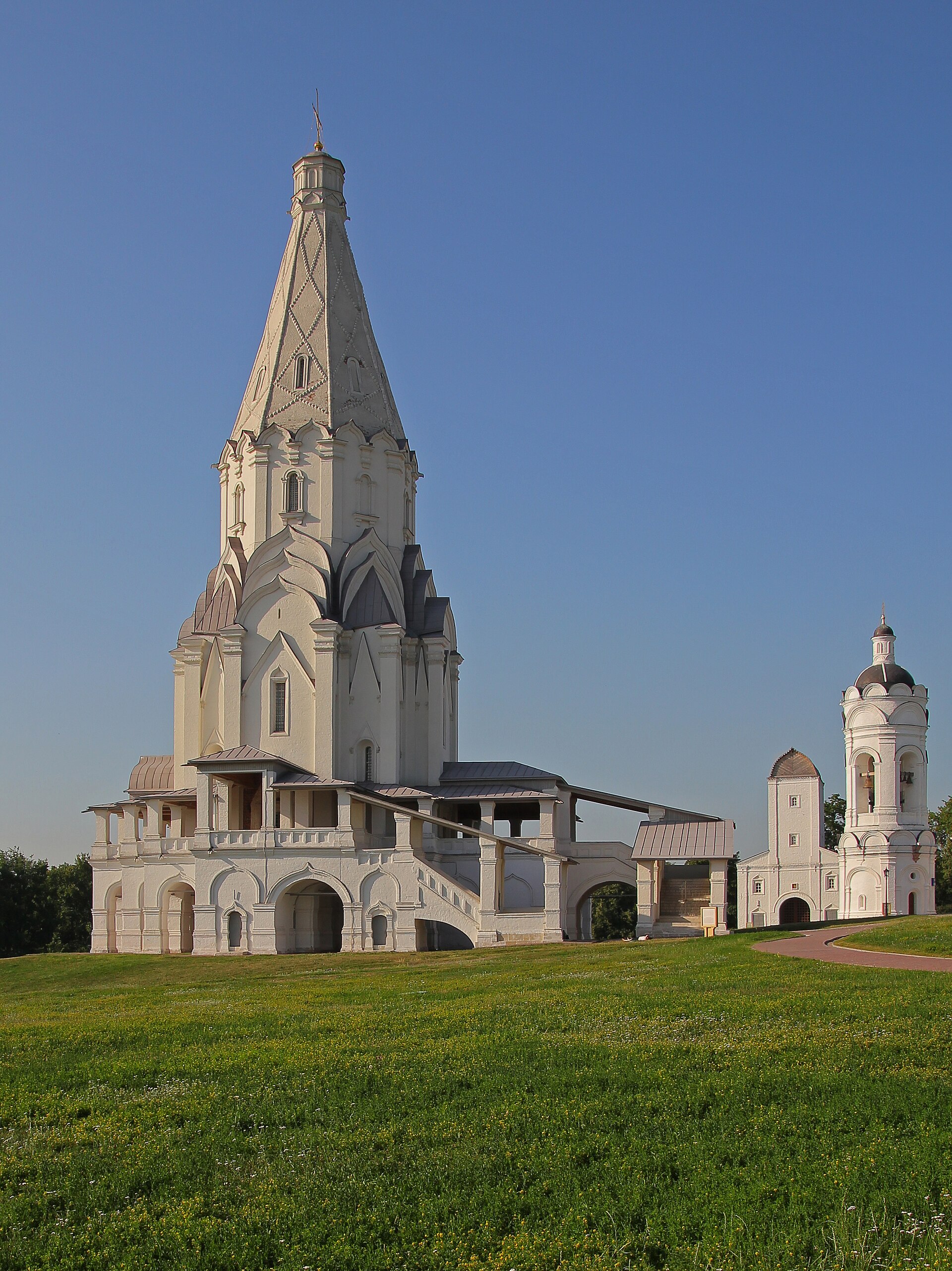
Kolomenskoye is a former royal estate situated on a high bank of the Moskva River, southeast of Moscow's city center. It served as a favored summer residence for the Grand Princes of Moscow and later the Tsars of Russia, most notably during the 16th and 17th centuries. The site is best known for the Church of the Ascension, a masterpiece of Russian stone architecture built in 1532 to commemorate the birth of Ivan the Terrible.
Beyond its stone monuments, the estate functions as an open-air museum of wooden architecture, featuring structures relocated from various regions of Russia to preserve traditional building techniques. The site also includes the reconstructed wooden palace of Tsar Alexis Mikhailovich, which provides insight into the elaborate lifestyle and aesthetic preferences of the 17th-century Russian court.
Key Facts
- Materials
- White stone, Brick, Wood
- Civilization
- Russian
- Accessibility
- Partially accessible; some historic paths are uneven
- Date(s)
- 1532 - 17th century
- Condition
- Well-preserved museum-reserve
- Original Function
- Royal summer residence and religious center
- Key Figures
- Vasili III, Ivan the Terrible, Alexis Mikhailovich
Foundation and the Church of the Ascension
1532The Church of the Ascension was commissioned by Grand Prince Vasili III. It is considered the first stone tent-roofed church in Russia, marking a significant departure from traditional Byzantine-influenced cross-domed designs.
The Golden Age of the Tsars
17th CenturyUnder Tsar Alexis Mikhailovich, the estate reached its peak. A massive, intricate wooden palace was constructed, often referred to as the 'Eighth Wonder of the World' by contemporaries for its complex rooflines and ornate interiors.
Imperial Transition and Decline
18th CenturyWith the founding of Saint Petersburg and the shift of the capital, Kolomenskoye lost its status as the primary royal residence. The original wooden palace fell into disrepair and was eventually dismantled by order of Catherine the Great.
Museum Establishment
20th CenturyIn 1923, the site was designated a museum. Architect Pyotr Baranovsky played a crucial role in saving historic wooden structures from across the Soviet Union by relocating them to the grounds of Kolomenskoye.
Cultural Significance
Kolomenskoye represents the evolution of Russian architectural identity, bridging the gap between medieval religious traditions and the secular grandeur of the early modern period. It serves as a vital repository for Russian wooden architecture, a tradition that has largely vanished from the modern landscape.
For Muscovites, the estate is a significant recreational and cultural space that connects the contemporary urban population with the historical legacy of the Tsardom of Russia. Its inclusion on the UNESCO World Heritage list underscores its importance as a unique example of tent-roofed architecture.
Interpretive Notes
Scholarly debates and areas of uncertainty
The exact origins of the tent-roofed architectural style remain a subject of academic discussion. While some scholars argue it evolved from indigenous wooden church designs, others suggest influences from Gothic or Caucasian stone architecture.
Visiting Information
Entry Rules
The park grounds are open daily. Individual museum buildings and the palace require separate tickets. Modest dress is recommended when entering active religious structures.
Best Times to Visit
Late spring and early autumn for pleasant weather to explore the expansive grounds. Avoid weekends if seeking a quiet experience.
Photography
Personal photography is permitted outdoors. Flash photography and tripods are generally prohibited inside museum buildings and the palace.
Preservation Notes
Stay on designated paths to protect the landscape. Do not touch historic wooden surfaces or stone carvings. Some areas may be closed during winter months for maintenance.
Nearby POIs
11 shown- Tsaritsyno Palace4.8 km
- State Darwin Museum7.1 km
- The Garage Museum8.7 km
- Tagansky Protected Command Point9.6 km
- Peter the Great Statue9.7 km
- Tretyakov Gallery9.8 km
- Novodevichy Convent10.1 km
- Multimedia Art Museum10.2 km
- Cathedral of Christ the Saviour10.4 km
- Pushkin State Museum of Fine Arts10.6 km
- Cathedral of the Dormition10.9 km
Sources & Further Reading
- [1]
- [2]Russian Wooden Architecture — Alexander Opolovnikov. Progress Publishers (1983)
Key Facts
- Materials
- White stone, Brick, Wood
- Civilization
- Russian
- Accessibility
- Partially accessible; some historic paths are uneven
- Date(s)
- 1532 - 17th century
- Condition
- Well-preserved museum-reserve
- Original Function
- Royal summer residence and religious center
- Key Figures
- Vasili III, Ivan the Terrible, Alexis Mikhailovich
Nearby POIs
11 shown- Tsaritsyno Palace4.8 km
- State Darwin Museum7.1 km
- The Garage Museum8.7 km
- Tagansky Protected Command Point9.6 km
- Peter the Great Statue9.7 km
- Tretyakov Gallery9.8 km
- Novodevichy Convent10.1 km
- Multimedia Art Museum10.2 km
- Cathedral of Christ the Saviour10.4 km
- Pushkin State Museum of Fine Arts10.6 km
- Cathedral of the Dormition10.9 km