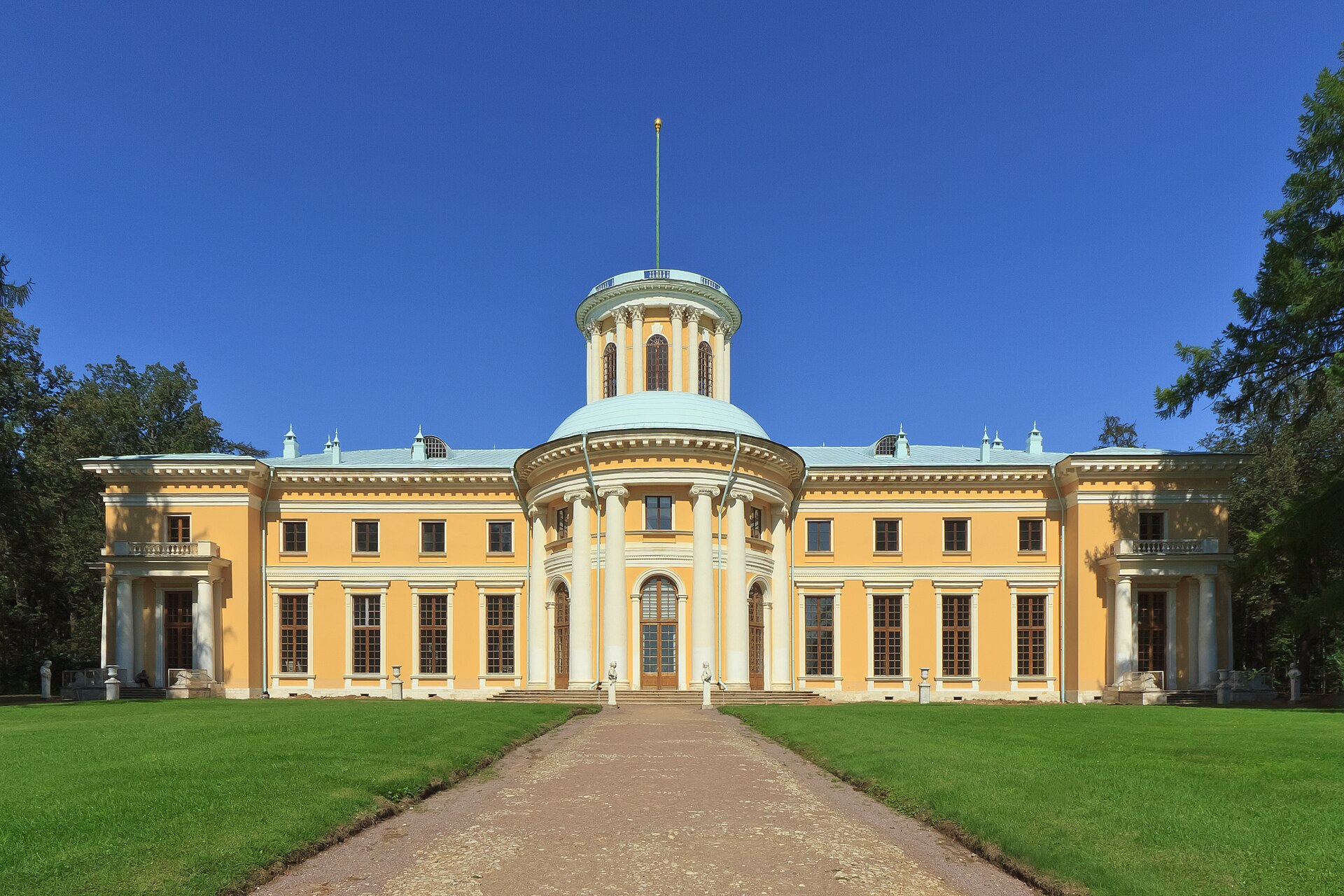
Arkhangelskoye Palace is a prominent 18th-century neoclassical estate located in the Krasnogorsk district near Moscow. Often referred to as the 'Russian Versailles,' the complex is celebrated for its symmetrical architectural design, extensive terraced gardens, and its historical role as a center for Russian aristocratic culture and art collection.
The estate was primarily developed by Prince Nikolai Yusupov, who transformed the site into a repository for fine art, including paintings, sculptures, and rare porcelain. The palace grounds feature a series of formal gardens that descend toward the Moskva River, integrating classical European landscape design with the surrounding Russian topography.
Key Facts
- Materials
- Brick, Stucco, White stone, Wood
- Civilization
- Russian Empire
- Accessibility
- Grounds are accessible; palace interiors have limited mobility access
- Date(s)
- 1780s - 1810s
- Condition
- Museum and cultural heritage site
- Original Function
- Aristocratic country estate
- Key Figures
- Prince Nikolai Yusupov, Giacomo Quarenghi, Jean-François Thomas de Thomon
Establishment and Early Development
17th - 18th centuryThe site was originally recorded in the 16th century, but the current architectural ensemble began to take shape in the 1780s under Prince Nikolai Golitsyn. The initial design followed the principles of early Russian classicism.
The Yusupov Era
1810 - 1917Prince Nikolai Yusupov purchased the estate in 1810 and significantly expanded the palace and gardens. He curated a vast collection of European art and hosted the Russian elite, establishing the estate as a premier cultural hub of the era.
Post-Revolutionary Transformation
1917 - 1990sFollowing the Russian Revolution, the estate was nationalized and converted into a museum. Despite the political upheaval, the core of the art collection was preserved, and the site served various functions including a military sanatorium during the Soviet period.
Modern Preservation
2000s - presentThe estate currently operates as a state museum-preserve. Ongoing restoration efforts focus on the conservation of the palace interiors, the preservation of the historic park landscape, and the maintenance of the extensive art collection.
Cultural Significance
Arkhangelskoye serves as a vital example of the Russian country estate culture that flourished during the 19th century. It represents the synthesis of European neoclassical architectural ideals with the lifestyle of the Russian nobility, acting as a bridge between Western artistic trends and local traditions.
Today, the site is a significant cultural landmark in the Moscow region, serving as both a museum of decorative arts and a public park. It remains a key reference point for studies of Russian aristocratic life and the history of landscape architecture in the region.
Interpretive Notes
Scholarly debates and areas of uncertainty
There is ongoing academic discussion regarding the attribution of specific architectural elements of the palace, as several prominent architects, including Giacomo Quarenghi and Jean-François Thomas de Thomon, were involved in various stages of its design and modification. The extent of the original 18th-century layout versus the 19th-century expansions remains a subject of architectural analysis.
Visiting Information
Entry Rules
The estate is open to the public. Tickets are required for entry into the palace interiors and specific exhibitions. Visitors are expected to follow museum conduct rules, including no touching of artifacts and maintaining quiet in the galleries.
Best Times to Visit
Late spring and summer are ideal for exploring the extensive terraced gardens. Weekdays are recommended to avoid high visitor traffic from Moscow.
Photography
Non-commercial photography is permitted in the park. Photography inside the palace requires a separate permit or is restricted to specific areas; flash is prohibited to protect the art collection.
Preservation Notes
Visitors must remain on designated paths within the gardens to prevent soil erosion on the terraces. Touching of architectural surfaces and historical furniture is strictly prohibited.
Nearby POIs
11 shown- Stalin's Dacha14.5 km
- Museum of the Great Patriotic War15.2 km
- Poklonnaya Hill15.3 km
- Novodevichy Convent18.4 km
- Multimedia Art Museum20.4 km
- State Darwin Museum20.5 km
- Pushkin State Museum of Fine Arts20.7 km
- Cathedral of Christ the Saviour20.7 km
- Moscow Museum of Modern Art20.8 km
- Ostankino Tower20.8 km
- Central Armed Forces Museum20.9 km
Sources & Further Reading
- [1]The Yusupov Estate at Arkhangelskoye — Elena A. Borisova. Russian Heritage Press (2012)
- [2]Russian Neoclassical Architecture: 1750-1850 — Dmitry Shvidkovsky. Yale University Press (2007)
Key Facts
- Materials
- Brick, Stucco, White stone, Wood
- Civilization
- Russian Empire
- Accessibility
- Grounds are accessible; palace interiors have limited mobility access
- Date(s)
- 1780s - 1810s
- Condition
- Museum and cultural heritage site
- Original Function
- Aristocratic country estate
- Key Figures
- Prince Nikolai Yusupov, Giacomo Quarenghi, Jean-François Thomas de Thomon
Nearby POIs
11 shown- Stalin's Dacha14.5 km
- Museum of the Great Patriotic War15.2 km
- Poklonnaya Hill15.3 km
- Novodevichy Convent18.4 km
- Multimedia Art Museum20.4 km
- State Darwin Museum20.5 km
- Pushkin State Museum of Fine Arts20.7 km
- Cathedral of Christ the Saviour20.7 km
- Moscow Museum of Modern Art20.8 km
- Ostankino Tower20.8 km
- Central Armed Forces Museum20.9 km