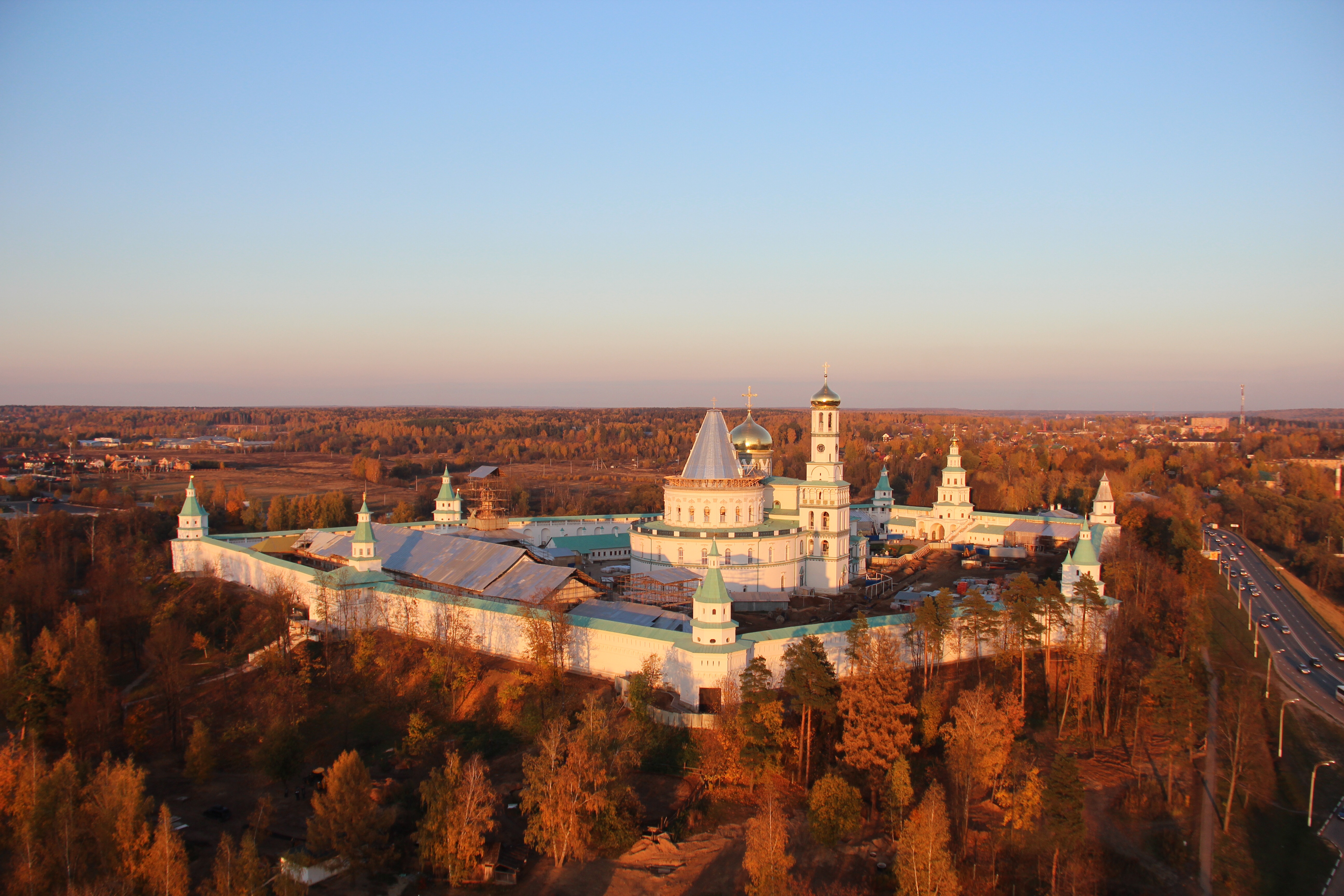
The New Jerusalem Monastery, located in Istra, Russia, was founded in 1656 by Patriarch Nikon. It was conceived as a deliberate architectural replica of the Church of the Holy Sepulchre in Jerusalem, intended to serve as a spiritual center for the Russian Orthodox Church and a physical manifestation of the 'Third Rome' concept.
The complex is dominated by the massive Resurrection Cathedral, which features a distinctive rotunda and a complex system of chapels. Throughout its history, the monastery has undergone significant periods of destruction and restoration, most notably following the damage sustained during the German occupation in World War II, which led to a decades-long reconstruction effort.
Key Facts
- Materials
- Brick, White stone, Ceramic tiles
- Civilization
- Russian
- Accessibility
- Grounds are accessible; cathedral interior has some steps
- Date(s)
- 1656–1685
- Condition
- Fully restored and active
- Original Function
- Monastic complex and pilgrimage site
- Key Figures
- Patriarch Nikon, Tsar Alexis of Russia
Founding and Vision
1656-1666Patriarch Nikon founded the monastery on the Istra River, which he renamed the Jordan. He commissioned the construction of buildings that mirrored the topography and architecture of the Holy Land, aiming to bring the sacred sites of Jerusalem to the Russian landscape.
Imperial Patronage
17th-19th centuryFollowing Nikon's exile, the monastery continued to receive support from the Romanov dynasty. It became a major pilgrimage destination and a repository for religious art, manuscripts, and liturgical treasures.
War and Destruction
1941During the Battle of Moscow, the monastery was occupied by German forces. Upon their retreat, the main cathedral and its iconic rotunda were heavily damaged by explosives, resulting in the loss of significant architectural details.
Restoration and Modern Era
1950-presentExtensive restoration work began in the mid-20th century to stabilize the ruins. A comprehensive reconstruction project, completed in the early 21st century, restored the cathedral to its original 17th-century appearance, and the site was returned to the Russian Orthodox Church.
Cultural Significance
The monastery represents a unique intersection of theology and architecture, serving as a physical attempt to relocate the sacred geography of the Holy Land to Russia. It remains a primary symbol of the 17th-century reforms of the Russian Orthodox Church and a testament to the endurance of Russian religious tradition through periods of political and military upheaval.
Interpretive Notes
Scholarly debates and areas of uncertainty
Debate persists regarding the extent to which the monastery's architecture accurately reflects the 17th-century Jerusalem original versus the idealized vision of Patriarch Nikon. Scholars also discuss the ideological implications of the 'Third Rome' concept as expressed through the monastery's layout.
Visiting Information
Entry Rules
Open daily. Entry to the monastery grounds is free. Modest dress is required for entry into the cathedral (shoulders and knees covered; women are encouraged to wear headscarves).
Best Times to Visit
Late spring and early autumn offer the best weather for walking the extensive grounds. Avoid major Orthodox holidays if you prefer to avoid large crowds.
Photography
Photography is permitted in the outdoor areas. Inside the cathedral, photography is generally prohibited or restricted to non-flash, and permission should be sought from the clergy.
Preservation Notes
The site is an active religious institution; please maintain a quiet demeanor. Restoration work is ongoing in peripheral buildings; follow all posted safety signage.
Nearby POIs
7 shownSources & Further Reading
- [1]Patriarch Nikon and the New Jerusalem Monastery — William Craft Brumfield. University of Washington Press (1993)
- [2]The Architecture of the New Jerusalem Monastery — A. V. Ikonnikov. Russian Academy of Architecture (2005)
Key Facts
- Materials
- Brick, White stone, Ceramic tiles
- Civilization
- Russian
- Accessibility
- Grounds are accessible; cathedral interior has some steps
- Date(s)
- 1656–1685
- Condition
- Fully restored and active
- Original Function
- Monastic complex and pilgrimage site
- Key Figures
- Patriarch Nikon, Tsar Alexis of Russia