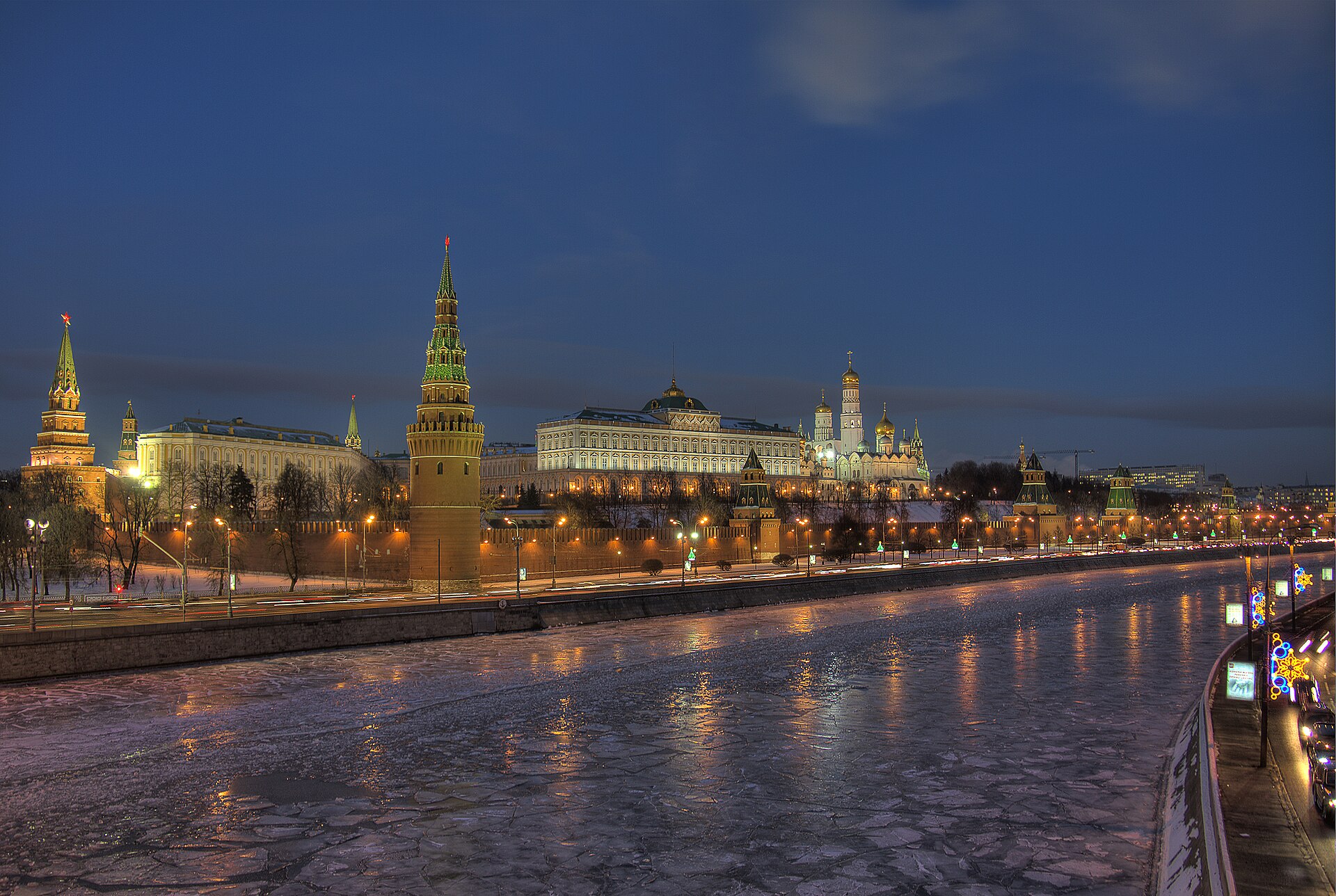
The Moscow Kremlin is a fortified complex at the heart of Moscow, originally constructed in the 12th century and rebuilt several times over subsequent centuries. It has served as the political, religious, and administrative center of Russia for centuries, housing the tsars, Soviet leaders, and the modern Russian government. Today, the Kremlin functions as a museum complex with operational government buildings, including the official residence of the President of Russia. Its historic cathedrals, palaces, and defensive walls remain major cultural and architectural landmarks.
Key Facts
- Materials
- Brick, Stone, Wood (interiors)
- Civilization
- Tsardom of Russia; Russian Empire; Soviet Union; Russian Federation
- Date(s)
- 12th century onwards; major reconstructions 14th-15th centuries
- Condition
- Well-preserved, partially operational as government and museum complex
- Original Function
- Fortified political and administrative center
- Key Figures
- Ivan III, Ivan IV (Ivan the Terrible), Peter the Great, Vladimir Lenin, Current Russian Presidents
Early Foundations
12th-14th centuriesThe first Kremlin was built as a wooden fortification to defend Moscow. Over time, stone walls and towers were added to strengthen the complex against invasions and internal threats.
Grand Reconstruction and Tsarist Era
15th-17th centuriesIvan III commissioned Italian architects to rebuild the Kremlin with red brick walls, towers, and cathedrals. The complex became the residence of the tsars and a symbol of centralized Russian authority.
Imperial and Soviet Transformations
18th-20th centuriesWhile Peter the Great shifted the capital to Saint Petersburg, the Kremlin remained a ceremonial and religious hub. During the Soviet era, it was repurposed as the seat of government, and many churches were secularized.
Modern Era and Museum Status
20th century - presentThe Kremlin now functions as a museum complex, with select areas open to the public, including the Armory, cathedrals, and palace grounds, while continuing to serve as the official residence of the Russian President.
Cultural Significance
The Kremlin is both a symbol of Russian political power and a repository of the country’s cultural heritage. Its architecture, including cathedrals and palaces, reflects centuries of Russian art, religion, and governance, making it central to Moscow’s and Russia’s identity.
Interpretive Notes
Scholarly debates and areas of uncertainty
Historians debate the exact origins of some Kremlin walls and towers, as well as the extent of Italian influence on Russian architecture during the 15th century. There is also discussion about preservation versus modernization in ongoing restorations.
Visiting Information
Entry Rules
Paid admission required for museum areas. Certain government buildings are off-limits. Security screening is mandatory for all visitors.
Best Times to Visit
Weekday mornings to avoid tourist crowds. Major Russian holidays can include official ceremonies, which may restrict access.
Photography
Personal photography allowed in most museum areas. Tripods, flash photography, and commercial photography require a permit. Restricted areas include government buildings.
Preservation Notes
Stay on marked paths and do not touch historical artifacts. Restoration projects may temporarily restrict access to some towers, walls, or cathedrals.
Nearby POIs
11 shown- Cathedral of the Dormition0.1 km
- Lenin's Mausoleum0.3 km
- Cathedral of Vasily the Blessed0.3 km
- State Historical Museum0.4 km
- Cathedral of Our Lady of Kazan0.4 km
- Pushkin State Museum of Fine Arts0.9 km
- Bolshoi Theatre1 km
- Cathedral of Christ the Saviour1.1 km
- Tretyakov Gallery1.2 km
- Peter the Great Statue1.6 km
- Multimedia Art Museum1.7 km
Sources & Further Reading
- [1]The Kremlin: History, Architecture, and Power — Sergei Soloviev. Moscow Historical Press (2015)
- [2]Russian Fortresses and the Kremlin — William Craft Brumfield. Cambridge University Press (2004)
Key Facts
- Materials
- Brick, Stone, Wood (interiors)
- Civilization
- Tsardom of Russia; Russian Empire; Soviet Union; Russian Federation
- Date(s)
- 12th century onwards; major reconstructions 14th-15th centuries
- Condition
- Well-preserved, partially operational as government and museum complex
- Original Function
- Fortified political and administrative center
- Key Figures
- Ivan III, Ivan IV (Ivan the Terrible), Peter the Great, Vladimir Lenin, Current Russian Presidents
Nearby POIs
11 shown- Cathedral of the Dormition0.1 km
- Lenin's Mausoleum0.3 km
- Cathedral of Vasily the Blessed0.3 km
- State Historical Museum0.4 km
- Cathedral of Our Lady of Kazan0.4 km
- Pushkin State Museum of Fine Arts0.9 km
- Bolshoi Theatre1 km
- Cathedral of Christ the Saviour1.1 km
- Tretyakov Gallery1.2 km
- Peter the Great Statue1.6 km
- Multimedia Art Museum1.7 km