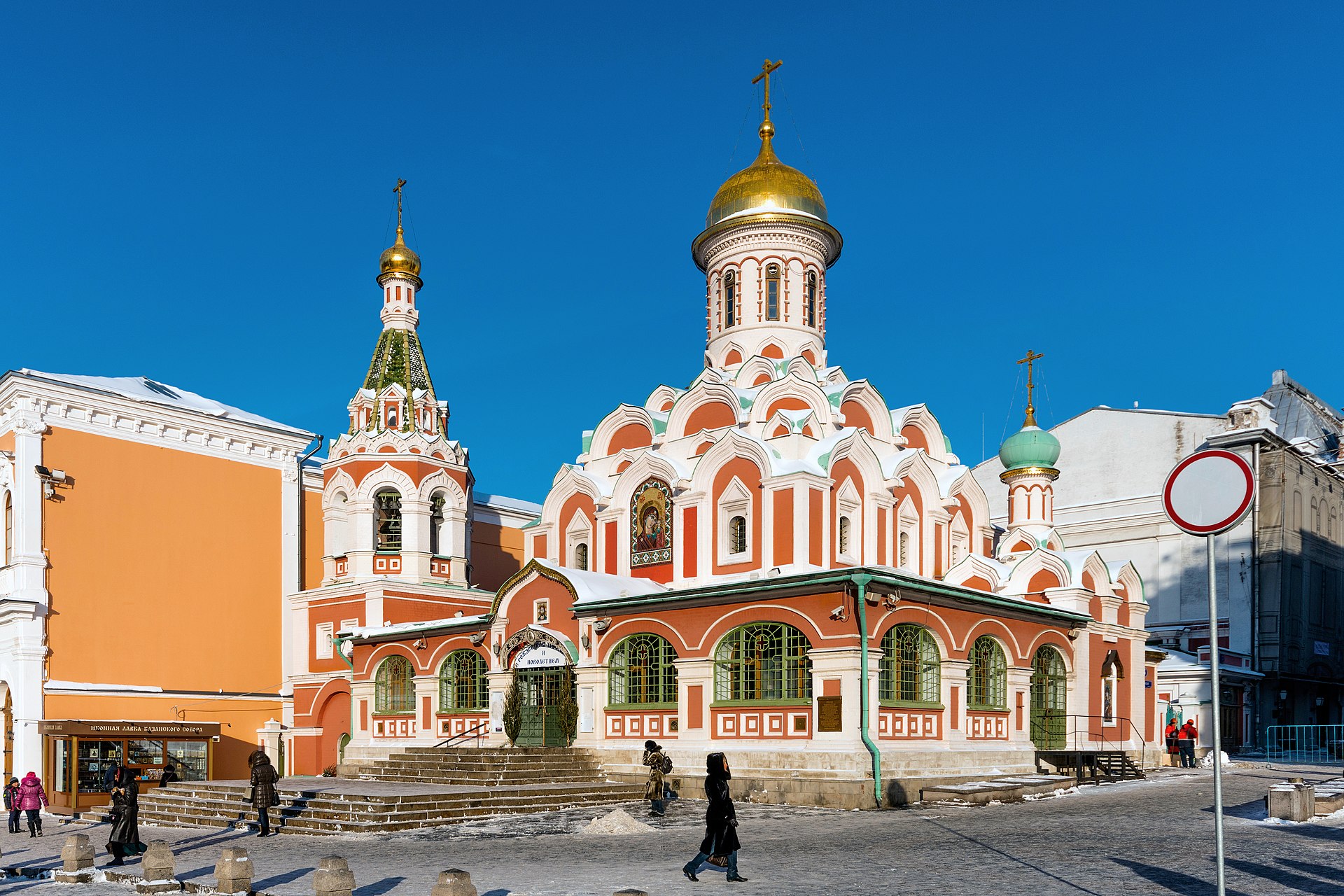
Cathedral of Our Lady of Kazan is a Russian Orthodox church located on the northeast corner of Red Square in Moscow. Originally built in the 1620s to commemorate Russia’s victory over Polish-Lithuanian forces, it became one of the most important religious landmarks in the capital. The cathedral is dedicated to the Kazan Icon of the Mother of God, one of the most revered icons in Russian Orthodoxy. Demolished in 1936 during the Soviet anti-religious campaign, it was reconstructed between 1990 and 1993 based on historical records and architectural studies.
Key Facts
- Civilization
- Tsardom of Russia; Russian Federation
- Current Function
- Active Russian Orthodox cathedral
- Original Function
- Russian Orthodox cathedral
- Key Figures
- Prince Dmitry Pozharsky, Tsar Michael I
- Architectural Style
- Russian Revival / Traditional Muscovite style
- Reconstruction Date
- 1990-1993
- Original Construction Date
- 1625-1636
Foundation and Early History
1620s-17th centuryThe cathedral was originally commissioned by Prince Dmitry Pozharsky in honor of the Kazan Icon of the Mother of God, credited with aiding Russia’s liberation from Polish occupation during the Time of Troubles. The wooden church was later replaced with a brick structure under Tsar Michael I.
Imperial Period
18th-19th centuriesDuring the Russian Empire, Kazan Cathedral remained an important religious site near Red Square. It underwent restorations and architectural modifications reflecting evolving tastes while maintaining its traditional Muscovite character.
Soviet Demolition
1936As part of Stalin’s urban redevelopment plans and anti-religious policies, the cathedral was demolished to clear space for military parades on Red Square. Its destruction symbolized the broader suppression of religious institutions in the Soviet Union.
Reconstruction
1990-1993Following the collapse of the Soviet Union, Kazan Cathedral became one of the first religious buildings in Moscow to be reconstructed. Using historical drawings and archaeological research, architects restored it to reflect its 17th-century appearance. It reopened in 1993 as an active place of worship.
Cultural Significance
Kazan Cathedral symbolizes both Russia’s national resilience during the Time of Troubles and the revival of religious life after the Soviet period. Its reconstruction marked a broader movement to restore historic religious architecture in post-Soviet Russia.
Interpretive Notes
Scholarly debates and areas of uncertainty
Scholars debate the authenticity of reconstructed heritage sites, including Kazan Cathedral, questioning how closely modern reconstructions can replicate original materials and craftsmanship. Others view its reconstruction as an important act of cultural and spiritual restoration.
Visiting Information
Entry Rules
Free of charge and open to visitors daily. As an active place of worship, modest dress is expected. Services may limit tourist access during liturgical ceremonies.
Best Times to Visit
Early morning or late afternoon for quieter visits. Religious holidays and weekends tend to be busier.
Photography
Exterior photography allowed. Interior photography may be restricted during services; flash photography is discouraged.
Preservation Notes
Visitors should maintain respectful behavior appropriate to an active Orthodox cathedral. Touching icons or liturgical objects may be restricted.
Nearby POIs
11 shown- State Historical Museum0.1 km
- Lenin's Mausoleum0.2 km
- Cathedral of Vasily the Blessed0.4 km
- Kremlin0.4 km
- Cathedral of the Dormition0.5 km
- Bolshoi Theatre0.5 km
- Pushkin State Museum of Fine Arts1.3 km
- Moscow Museum of Modern Art1.3 km
- Cathedral of Christ the Saviour1.5 km
- Tretyakov Gallery1.6 km
- Peter the Great Statue2 km
Sources & Further Reading
- [1]
Key Facts
- Civilization
- Tsardom of Russia; Russian Federation
- Current Function
- Active Russian Orthodox cathedral
- Original Function
- Russian Orthodox cathedral
- Key Figures
- Prince Dmitry Pozharsky, Tsar Michael I
- Architectural Style
- Russian Revival / Traditional Muscovite style
- Reconstruction Date
- 1990-1993
- Original Construction Date
- 1625-1636
Nearby POIs
11 shown- State Historical Museum0.1 km
- Lenin's Mausoleum0.2 km
- Cathedral of Vasily the Blessed0.4 km
- Kremlin0.4 km
- Cathedral of the Dormition0.5 km
- Bolshoi Theatre0.5 km
- Pushkin State Museum of Fine Arts1.3 km
- Moscow Museum of Modern Art1.3 km
- Cathedral of Christ the Saviour1.5 km
- Tretyakov Gallery1.6 km
- Peter the Great Statue2 km