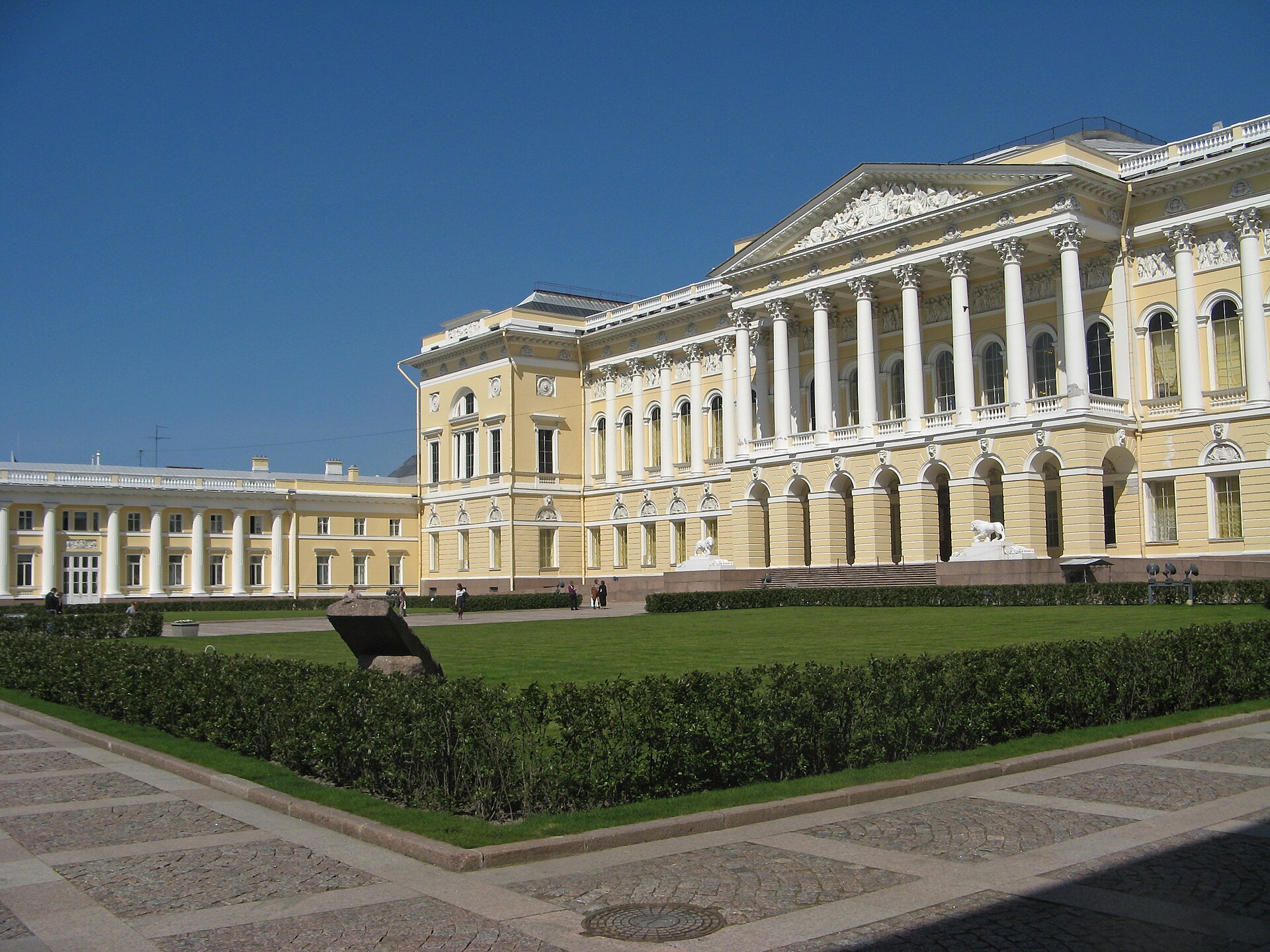
The Mikhailovsky Palace is a prominent Neoclassical building in Saint Petersburg, designed by the architect Carlo Rossi and constructed between 1819 and 1825 for Grand Duke Michael Pavlovich. The palace serves as the main building of the State Russian Museum, which houses the world's largest collection of Russian fine art, ranging from ancient icons to 20th-century avant-garde works.
The structure is a masterpiece of the Russian Empire style, featuring a grand facade with an eight-column portico and an expansive garden that connects to the Griboyedov Canal. Following the death of the Grand Duke, the building was repurposed by the state, eventually becoming the center of the Russian Museum in 1895, which remains a primary institution for the preservation and study of national artistic heritage.
Key Facts
- Materials
- Stone, Brick, Stucco, Marble
- Civilization
- Russian Empire
- Accessibility
- Wheelchair accessible with elevator access to main galleries
- Date(s)
- 1819-1825
- Condition
- Well-preserved, active museum
- Original Function
- Imperial residence
- Key Figures
- Carlo Rossi, Grand Duke Michael Pavlovich, Tsar Nicholas II
Commission and Construction
1819-1825Commissioned by Tsar Alexander I for his younger brother, Grand Duke Michael Pavlovich, the palace was designed by Carlo Rossi. It was intended to be a grand residence that would showcase the architectural sophistication of the Russian Empire.
Imperial Residence
1825-1894The palace served as the home of the Grand Duke and his family for several decades. It was a center of social and cultural life in Saint Petersburg, hosting numerous balls and artistic gatherings.
Establishment of the Russian Museum
1895-1917Tsar Nicholas II issued a decree in 1895 to establish the 'Russian Museum of His Imperial Majesty Alexander III' in the palace. The building underwent interior renovations to accommodate the extensive art collection.
Soviet and Modern Era
1917-PresentFollowing the Russian Revolution, the museum was nationalized and expanded its collection significantly. Today, it operates as the State Russian Museum, managing the palace and several other historic buildings in the city.
Cultural Significance
The Mikhailovsky Palace is central to the cultural identity of Saint Petersburg, representing the pinnacle of 19th-century Russian architectural achievement. As the home of the State Russian Museum, it acts as the primary repository for the nation's visual history, bridging the gap between imperial-era art and the revolutionary movements of the 20th century.
Interpretive Notes
Scholarly debates and areas of uncertainty
Debates often center on the balance between preserving the palace's original imperial interiors and the functional requirements of a modern, high-traffic art museum. Additionally, the provenance of certain artworks acquired during the Soviet era remains a subject of ongoing research and international dialogue.
Visiting Information
Entry Rules
Open daily except Tuesdays. Tickets can be purchased online or at the museum box office. Visitors must check large bags and coats in the cloakroom. Flash photography is prohibited in certain galleries.
Best Times to Visit
Weekday mornings are best to avoid large tour groups. The museum is particularly significant during the White Nights season in June.
Photography
Non-commercial photography is permitted without flash or tripods. Professional photography requires prior written authorization from the museum administration.
Preservation Notes
The palace is a protected historical monument. Visitors are requested to refrain from touching exhibits and to follow designated pathways to protect the historic flooring and wall finishes.
Nearby POIs
11 shownSources & Further Reading
- [1]The State Russian Museum: A History — Evgenia Petrova. Palace Editions (2005)
- [2]Carlo Rossi: Architect of Saint Petersburg — V. A. Shvidkovsky. Yale University Press (2007)
Key Facts
- Materials
- Stone, Brick, Stucco, Marble
- Civilization
- Russian Empire
- Accessibility
- Wheelchair accessible with elevator access to main galleries
- Date(s)
- 1819-1825
- Condition
- Well-preserved, active museum
- Original Function
- Imperial residence
- Key Figures
- Carlo Rossi, Grand Duke Michael Pavlovich, Tsar Nicholas II