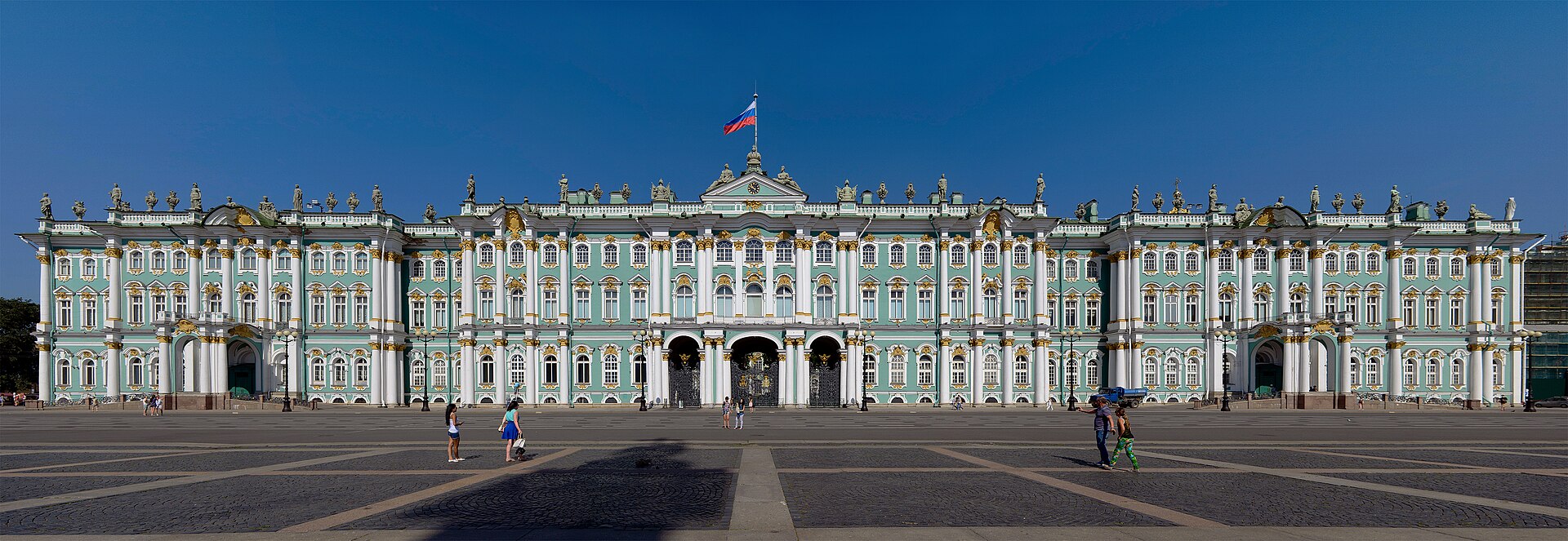
The Winter Palace in Saint Petersburg served as the official residence of the Russian monarchs from 1732 to 1917. Designed primarily by architect Bartolomeo Rastrelli, the current structure is the fourth iteration of the palace, constructed between 1754 and 1762. Its elaborate Elizabethan Baroque exterior features a distinctive green and white facade adorned with gilded stucco and numerous statues.
Following the 1917 October Revolution, the palace became a symbol of the transition from imperial rule to the Soviet era. Today, it serves as the primary building of the State Hermitage Museum, one of the largest and oldest museums in the world, housing a vast collection of art and historical artifacts spanning centuries of human civilization.
Key Facts
- Materials
- Brick, Stucco, Granite, Marble, Gold leaf
- Civilization
- Russian Empire
- Accessibility
- Wheelchair accessible with elevators and ramps
- Date(s)
- 1754-1762
- Condition
- Well-preserved, active museum
- Original Function
- Imperial residence
- Key Figures
- Empress Elizabeth Petrovna, Catherine the Great, Tsar Nicholas II
Construction and Imperial Era
1754-1762Commissioned by Empress Elizabeth, the palace was designed by Bartolomeo Rastrelli. It was intended to demonstrate the power and wealth of the Russian Empire. Following the fire of 1837, the interiors were extensively rebuilt by architects Vasily Stasov and Alexander Briullov, incorporating both original designs and contemporary neoclassical elements.
The October Revolution
1917The palace became the focal point of the October Revolution when it was stormed by Bolshevik forces. The event marked the end of the Russian Provisional Government and the beginning of Soviet rule, fundamentally altering the function of the building.
Museum Transformation
1920-presentAfter the revolution, the palace was officially designated as a state museum. It has since undergone extensive restoration to preserve its imperial interiors and accommodate the growing collections of the State Hermitage Museum, surviving the Siege of Leningrad during World War II.
Cultural Significance
The Winter Palace is a cornerstone of Russian cultural identity, representing the height of imperial architectural ambition and the subsequent political shifts of the 20th century. It remains a global symbol of Saint Petersburg and a repository for world-class art, reflecting the complex history of Russia's engagement with European culture.
Interpretive Notes
Scholarly debates and areas of uncertainty
Debates persist regarding the extent of the 1837 fire's destruction and how much of Rastrelli's original interior design was authentically restored versus reinterpreted during the 19th-century reconstruction efforts.
Visiting Information
Entry Rules
Open Tuesday through Sunday. Tickets must be purchased online via the official Hermitage website. Visitors must pass through security screening. Large bags and umbrellas must be left in the cloakroom.
Best Times to Visit
Weekday mornings (10:30-12:00) to avoid the largest tour groups. Winter months offer a quieter experience and a unique view of the palace against the snowy Neva embankment.
Photography
Non-commercial photography without flash or tripods is permitted in most permanent exhibition halls. Professional photography requires prior written authorization.
Preservation Notes
Do not touch the exhibits or wall coverings. Maintain a respectful distance from historical furniture and decorative arts. The building is a protected monument; follow all marked visitor paths.
Nearby POIs
11 shownSources & Further Reading
- [1]The Winter Palace: The Imperial Residence — Piotrovsky, Mikhail. Hermitage Museum Publishing (2000)
- [2]St. Petersburg: A Cultural History — Volkov, Solomon. Free Press (1995)
Key Facts
- Materials
- Brick, Stucco, Granite, Marble, Gold leaf
- Civilization
- Russian Empire
- Accessibility
- Wheelchair accessible with elevators and ramps
- Date(s)
- 1754-1762
- Condition
- Well-preserved, active museum
- Original Function
- Imperial residence
- Key Figures
- Empress Elizabeth Petrovna, Catherine the Great, Tsar Nicholas II