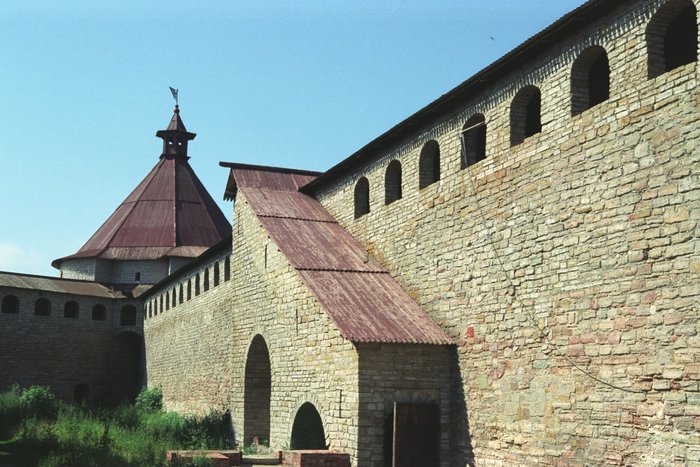
Oreshek Fortress is a historic citadel situated on Orekhovy Island at the source of the Neva River near Shlisselburg. Originally founded in 1323 by Prince Yury of Moscow as a wooden fortification to defend the Novgorod Republic against Swedish expansion, it was later rebuilt in stone during the 14th and 15th centuries. Its strategic location made it a focal point of centuries of territorial conflict between Russia and Sweden.
Beyond its military utility, the fortress gained notoriety during the 18th and 19th centuries as a high-security political prison, housing prominent revolutionaries and dissidents. During World War II, the fortress served as a critical defensive position, with its garrison holding out against German forces for 498 days, preventing the complete encirclement of Leningrad. Today, it functions as a museum and memorial site.
Key Facts
- Materials
- Limestone, Brick, Fieldstone
- Civilization
- Novgorod Republic / Russian Empire
- Accessibility
- Accessible by ferry from Shlisselburg
- Date(s)
- 1323 (original), 14th-16th century (stone)
- Condition
- Partially restored museum and memorial
- Original Function
- Border fortress
- Key Figures
- Prince Yury of Moscow, Peter the Great, Alexander Ulyanov
Foundation and Medieval Defense
1323-1612Founded in 1323, the fortress was the primary defensive outpost of the Novgorod Republic. It was captured by Sweden in 1612 during the Time of Troubles and renamed Nöteborg, serving as a key Swedish stronghold for nearly a century.
Imperial Russian Expansion
1702-1917Peter the Great recaptured the fortress in 1702 during the Great Northern War, renaming it Shlisselburg. As the Russian border moved westward, the site lost its primary military importance and was repurposed as a notorious political prison.
World War II Defense
1941-1943During the Siege of Leningrad, the fortress became a symbol of resistance. A small garrison held the island against intense bombardment, effectively blocking the German advance along the Neva and maintaining a vital link in the defense of the city.
Modern Memorialization
1945-presentFollowing the war, the site was stabilized and converted into a branch of the Museum of the History of St. Petersburg. It now serves as a memorial to the defenders of Leningrad and a site for historical research.
Cultural Significance
Oreshek Fortress is a profound symbol of Russian resilience and the shifting geopolitical boundaries of the Baltic region. It represents the transition from medieval border warfare to the centralized power of the Russian Empire, and eventually to the ideological struggles of the 20th century. The site is deeply embedded in the collective memory of the Siege of Leningrad, serving as a site of pilgrimage for those honoring the city's wartime defenders.
Interpretive Notes
Scholarly debates and areas of uncertainty
Debate exists regarding the extent of the original 14th-century wooden structures and their exact layout, as subsequent stone fortifications largely obscured the earlier archaeological layers. Additionally, the interpretation of the prison's history remains a subject of study, focusing on the conditions of political prisoners and their impact on the revolutionary movements of the late 19th century.
Visiting Information
Entry Rules
Accessible via seasonal ferry from Shlisselburg. The site is open to the public during the navigation season (typically May to October). Guided tours are available and recommended for accessing specific historical prison blocks.
Best Times to Visit
Late spring and summer months when ferry services are operational and weather allows for walking the island perimeter.
Photography
Personal photography is permitted in outdoor areas and most museum exhibits. Professional or commercial photography requires prior authorization from the museum administration.
Preservation Notes
The site is an active archaeological and restoration zone. Visitors must stay on marked paths to avoid unstable masonry and ongoing conservation work. The island is exposed to river winds; appropriate clothing is advised.
Nearby POIs
11 shown- Alexander Nevsky Lavra36.5 km
- Faberge Museum38.9 km
- Cruiser Aurora39.2 km
- Saint Michael's Castle39.2 km
- Russian Museum of Ethnography39.4 km
- Mikhailovsky Palace39.5 km
- Church of the Savior on Blood39.7 km
- Cathedral of Our Lady of Kazan40 km
- Grand Maket Russia40.3 km
- Peter and Paul Fortress40.3 km
- Alexander Column40.4 km
Sources & Further Reading
- [1]The Fortress of Shlisselburg: A History — Dmitry Shvidkovsky. St. Petersburg Historical Review (2015)
- [2]Russian Fortifications of the Baltic — Elena A. Kuleshova. Academic Press of Russia (2019)
Key Facts
- Materials
- Limestone, Brick, Fieldstone
- Civilization
- Novgorod Republic / Russian Empire
- Accessibility
- Accessible by ferry from Shlisselburg
- Date(s)
- 1323 (original), 14th-16th century (stone)
- Condition
- Partially restored museum and memorial
- Original Function
- Border fortress
- Key Figures
- Prince Yury of Moscow, Peter the Great, Alexander Ulyanov
Nearby POIs
11 shown- Alexander Nevsky Lavra36.5 km
- Faberge Museum38.9 km
- Cruiser Aurora39.2 km
- Saint Michael's Castle39.2 km
- Russian Museum of Ethnography39.4 km
- Mikhailovsky Palace39.5 km
- Church of the Savior on Blood39.7 km
- Cathedral of Our Lady of Kazan40 km
- Grand Maket Russia40.3 km
- Peter and Paul Fortress40.3 km
- Alexander Column40.4 km