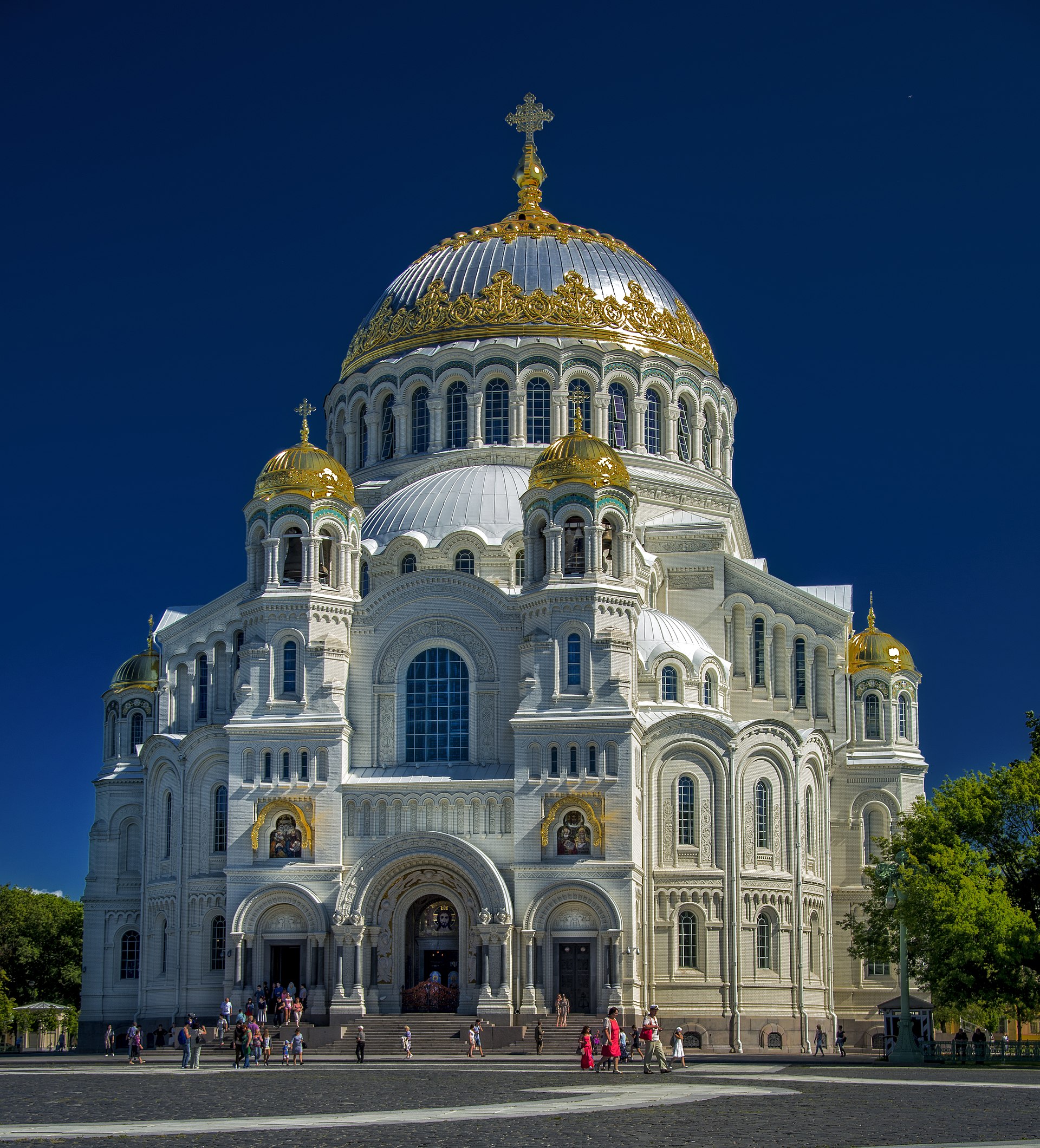
Naval St. Nicholas Cathedral
The Kronstadt Naval Cathedral,dedicated to Saint Nicholas the Wonderworker, serves as the principal church of the Russian Navy. Located in the port city of Kronstadt, it was constructed between 1903 and 1913 to honor the fallen seamen of the Imperial Russian Navy. Also known as the Naval St. Nicholas Cathedral, it was designed by architect Vasily Kosyakov, who drew inspiration from the Hagia Sophia in Constantinople, incorporating a massive central dome and intricate mosaic work.
Following the Russian Revolution, the cathedral was secularized and repurposed as a cinema, a concert hall, and a museum, suffering significant interior damage during the Soviet era. It underwent a comprehensive restoration process between 2005 and 2013, returning it to its original religious function. Today, it stands as a prominent monument to Russian maritime history and Orthodox architectural tradition.
Key Facts
- Materials
- Brick, Granite, Marble, Reinforced concrete
- Civilization
- Russian Empire
- Accessibility
- Ground level access available
- Date(s)
- 1903-1913
- Condition
- Fully restored and active
- Original Function
- Naval memorial and cathedral
- Key Figures
- Vasily Kosyakov, Tsar Nicholas II
Conception and Construction
1903-1913The cathedral was commissioned to serve as a spiritual center for the sailors of the Baltic Fleet. Tsar Nicholas II laid the foundation stone in 1903. The design utilized modern engineering techniques, including reinforced concrete, to support the massive dome.
Soviet Secularization
1929-1990sIn 1929, the Soviet government closed the cathedral. The interior was stripped of its religious icons and murals, and the building was converted into a cinema and later a concert hall for the Kronstadt garrison.
Restoration and Re-consecration
2005-2013A major restoration project began in 2005, aiming to recreate the original interior aesthetics. The cathedral was re-consecrated in 2013 by Patriarch Kirill of Moscow, marking the centenary of its original opening.
Cultural Significance
The cathedral acts as a symbolic pantheon for the Russian Navy. Its walls are inscribed with the names of sailors and ships lost in service, making it a site of pilgrimage for naval families and veterans. It represents the synthesis of imperial Russian state power and Orthodox religious identity.
Interpretive Notes
Scholarly debates and areas of uncertainty
Debates exist regarding the extent to which the 2005-2013 restoration accurately reflects the original 1913 interior, given the near-total destruction of the original murals and icons during the Soviet period.
Visiting Information
Entry Rules
Open daily. Entry is free. Visitors are expected to dress modestly; women should cover their heads and men should remove hats upon entering.
Best Times to Visit
Weekdays during the morning hours to avoid weekend crowds and local tour groups.
Photography
Photography is permitted without flash, provided it does not disrupt ongoing religious services.
Preservation Notes
The cathedral is a protected cultural heritage site. Visitors are requested to remain quiet and avoid touching the restored wall paintings and icons.
Nearby POIs
11 shownSources & Further Reading
- [1]The Kronstadt Naval Cathedral: History and Restoration — A. V. Konyushkov. St. Petersburg Historical Review (2014)
- [2]Russian Neo-Byzantine Architecture — Dmitry Shvidkovsky. Yale University Press (2007)
Key Facts
- Materials
- Brick, Granite, Marble, Reinforced concrete
- Civilization
- Russian Empire
- Accessibility
- Ground level access available
- Date(s)
- 1903-1913
- Condition
- Fully restored and active
- Original Function
- Naval memorial and cathedral
- Key Figures
- Vasily Kosyakov, Tsar Nicholas II