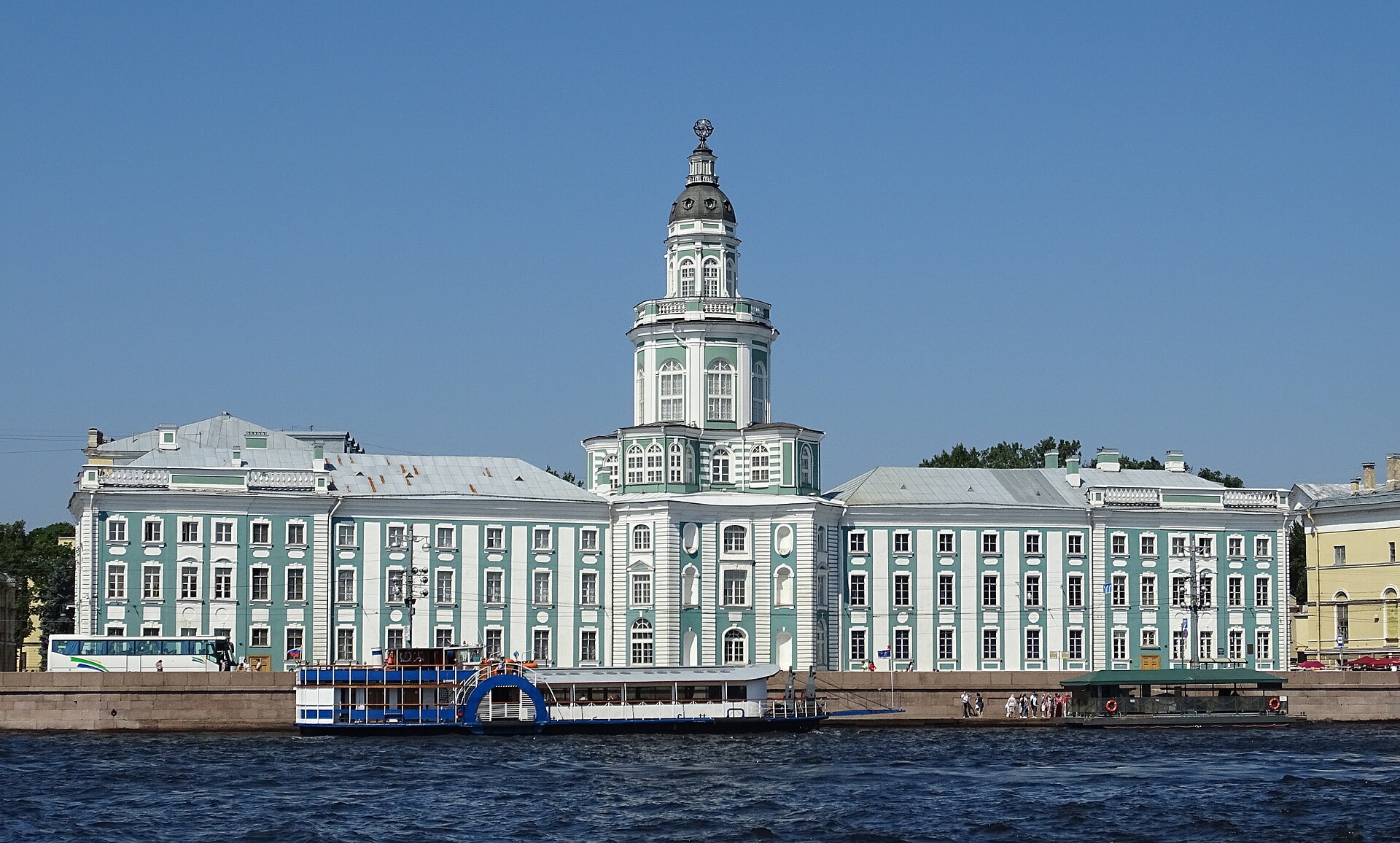
The Kunstkamera, officially the Peter the Great Museum of Anthropology and Ethnography, was established by Peter the Great in 1714. It holds the distinction of being the first public museum in Russia, originally designed to house the Tsar's extensive collection of natural and artificial curiosities, including anatomical specimens and rare artifacts collected during his travels across Europe.
The building itself is a prominent example of Petrine Baroque architecture, situated on the University Embankment in Saint Petersburg. While the museum is historically famous for its collection of 'grotesques'—anatomic anomalies preserved in spirits—it has evolved into a major research institution dedicated to the study of global ethnography, anthropology, and archaeology.
Key Facts
- Materials
- Brick, Stucco, Stone
- Civilization
- Russian Empire
- Accessibility
- Ground floor accessible, upper floors limited
- Date(s)
- 1718-1734
- Condition
- Well-preserved, active museum and research institute
- Original Function
- Cabinet of curiosities and scientific research center
- Key Figures
- Peter the Great, Mikhail Lomonosov, Georg Johann von Frisch
Foundation by Peter the Great
1714-1718Peter the Great founded the museum to house his personal collection of curiosities. He sought to promote scientific inquiry and modernize Russian society by providing public access to natural history specimens and technological innovations.
Architectural Development
1718-1734The current building was designed by architects Georg Johann Mattarnovi, Nicolaus Michetti, and Mikhail Zemtsov. Its distinctive silhouette, featuring a central tower, became a symbol of the Russian Academy of Sciences.
Scientific Evolution
18th-19th centuryThe museum became the center of the Russian Academy of Sciences. It hosted the work of polymath Mikhail Lomonosov and served as a repository for ethnographic collections gathered during Russian expeditions to Siberia, the Americas, and the Pacific.
Modern Era
20th century-presentFollowing the Russian Revolution, the institution was reorganized into the Museum of Anthropology and Ethnography. It continues to function as a leading research center under the Russian Academy of Sciences, maintaining its historical collections while expanding its ethnographic research.
Cultural Significance
The Kunstkamera represents the transition of Russia into a European-style scientific power during the 18th century. It serves as a physical manifestation of Peter the Great's 'Enlightenment' reforms, shifting the focus of Russian intellectual life toward empirical observation and global exploration.
For the public, the museum remains a unique cultural landmark that bridges the gap between early modern curiosity cabinets and contemporary scientific museums. Its collections are deeply embedded in the identity of Saint Petersburg as a city of science and history.
Interpretive Notes
Scholarly debates and areas of uncertainty
There is ongoing academic discussion regarding the ethics of displaying human anatomical remains in the 'grotesque' collection. Scholars debate the balance between maintaining the historical integrity of Peter the Great's original collection and modern standards of museum ethics and human dignity.
Visiting Information
Entry Rules
Open Tuesday through Sunday. Tickets can be purchased at the entrance or via the official website. Visitors are required to pass through security screening upon entry.
Best Times to Visit
Weekday mornings are recommended to avoid weekend crowds. The museum is particularly popular during the White Nights season in June.
Photography
Personal photography is permitted without flash. Professional photography and videography require prior authorization from the museum administration.
Preservation Notes
The building is a protected historical monument. Visitors are requested to refrain from touching display cases and to follow designated pathways within the galleries.
Nearby POIs
11 shownSources & Further Reading
- [1]The Kunstkamera: Peter the Great's Museum of Curiosities — K. V. Chistov. Russian Academy of Sciences (1998)View
- [2]St. Petersburg: A Cultural History — Solomon Volkov. Free Press (1997)
Key Facts
- Materials
- Brick, Stucco, Stone
- Civilization
- Russian Empire
- Accessibility
- Ground floor accessible, upper floors limited
- Date(s)
- 1718-1734
- Condition
- Well-preserved, active museum and research institute
- Original Function
- Cabinet of curiosities and scientific research center
- Key Figures
- Peter the Great, Mikhail Lomonosov, Georg Johann von Frisch