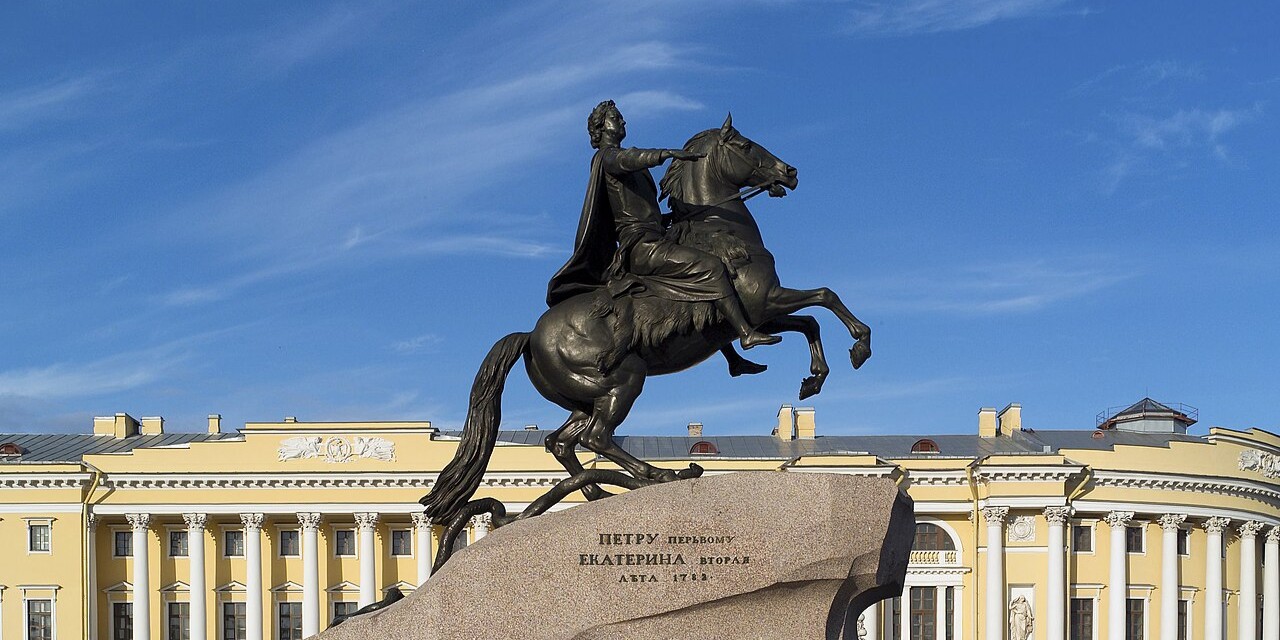
The Bronze Horseman is an equestrian statue of Peter the Great located in Senate Square in Saint Petersburg, Russia. Commissioned by Empress Catherine the Great, the monument was created by the French sculptor Étienne Maurice Falconet and unveiled in 1782. The statue depicts the Tsar mounted on a rearing horse, his hand outstretched toward the Neva River, symbolizing his role as the founder of the city and the architect of Russia's modernization.
The monument is renowned for its massive pedestal, known as the Thunder Stone. This enormous block of granite, weighing approximately 1,250 tons, was transported from the Gulf of Finland to the city center using a sophisticated system of rollers and tracks, representing a significant engineering feat of the 18th century.
Key Facts
- Materials
- Bronze, Granite
- Civilization
- Russian Empire
- Accessibility
- Fully accessible in public square
- Date(s)
- 1768-1782
- Condition
- Well-preserved, public landmark
- Original Function
- Commemorative monument
- Key Figures
- Peter the Great, Catherine the Great, Étienne Maurice Falconet
Commission and Design
1766-1768Catherine the Great sought to legitimize her rule by linking it to the legacy of Peter the Great. She commissioned Falconet, who arrived in Saint Petersburg in 1766. Falconet chose to depict the Tsar not as a Roman conqueror, but as a civilizing force, emphasizing the horse's rearing posture to suggest the taming of the wild Russian landscape.
The Thunder Stone
1769-1770The search for a suitable pedestal led to the discovery of a massive granite boulder in Lakhta. Moving the stone required the invention of specialized machinery, including a track system with bronze spheres, which allowed the stone to be transported over several miles to the coast and then barged to the city.
Unveiling and Legacy
1782The statue was unveiled on August 7, 1782. It became a central icon of the city, later immortalized in Alexander Pushkin's 1833 poem 'The Bronze Horseman,' which cemented the statue's place in Russian literature and cultural consciousness.
Cultural Significance
The Bronze Horseman serves as the primary symbol of Saint Petersburg. It represents the transition of Russia into a European power and the personal vision of Peter the Great. The statue is deeply embedded in the city's identity, often serving as a focal point for civic gatherings and a subject of artistic inspiration for centuries.
Interpretive Notes
Scholarly debates and areas of uncertainty
Debate persists regarding the intended symbolism of the serpent beneath the horse's hooves. While traditionally interpreted as a representation of treachery or the enemies of Peter's reforms, some scholars argue it serves a structural purpose to provide a third point of contact for the statue's balance.
Visiting Information
Entry Rules
The monument is located in a public square and is accessible 24 hours a day at no cost.
Best Times to Visit
Early morning or late evening to avoid heavy tourist traffic and to view the statue against the backdrop of the Neva River.
Photography
No restrictions for personal photography.
Preservation Notes
The monument is monitored by the State Museum of Urban Sculpture. Visitors are prohibited from climbing the pedestal.
Nearby POIs
11 shownSources & Further Reading
- [1]The Bronze Horseman: Falconet's Monument to Peter the Great — Alexander M. Schenker. Yale University Press (2003)
- [2]St. Petersburg: A Cultural History — Solomon Volkov. Free Press (1995)
Key Facts
- Materials
- Bronze, Granite
- Civilization
- Russian Empire
- Accessibility
- Fully accessible in public square
- Date(s)
- 1768-1782
- Condition
- Well-preserved, public landmark
- Original Function
- Commemorative monument
- Key Figures
- Peter the Great, Catherine the Great, Étienne Maurice Falconet