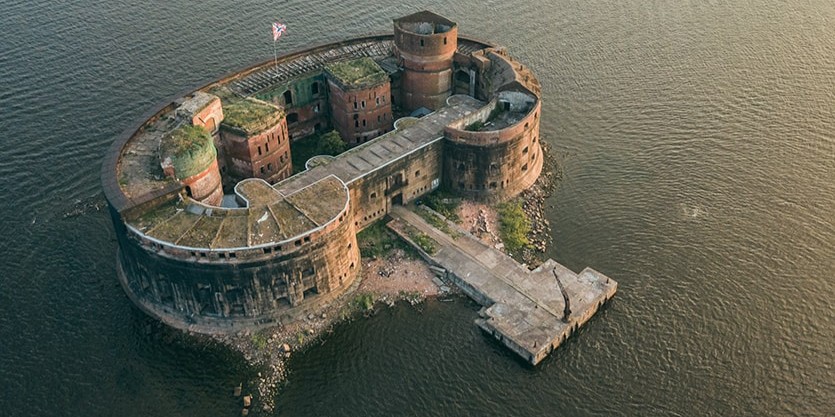
Fort Grand Duke Konstantin
Fort Grand Duke Konstantin is a maritime fortification located on an artificial island near Kotlin Island, serving as a key defensive component of the Kronstadt naval base. Originally constructed in the mid-19th century to protect Saint Petersburg from naval incursions, it represents a significant evolution in Russian coastal defense architecture, transitioning from wooden structures to reinforced masonry and iron-clad batteries.
The fort played a vital role in the defense of the Gulf of Finland during various conflicts, including the Crimean War and the Russian Civil War. Today, the site has been repurposed as a historical park and maritime center, preserving the remaining casemates and defensive walls while providing insight into the strategic importance of the Baltic Sea defenses.
Key Facts
- Materials
- Granite, Brick, Earthworks, Iron
- Civilization
- Russian Empire
- Accessibility
- Accessible via causeway from Kronstadt
- Date(s)
- 1807-1861
- Condition
- Partially restored, historical park
- Original Function
- Coastal defense battery
- Key Figures
- Grand Duke Konstantin Nikolayevich
Establishment and Early Defense
1807-1850sThe fort was established as a wooden battery to bolster the defenses of Kronstadt. It was named after Grand Duke Konstantin Nikolayevich, who served as the head of the Russian Navy.
Modernization and Iron-Clad Era
1850s-1861Following the lessons of the Crimean War, the fort was significantly rebuilt using stone and iron to withstand modern naval artillery, becoming one of the most advanced defensive positions in the region.
Soviet Era and Decline
1917-1990sDuring the Soviet period, the fort continued to serve military functions, including anti-aircraft defense. Following the collapse of the Soviet Union, the site was decommissioned and fell into a period of neglect.
Contemporary Restoration
2000s-PresentThe site has undergone extensive restoration efforts to convert it into a cultural and tourist destination, focusing on preserving its military heritage while hosting maritime events.
Cultural Significance
The fort is a symbol of the maritime history of Saint Petersburg and the strategic importance of the Kronstadt naval fortress. It reflects the technological shifts in 19th-century military engineering and the enduring Russian focus on Baltic security.
Interpretive Notes
Scholarly debates and areas of uncertainty
Debates exist regarding the extent of original 19th-century masonry versus Soviet-era modifications, complicating restoration efforts aimed at returning the fort to its mid-Victorian appearance.
Visiting Information
Entry Rules
Open to the public. Tickets are required for guided tours and entry to specific museum exhibitions within the fort. Check local schedules for seasonal operating hours.
Best Times to Visit
Summer months (June-August) for outdoor tours and maritime events. Weekdays are recommended to avoid crowds from Saint Petersburg.
Photography
Personal photography is permitted. Commercial photography or drone usage requires prior authorization from the site administration.
Preservation Notes
Visitors are advised to stay on marked paths as some areas of the fortification remain structurally fragile. Do not climb on the historic masonry walls.
Nearby POIs
11 shownSources & Further Reading
- [1]Kronstadt: The Fortress and the City — V. A. Ivanov. Saint Petersburg Historical Press (2015)
- [2]Russian Coastal Defenses in the 19th Century — N. P. Petrov. Military History Journal (2018)
Key Facts
- Materials
- Granite, Brick, Earthworks, Iron
- Civilization
- Russian Empire
- Accessibility
- Accessible via causeway from Kronstadt
- Date(s)
- 1807-1861
- Condition
- Partially restored, historical park
- Original Function
- Coastal defense battery
- Key Figures
- Grand Duke Konstantin Nikolayevich