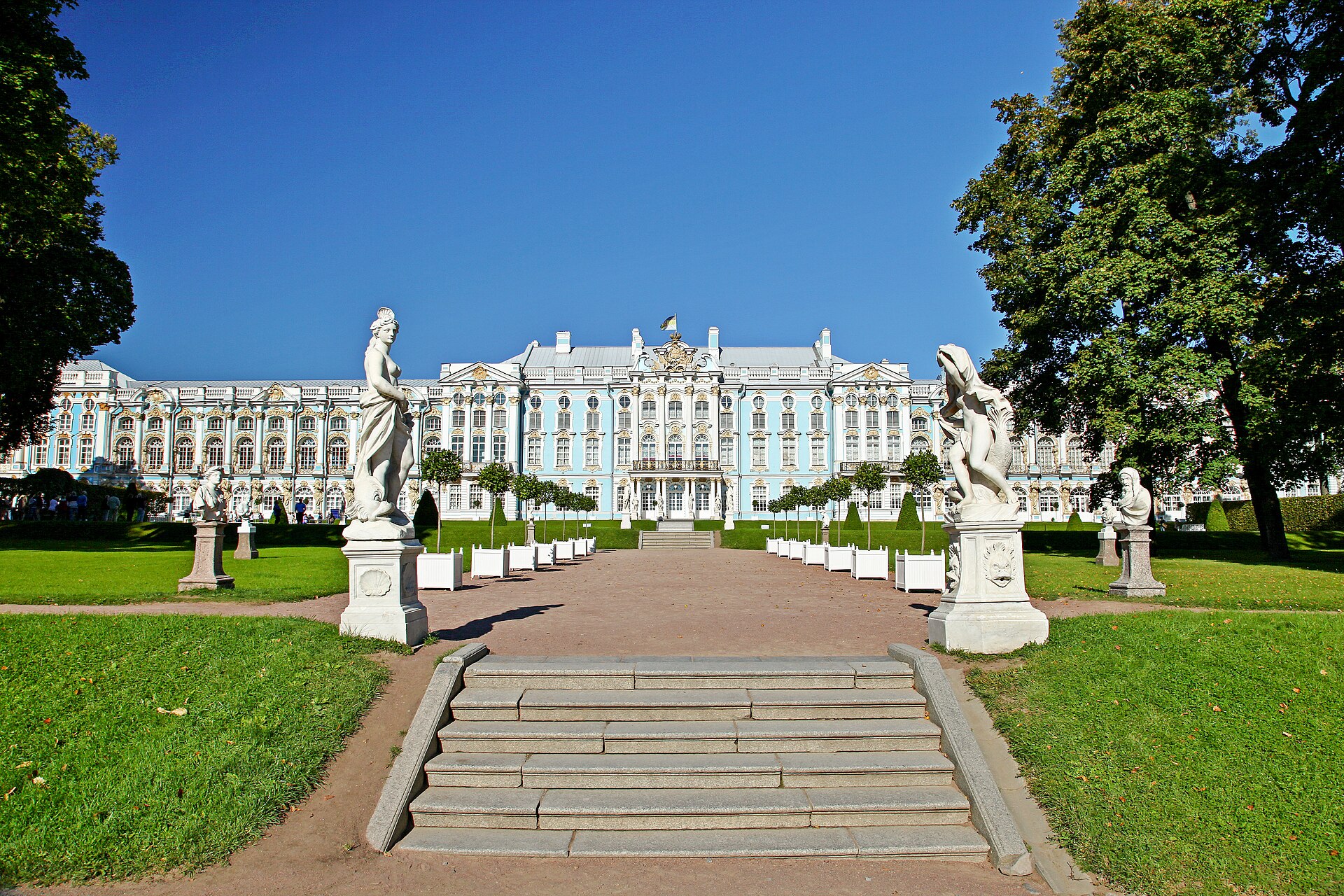
Ekaterina's Palace, located in the town of Tsarskoye Selo near Saint Petersburg, served as the opulent summer residence of the Russian tsars. Originally commissioned by Empress Catherine I in 1717, the structure was significantly expanded and redesigned in the mid-18th century by Bartolomeo Rastrelli, who transformed it into a masterpiece of Russian Baroque architecture.
The palace is renowned for its striking blue and white facade, adorned with gilded stucco details, and its lavish interiors, most notably the Amber Room. Following extensive damage during World War II, the palace underwent a meticulous, decades-long restoration process that continues to serve as a benchmark for architectural preservation.
Key Facts
- Materials
- Brick, Stucco, Gold leaf, Amber, Marble
- Civilization
- Russian Empire
- Accessibility
- Limited; some areas require guided tours and specific footwear
- Date(s)
- 1717–1756
- Condition
- Extensively restored and functioning as a state museum
- Original Function
- Imperial summer residence
- Key Figures
- Catherine I, Empress Elizabeth, Catherine the Great, Bartolomeo Rastrelli
Foundations and Early Expansion
1717–1740sThe site began as a modest stone palace commissioned by Catherine I. Under the reign of Empress Elizabeth, the structure was dramatically enlarged to reflect the growing power and prestige of the Russian imperial court.
The Rastrelli Transformation
1748–1756Architect Bartolomeo Rastrelli redesigned the palace in the ornate Elizabethan Baroque style. The exterior was lengthened to over 300 meters, and the interior was decorated with gold-leaf carvings and intricate parquet floors.
Neoclassical Refinements
Late 18th centuryCatherine the Great commissioned Scottish architect Charles Cameron to update several interiors in the Neoclassical style, favoring lighter, more restrained aesthetics over the heavy Baroque ornamentation of the previous era.
War and Restoration
1941–presentDuring the German occupation in World War II, the palace was severely damaged and looted, including the removal of the famous Amber Room. Post-war restoration began in the late 1950s, culminating in the recreation of the Amber Room in 2003.
Cultural Significance
The Catherine Palace stands as a primary symbol of the Romanov dynasty's absolute power and artistic patronage. It represents the synthesis of Western European architectural trends with Russian imperial ambition, serving as a focal point for the study of 18th-century decorative arts.
Today, the palace is a cornerstone of Russian cultural heritage. The reconstruction of the Amber Room is widely regarded as one of the most significant achievements in modern art conservation, symbolizing the resilience of Russian cultural identity following the destruction of the Second World War.
Interpretive Notes
Scholarly debates and areas of uncertainty
The authenticity of the reconstructed Amber Room remains a subject of discussion among historians and conservators. While the recreation is technically precise, some scholars debate the ethical implications of prioritizing the restoration of imperial symbols over other war-damaged historical sites.
Visiting Information
Entry Rules
Entry is by ticket only, often requiring advance booking during peak tourist seasons. Visitors must wear protective shoe covers provided at the entrance. Large bags and backpacks are not permitted inside the palace halls.
Best Times to Visit
Early morning or late afternoon on weekdays to avoid large tour groups. The palace gardens are best visited during the 'White Nights' period in June or during the autumn foliage season.
Photography
Photography is permitted in most areas without flash or tripods. Professional photography and videography require prior authorization from the museum administration.
Preservation Notes
The palace is a fragile environment; visitors must refrain from touching gilded surfaces, wall coverings, or furniture. Strict climate control is maintained to protect the historic interiors.
Nearby POIs
11 shown- Alexander Palace0.6 km
- Monument to the Heroic Defenders of Leningrad14.8 km
- Grand Maket Russia19.5 km
- Alexander Nevsky Lavra22.9 km
- Yusupov Palace24.4 km
- Faberge Museum24.5 km
- Cathedral of Our Lady of Kazan24.7 km
- Saint Isaac's Cathedral24.8 km
- Russian Museum of Ethnography25 km
- Mikhailovsky Palace25.1 km
- Bronze Horseman25.1 km
Sources & Further Reading
- [1]The Amber Room: The Fate of the World's Greatest Lost Treasure — Catherine Scott-Clark and Adrian Levy. Atlantic Books (2004)
- [2]Tsarskoye Selo: The Palace and Park Ensembles — I. K. Botova. Aurora Art Publishers (1998)
Key Facts
- Materials
- Brick, Stucco, Gold leaf, Amber, Marble
- Civilization
- Russian Empire
- Accessibility
- Limited; some areas require guided tours and specific footwear
- Date(s)
- 1717–1756
- Condition
- Extensively restored and functioning as a state museum
- Original Function
- Imperial summer residence
- Key Figures
- Catherine I, Empress Elizabeth, Catherine the Great, Bartolomeo Rastrelli
Nearby POIs
11 shown- Alexander Palace0.6 km
- Monument to the Heroic Defenders of Leningrad14.8 km
- Grand Maket Russia19.5 km
- Alexander Nevsky Lavra22.9 km
- Yusupov Palace24.4 km
- Faberge Museum24.5 km
- Cathedral of Our Lady of Kazan24.7 km
- Saint Isaac's Cathedral24.8 km
- Russian Museum of Ethnography25 km
- Mikhailovsky Palace25.1 km
- Bronze Horseman25.1 km