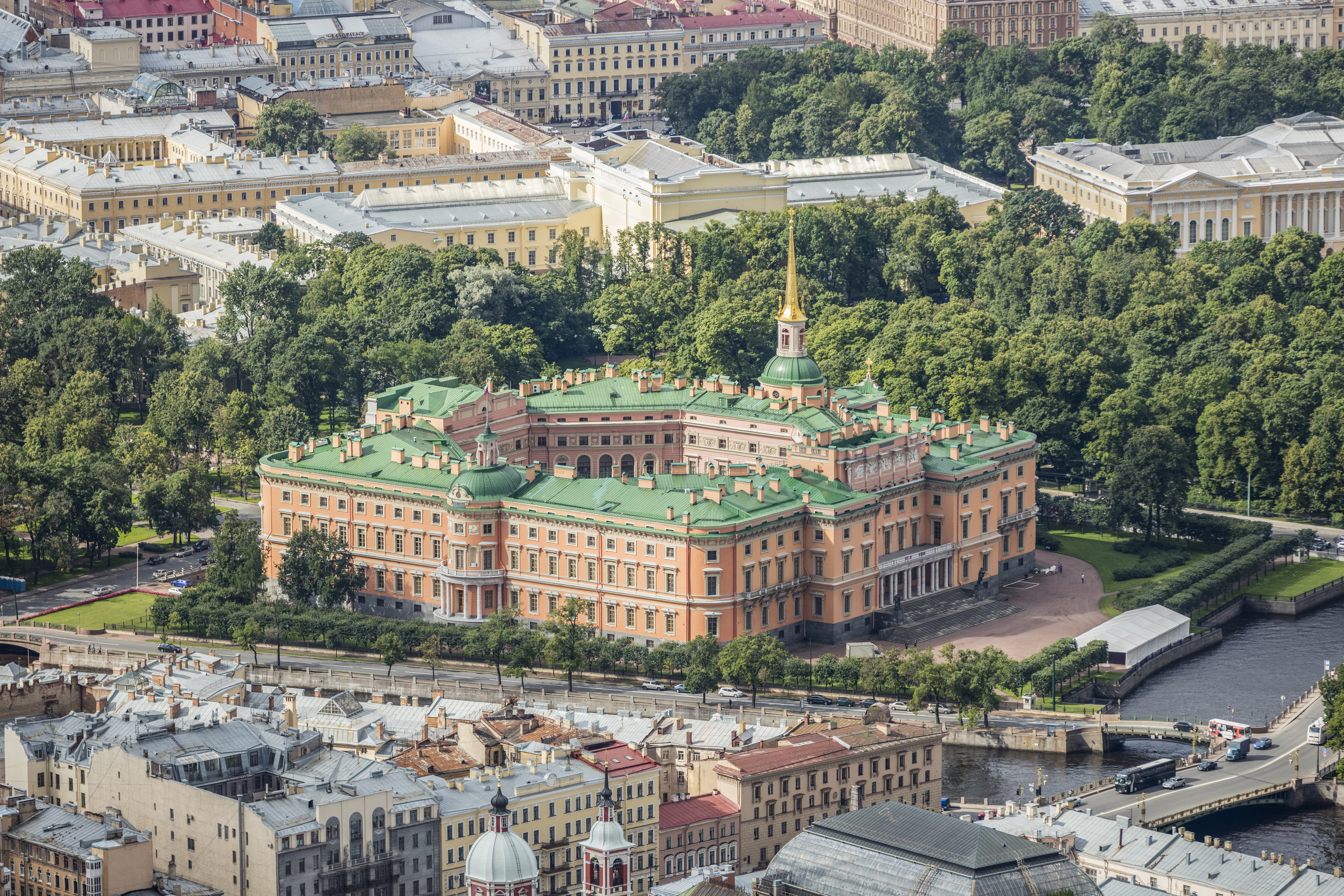
Saint Michael's Castle, also known as the Mikhailovsky Castle, is a former royal residence located in the historic center of Saint Petersburg. Commissioned by Emperor Paul I, it was constructed between 1797 and 1801 as a fortified palace designed to serve as both a secure residence and a symbol of the Emperor's authority. The building is notable for its distinct architectural style, which blends elements of French classicism with the defensive features of a medieval fortress, including moats and drawbridges.
The palace features a unique square layout with an octagonal central courtyard, a design choice that reflects Paul I's fascination with the Order of Saint John of Jerusalem. Following the assassination of Paul I within the castle walls only forty days after he moved in, the building lost its status as a primary imperial residence and was eventually repurposed for various military and educational institutions before becoming a branch of the State Russian Museum.
Key Facts
- Materials
- Brick, Stone, Marble, Granite
- Civilization
- Russian Empire
- Accessibility
- Ground floor accessible, upper levels limited
- Date(s)
- 1797-1801
- Condition
- Restored and active as a museum
- Original Function
- Imperial residence and fortress
- Key Figures
- Emperor Paul I, Vincenzo Brenna, Vasily Bazhenov
Conception and Construction
1797-1801Emperor Paul I, fearing for his safety, ordered the construction of a new residence on the site of the former Summer Palace of Elizabeth Petrovna. Architects Vincenzo Brenna and Vasily Bazhenov were tasked with creating a structure that functioned as a fortress, surrounded by moats and guarded by canals.
The Assassination of Paul I
1801On the night of March 24, 1801, Emperor Paul I was assassinated in his bedroom within the castle by a group of conspirators. The event marked the end of the building's brief tenure as the official imperial residence.
Military and Educational Use
19th centuryFollowing the death of Paul I, the imperial family abandoned the castle. It was subsequently transferred to the Main Engineering School, leading to its alternative name, the Engineers' Castle. During this time, the interiors were significantly altered to accommodate classrooms and dormitories.
Restoration and Museum Status
20th century - presentIn the 1990s, the castle was transferred to the State Russian Museum. Extensive restoration projects were undertaken to return the exterior and key interior chambers to their original 18th-century appearance, allowing the site to open to the public as a cultural venue.
Cultural Significance
Saint Michael's Castle stands as a physical manifestation of the paranoia and romantic idealism of Emperor Paul I. Its architectural departure from the traditional open palaces of the Romanovs highlights the political instability of the era. Today, it serves as a critical site for understanding late 18th-century Russian court life and the transition toward the Romantic movement in architecture.
Interpretive Notes
Scholarly debates and areas of uncertainty
The extent to which the castle's design was influenced by Paul I's personal obsession with the Knights Hospitaller remains a subject of study. While the octagonal courtyard is clearly symbolic, scholars debate whether the defensive features were purely functional or intended as a symbolic rejection of the Enlightenment-era openness favored by his mother, Catherine the Great.
Visiting Information
Entry Rules
Open daily except Tuesdays. Tickets can be purchased at the entrance or online. Visitors must follow museum conduct rules; large bags and backpacks must be left in the cloakroom.
Best Times to Visit
Weekday mornings are recommended to avoid weekend crowds. The castle is particularly striking during the winter months when the surrounding park and canals are covered in snow.
Photography
Non-commercial photography is permitted without flash or tripods. Professional photography requires prior authorization from the museum administration.
Preservation Notes
The building is a protected cultural heritage site. Visitors are requested to refrain from touching the walls or decorative elements and to remain within designated exhibition areas.
Nearby POIs
11 shownSources & Further Reading
- [1]The Mikhailovsky Castle: History and Architecture — Evgenia Petrova. State Russian Museum Publishing (2003)
- [2]Paul I: A Reassessment of his Reign — Roderick E. McGrew. Oxford University Press (1992)
Key Facts
- Materials
- Brick, Stone, Marble, Granite
- Civilization
- Russian Empire
- Accessibility
- Ground floor accessible, upper levels limited
- Date(s)
- 1797-1801
- Condition
- Restored and active as a museum
- Original Function
- Imperial residence and fortress
- Key Figures
- Emperor Paul I, Vincenzo Brenna, Vasily Bazhenov