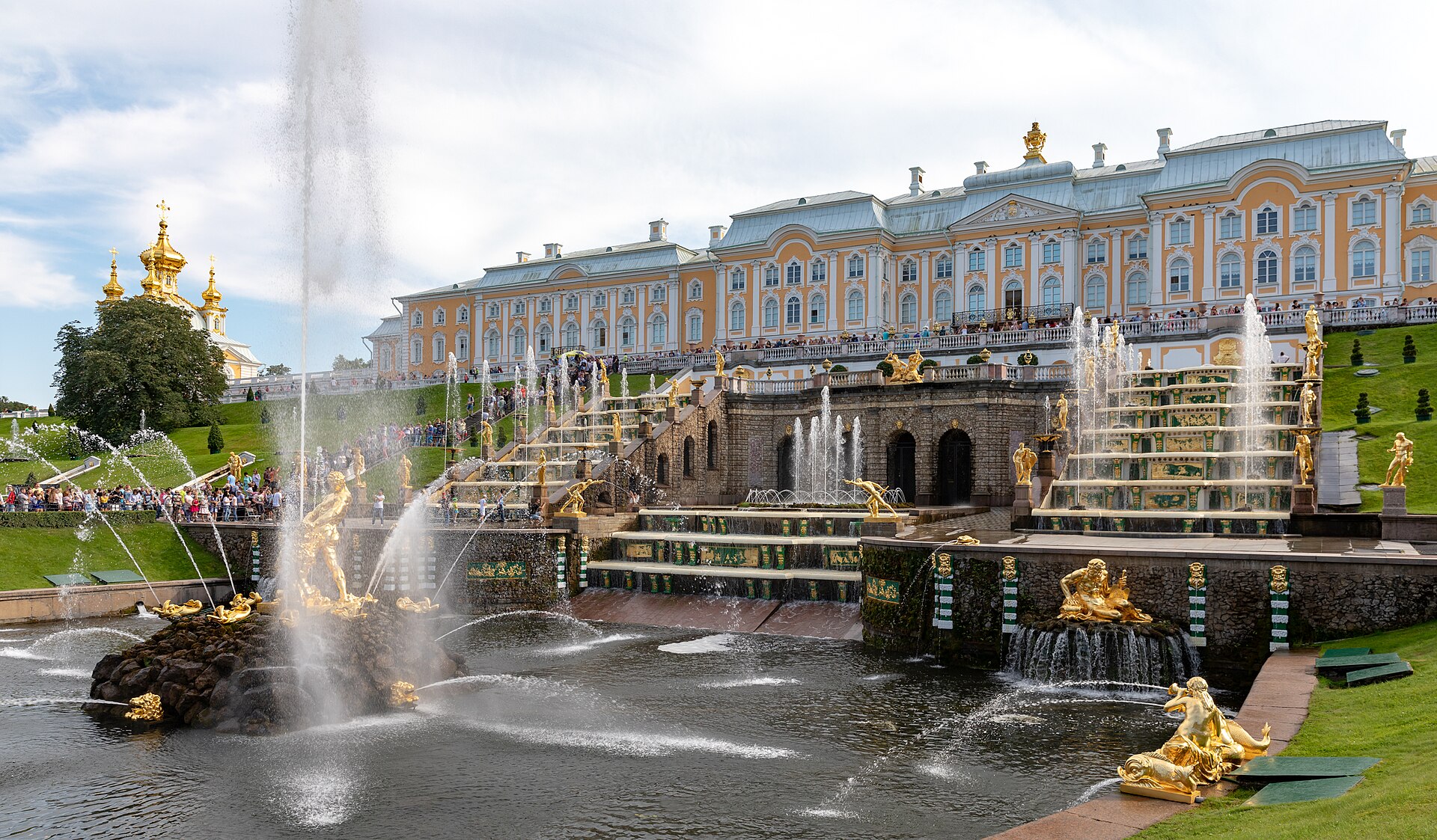
Petergof is a series of palaces and gardens located in Saint Petersburg, Russia, commissioned by Peter the Great as a direct response to the Palace of Versailles. Often referred to as the 'Russian Versailles,' the complex serves as a monumental display of imperial power and engineering, featuring an extensive network of fountains that operate without the use of pumps, relying instead on natural elevation differences.
The site comprises the Grand Palace, the Upper Garden, and the Lower Park, which houses the famous Grand Cascade. Following extensive damage during World War II, the complex underwent a massive, multi-decade restoration project to reconstruct the interiors and the intricate hydraulic systems that define its landscape architecture.
Key Facts
- Materials
- Marble, Gold leaf, Brick, Stucco
- Civilization
- Russian Empire
- Accessibility
- Partially accessible; some gravel paths and stairs
- Date(s)
- 1714 - 1725
- Condition
- Restored museum complex
- Original Function
- Imperial summer residence
- Key Figures
- Peter the Great, Jean-Baptiste Alexandre Le Blond, Bartolomeo Rastrelli
Founding and Design
1714-1725Peter the Great selected the site for his summer residence to overlook the Gulf of Finland. He personally drafted the initial plans for the gardens and the hydraulic system, enlisting European architects like Le Blond to execute the Baroque vision.
Imperial Expansion
18th-19th centurySuccessive monarchs, particularly Empress Elizabeth and Catherine the Great, expanded the palace and refined the gardens. Bartolomeo Rastrelli was commissioned to enlarge the Grand Palace, adding the opulent Baroque facades and interiors seen today.
Wartime Destruction and Restoration
1941-1945During the German occupation in World War II, the palace was looted and largely destroyed by fire. The fountains were dismantled and the park was heavily mined. Post-war restoration began almost immediately, with the first fountains reopening in 1946.
Cultural Significance
Petergof represents the 'Westernization' of Russia under Peter the Great, symbolizing the nation's emergence as a major European power. It remains a cornerstone of Russian cultural identity and a primary example of 18th-century landscape design and hydraulic engineering.
Today, the site is a major tourist destination and a center for historical research, reflecting the complex relationship between Russian imperial history and modern preservation efforts.
Interpretive Notes
Scholarly debates and areas of uncertainty
Debates persist regarding the extent of Peter the Great's personal involvement in the architectural design versus the contributions of his hired European architects. Additionally, the ethics of the post-war 'total reconstruction' of the palace interiors—which involved recreating lost art based on archival photographs—remains a topic of discussion in conservation circles.
Visiting Information
Entry Rules
Open daily. Tickets are required for entry to the Lower Park and the Grand Palace. Security screening is mandatory at all entrances. Modest attire is recommended for museum interiors.
Best Times to Visit
Late May to early September, when the fountains are operational. Weekdays are recommended to avoid heavy weekend crowds from Saint Petersburg.
Photography
Personal photography is permitted in the gardens. Photography is strictly prohibited inside the Grand Palace and other museum buildings.
Preservation Notes
Stay on marked paths to protect the historic landscaping. Do not touch the gilded statues or fountain mechanisms. Restoration is an ongoing process; some areas may be temporarily closed for maintenance.
Nearby POIs
11 shownSources & Further Reading
- [1]Peterhof: The Russian Versailles — Alexander V. Krayevsky. St. Petersburg Publishing House (2010)
- [2]The Fountains of Peterhof: Engineering and Art — Elena I. Belova. Journal of Russian Architectural History (2018)
Key Facts
- Materials
- Marble, Gold leaf, Brick, Stucco
- Civilization
- Russian Empire
- Accessibility
- Partially accessible; some gravel paths and stairs
- Date(s)
- 1714 - 1725
- Condition
- Restored museum complex
- Original Function
- Imperial summer residence
- Key Figures
- Peter the Great, Jean-Baptiste Alexandre Le Blond, Bartolomeo Rastrelli