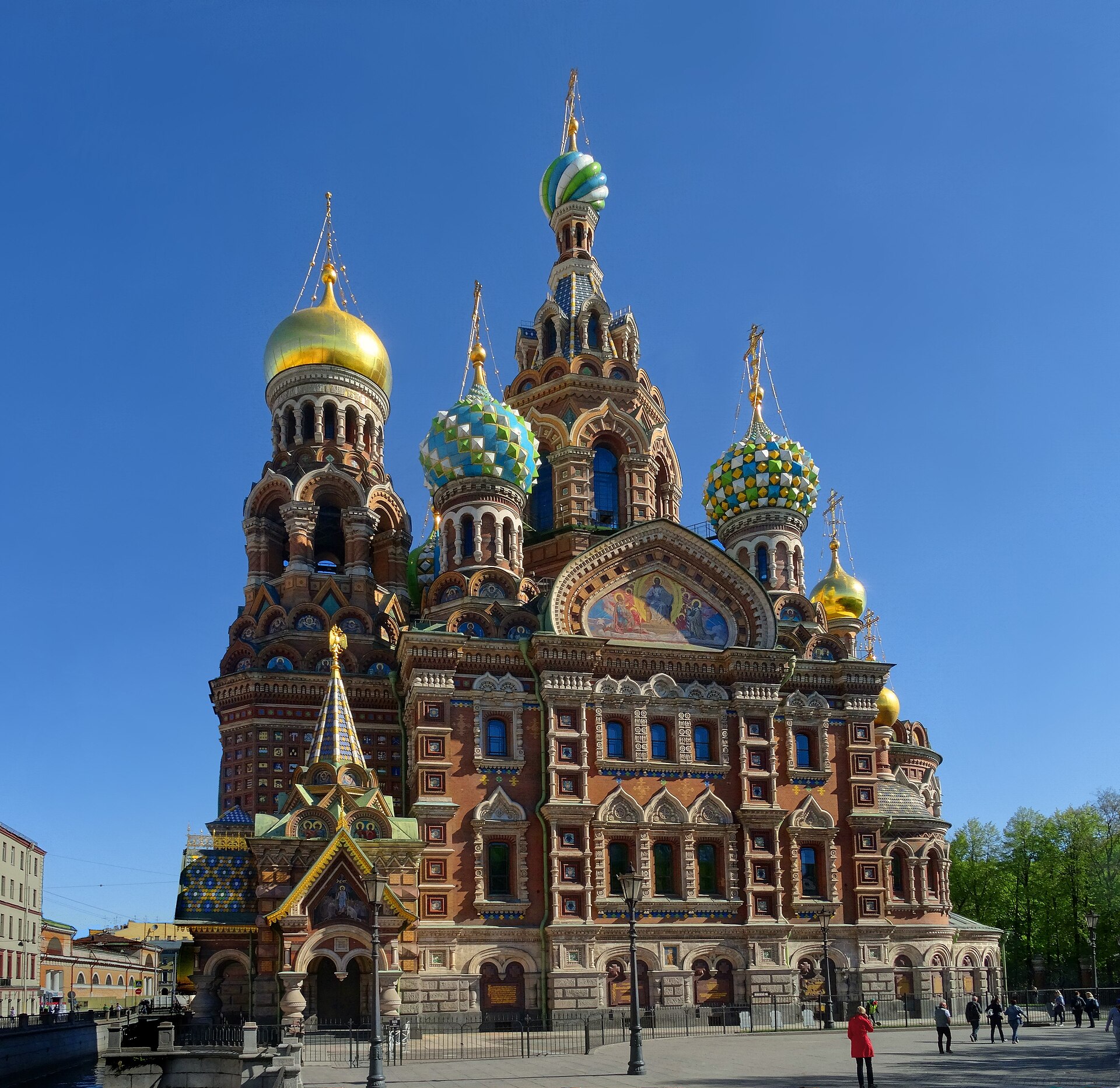
The Church of the Savior on Blood, officially the Cathedral of the Resurrection of Christ, is a prominent landmark in Saint Petersburg, Russia. It was constructed between 1883 and 1907 on the site where Emperor Alexander II was mortally wounded in an assassination attempt in March 1881. The church was funded by the imperial family and private donors to serve as a memorial to the late Tsar.
Architecturally, the building departs from the neoclassical style prevalent in Saint Petersburg, instead drawing inspiration from medieval Russian architecture and the 17th-century churches of Yaroslavl. Its exterior is characterized by intricate brickwork, colorful onion domes, and a vast collection of mosaics covering over 7,500 square meters of interior and exterior surfaces.
Key Facts
- Materials
- Brick, Marble, Granite, Mosaic tiles, Enamel
- Civilization
- Russian Empire
- Accessibility
- Wheelchair accessible at ground level
- Date(s)
- 1883-1907
- Condition
- Museum and secularized monument
- Original Function
- Memorial church
- Key Figures
- Alexander II of Russia, Alfred Parland, Archimandrite Ignaty
The Assassination and Commission
1881Following the assassination of Alexander II on the Griboyedov Canal embankment, the imperial family decided to construct a memorial church on the exact spot of the attack. A competition was held, and the design by Alfred Parland and Archimandrite Ignaty was selected.
Construction Phase
1883-1907Construction spanned over two decades, delayed by the complexity of the mosaic work and the technical challenges of building on the canal bank. The church was consecrated in 1907 during the reign of Nicholas II.
Soviet Era and Restoration
1917-1997Following the Russian Revolution, the church was looted and damaged. It was closed for services in the 1930s and used for various secular purposes, including a morgue during the Siege of Leningrad. Extensive restoration began in the 1970s and concluded in 1997 when it reopened as a museum.
Cultural Significance
The church serves as a physical manifestation of the Russian Revival movement, representing a deliberate return to national architectural roots as a reaction against Western European influences. It stands as a poignant symbol of the late imperial era and the political instability that preceded the 1917 revolution.
Today, it is one of the most recognizable symbols of Saint Petersburg. While it no longer functions as a primary place of worship, it remains a vital site for understanding the intersection of Russian Orthodox tradition and 19th-century commemorative architecture.
Interpretive Notes
Scholarly debates and areas of uncertainty
Debate persists regarding the extent to which the church's design was a genuine revival of medieval forms versus a stylized, romanticized interpretation intended to project imperial power. Additionally, the preservation of the mosaics, which are highly sensitive to the city's humid climate, remains a subject of ongoing technical discussion among conservators.
Visiting Information
Entry Rules
Open daily except Wednesdays. Tickets are required for entry. Visitors are expected to maintain a respectful demeanor as the site is a memorial.
Best Times to Visit
Early morning or late afternoon to avoid the peak tourist crowds that gather near the canal. Winter visits offer a unique perspective of the domes against the snow.
Photography
Personal photography is permitted without flash or tripods. Professional or commercial photography requires prior authorization from the museum administration.
Preservation Notes
The interior mosaics are extremely fragile; do not touch the walls or decorative elements. The building is subject to strict climate control to protect the artwork.
Nearby POIs
11 shownSources & Further Reading
- [1]The Church of the Savior on Blood: A History — N. V. Musienko. State Museum of the History of Saint Petersburg (2005)
- [2]Russian Revival Architecture — William Craft Brumfield. Duke University Press (1991)
Key Facts
- Materials
- Brick, Marble, Granite, Mosaic tiles, Enamel
- Civilization
- Russian Empire
- Accessibility
- Wheelchair accessible at ground level
- Date(s)
- 1883-1907
- Condition
- Museum and secularized monument
- Original Function
- Memorial church
- Key Figures
- Alexander II of Russia, Alfred Parland, Archimandrite Ignaty