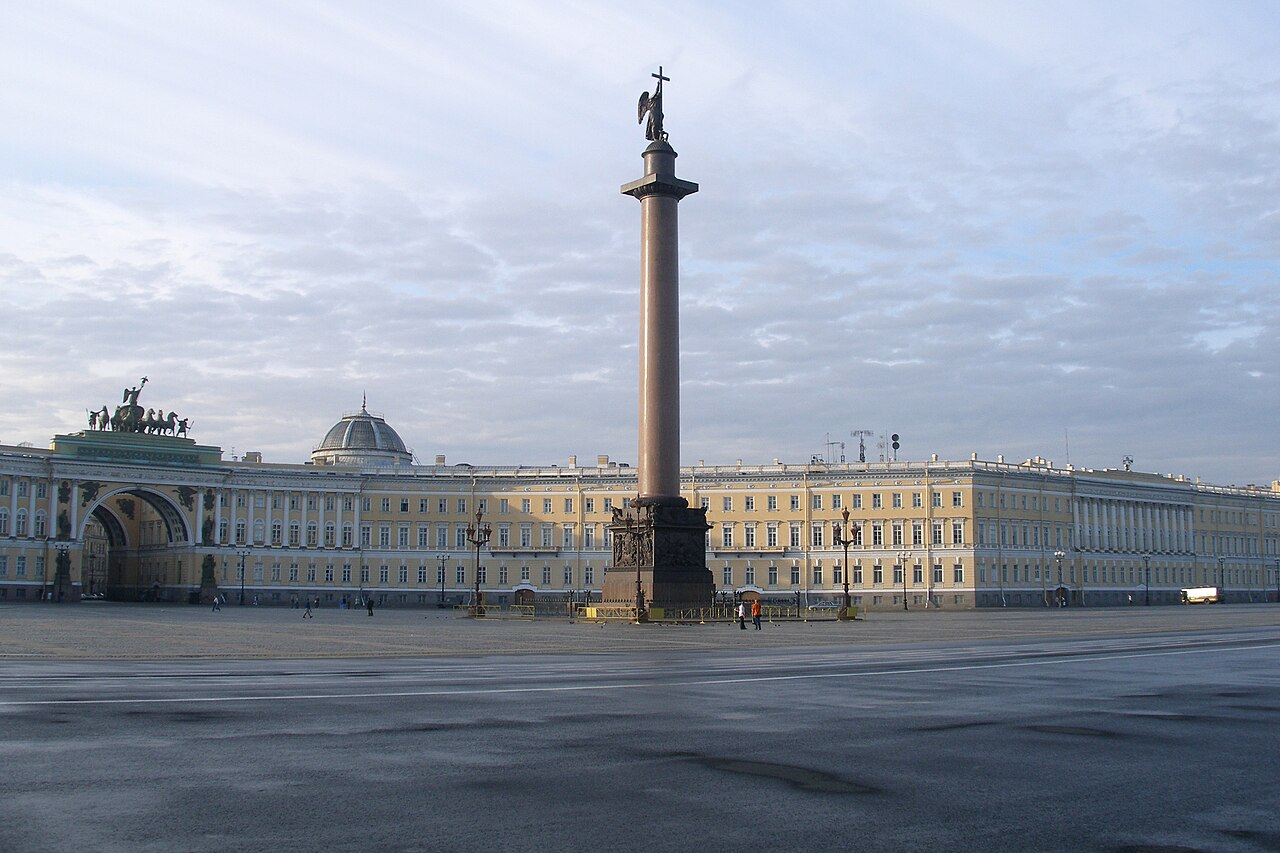
The Alexander Column is a triumphal monument located in the center of Palace Square in Saint Petersburg, Russia. Erected between 1830 and 1834, it commemorates the Russian victory over Napoleon Bonaparte and the French forces during the Patriotic War of 1812. The monument was commissioned by Emperor Nicholas I to honor his brother, Alexander I, who reigned during the conflict.
Designed by the French-born architect Auguste de Montferrand, the column is a monolithic red granite shaft topped by a bronze statue of an angel holding a cross, sculpted by Boris Orlovsky. It stands as the tallest triumphal column of its kind in the world, notable for its engineering feat of being held in place solely by its own weight without any structural attachment to the pedestal.
Key Facts
- Materials
- Red granite, Bronze
- Civilization
- Russian Empire
- Accessibility
- Public square, fully accessible
- Date(s)
- 1830-1834
- Condition
- Well-preserved
- Original Function
- Triumphal monument
- Key Figures
- Auguste de Montferrand, Nicholas I, Alexander I, Boris Orlovsky
Commission and Design
1829Following the victory over Napoleon, a competition was held to design a monument for Palace Square. Auguste de Montferrand, who had previously designed Saint Isaac's Cathedral, was selected to create a column that would surpass the height of the Vendôme Column in Paris.
Construction and Installation
1830-1834The granite monolith was quarried in Virolahti, Finland, and transported to Saint Petersburg by sea on a specially designed barge. The column was raised in a massive engineering operation involving 2,000 soldiers and 400 workmen, taking less than two hours to place on its pedestal.
Soviet Era and Preservation
20th CenturyDuring the Soviet period, the monument remained a central landmark of the city. It underwent significant restoration in the early 21st century to clean the granite and stabilize the bronze angel, ensuring the structural integrity of the monument.
Cultural Significance
The Alexander Column serves as a symbol of Russian military triumph and the imperial grandeur of Saint Petersburg. It anchors the architectural ensemble of Palace Square, framing the Winter Palace and the General Staff Building. The angel at the top is often interpreted as a representation of Alexander I, with the face of the statue modeled after the late Emperor.
Beyond its historical role, the column is a focal point for public gatherings and national celebrations. Its presence in the heart of the city reinforces the historical narrative of Russia's resilience against foreign invasion, maintaining its status as one of the most recognizable landmarks in the country.
Interpretive Notes
Scholarly debates and areas of uncertainty
There has been minor scholarly discussion regarding the structural stability of the column, specifically concerning the lack of mechanical fasteners. While some early 19th-century observers feared the column might topple, modern engineering analysis confirms that the precise center of gravity and the weight of the monolith provide sufficient stability against wind and seismic activity.
Visiting Information
Entry Rules
The monument is located in a public square and is accessible 24 hours a day. No entry fee is required.
Best Times to Visit
Early morning or late evening to avoid large crowds and to view the monument illuminated at night.
Photography
None. Personal photography is permitted.
Preservation Notes
The monument is a protected cultural heritage site. Climbing or defacing the pedestal is strictly prohibited.
Nearby POIs
11 shownSources & Further Reading
- [1]Saint Petersburg: A Cultural History — Solomon Volkov. Free Press (1995)
- [2]The Alexander Column: Engineering and Symbolism — Auguste de Montferrand. Imperial Academy of Arts (1836)
Key Facts
- Materials
- Red granite, Bronze
- Civilization
- Russian Empire
- Accessibility
- Public square, fully accessible
- Date(s)
- 1830-1834
- Condition
- Well-preserved
- Original Function
- Triumphal monument
- Key Figures
- Auguste de Montferrand, Nicholas I, Alexander I, Boris Orlovsky