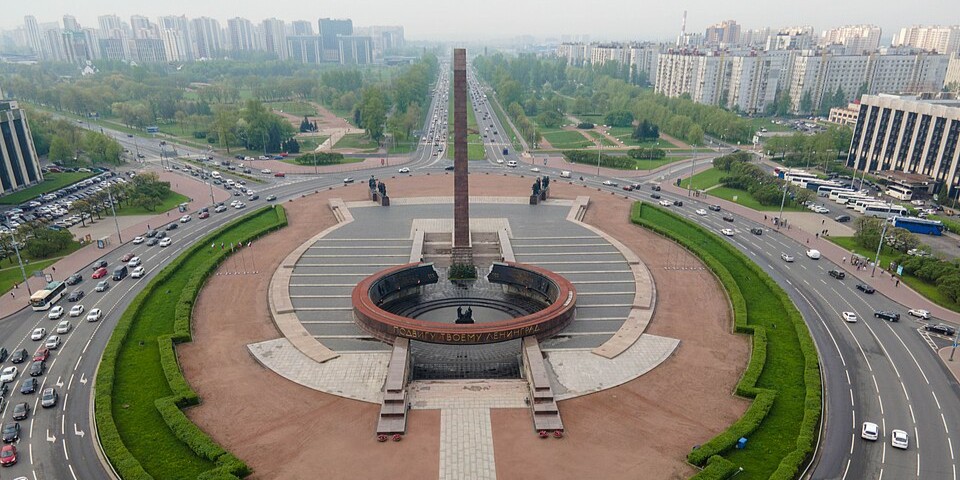
The Monument to the Heroic Defenders of Leningrad is a massive memorial complex located on Victory Square in Saint Petersburg, commemorating the city's resistance during the 872-day Siege of Leningrad in World War II. Designed by architects Sergei Speransky and Valentin Kamensky along with sculptor Mikhail Anikushin, the site was inaugurated in 1975 to mark the 30th anniversary of the Soviet victory.
The complex features a central 48-meter-tall obelisk surrounded by a ring of bronze sculptures depicting soldiers, workers, and citizens. Below the ground level, a subterranean memorial hall houses a museum dedicated to the history of the siege, featuring artifacts, maps, and personal accounts from the blockade period.
Key Facts
- Materials
- Granite, Bronze, Concrete
- Civilization
- Soviet Union
- Accessibility
- Ground level accessible; museum entrance requires stairs
- Date(s)
- 1975
- Condition
- Well-preserved, active memorial site
- Original Function
- War memorial and museum
- Key Figures
- Sergei Speransky, Valentin Kamensky, Mikhail Anikushin
Conception and Design
1960s-1970sFollowing the war, the city sought a grand memorial to honor the immense suffering and resilience of the Leningrad population. The site at the southern entrance to the city was chosen to symbolize the front line of the defense.
Inauguration
1975The monument was officially opened on May 9, 1975, to coincide with the 30th anniversary of the victory over Nazi Germany. It became a focal point for annual commemorations.
Modern Status
1990s-PresentThe site remains a protected cultural heritage monument of regional significance. It continues to serve as a primary location for state ceremonies and public remembrance of the Siege of Leningrad.
Cultural Significance
The monument serves as the primary site of collective memory for the Siege of Leningrad, an event that defined the city's modern identity. It represents the immense human cost of the war and the Soviet narrative of heroic endurance against overwhelming odds.
For the residents of Saint Petersburg, the site is a sacred space. It is frequently visited by veterans, families, and school groups, particularly on January 27, the anniversary of the lifting of the blockade, to pay respects to the millions who perished.
Interpretive Notes
Scholarly debates and areas of uncertainty
There is ongoing academic discussion regarding the evolution of Soviet war memorialization and how the monument's aesthetic reflects the transition from Stalinist monumentalism to the more expressive, human-centric style of the late Soviet period.
Visiting Information
Entry Rules
The outdoor memorial complex is open 24/7. The subterranean museum has specific operating hours, typically closed on Mondays and Tuesdays. Entry to the museum requires a ticket.
Best Times to Visit
January 27 (Siege lifting anniversary) and May 9 (Victory Day) are the most significant, though crowded. Early morning visits are recommended for a quieter experience.
Photography
Personal photography is permitted in the outdoor area. Flash photography is generally prohibited inside the museum gallery.
Preservation Notes
The monument is subject to regular maintenance by the city. Visitors are expected to maintain a respectful demeanor as it is a site of mourning.
Nearby POIs
11 shownSources & Further Reading
- [1]The Siege of Leningrad: 1941–1944 — David M. Glantz. University Press of Kansas (2001)
- [2]Leningrad: State of Siege — Michael Jones. Basic Books (2008)
Key Facts
- Materials
- Granite, Bronze, Concrete
- Civilization
- Soviet Union
- Accessibility
- Ground level accessible; museum entrance requires stairs
- Date(s)
- 1975
- Condition
- Well-preserved, active memorial site
- Original Function
- War memorial and museum
- Key Figures
- Sergei Speransky, Valentin Kamensky, Mikhail Anikushin