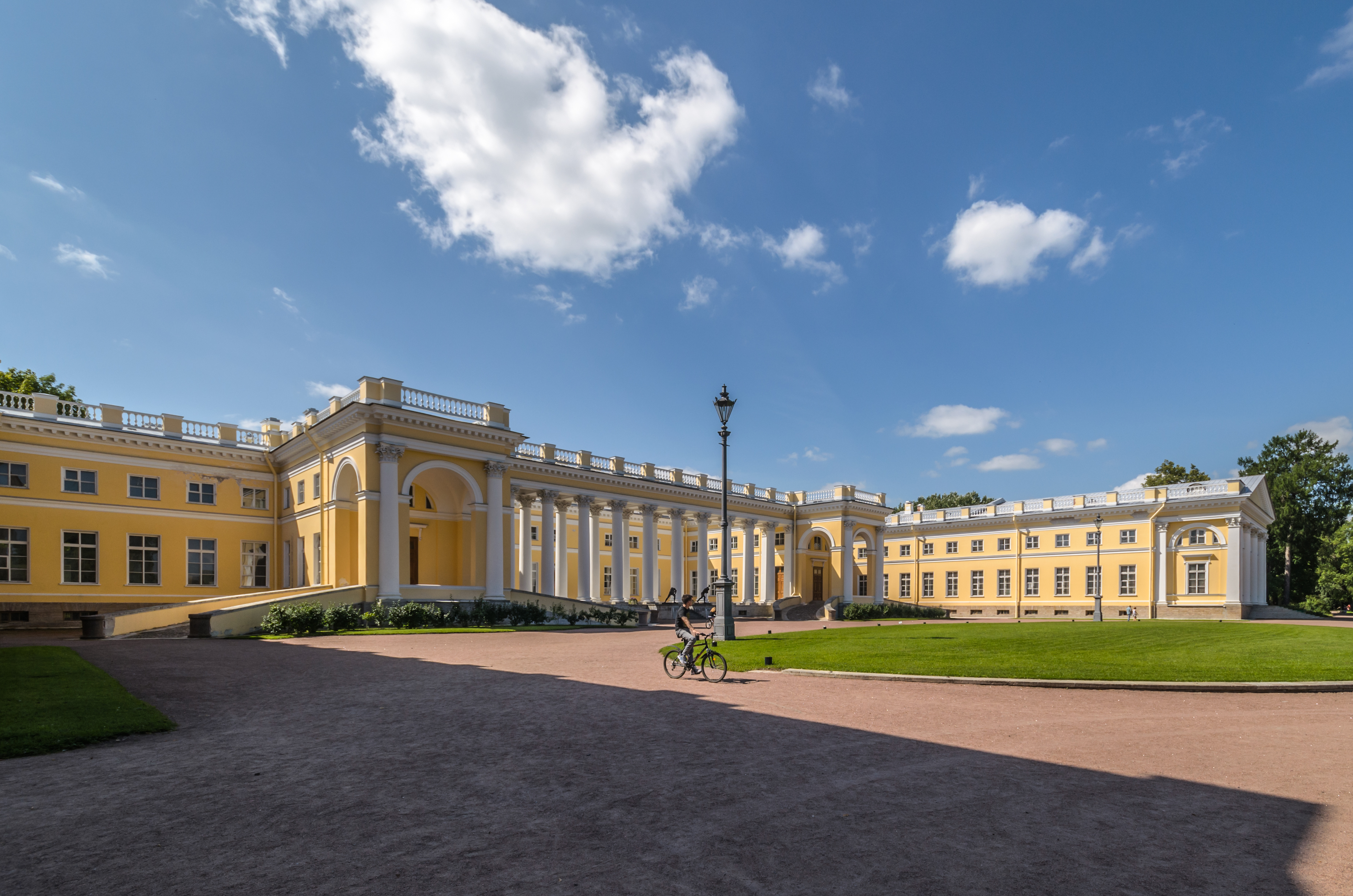
The Alexander Palace is a prominent Neoclassical structure located in the town of Pushkin, near Saint Petersburg. Commissioned by Empress Catherine the Great for her grandson, the future Tsar Alexander I, it was designed by architect Giacomo Quarenghi and completed in 1796. The palace is characterized by its restrained, elegant facade and its expansive park grounds, which were developed in both formal and landscape styles.
While it served as a secondary residence for the Romanov family throughout the 19th century, the palace is most historically significant as the primary home of Tsar Nicholas II and Empress Alexandra Feodorovna. The family lived here from 1905 until their departure for exile in 1917. Following extensive restoration efforts, the palace now functions as a museum, offering insight into the private lives of the last Russian imperial family.
Key Facts
- Materials
- Brick, Stucco, Stone
- Civilization
- Russian Empire
- Accessibility
- Wheelchair accessible in primary exhibition areas
- Date(s)
- 1792-1796
- Condition
- Restored and open as a museum
- Original Function
- Imperial residence
- Key Figures
- Catherine the Great, Alexander I, Nicholas II, Alexandra Feodorovna, Giacomo Quarenghi
Commission and Construction
1792-1796The palace was commissioned by Catherine the Great as a wedding gift for her grandson, Alexander Pavlovich. Giacomo Quarenghi, the court architect, designed the building in a strict Palladian style, emphasizing symmetry and classical proportions.
Imperial Residence
19th CenturyThroughout the 19th century, the palace served as a favored retreat for various members of the Romanov dynasty. It was frequently used for summer stays, away from the formal constraints of the Winter Palace in Saint Petersburg.
The Last Romanovs
1905-1917Following the 1905 Revolution, Tsar Nicholas II and his family moved to the Alexander Palace, making it their permanent residence. It was here that the family lived in relative seclusion until their arrest and subsequent exile following the February Revolution of 1917.
Soviet Era and Restoration
1918-PresentAfter the revolution, the palace was converted into a museum. During World War II, the building suffered significant damage during the German occupation. Extensive restoration projects, particularly in the 21st century, have focused on recreating the private apartments of Nicholas II and Alexandra.
Cultural Significance
The Alexander Palace holds deep cultural significance as the site of the final domestic life of the Russian monarchy. It represents the transition from the absolute power of the Tsars to the collapse of the imperial system. The preservation of the private rooms provides a unique, intimate perspective on the Romanov family that is distinct from the grand state rooms of other imperial palaces.
Interpretive Notes
Scholarly debates and areas of uncertainty
Debates among historians often center on the extent to which the palace's design reflected the personal political ideologies of Alexander I versus the aesthetic preferences of Catherine the Great. Additionally, there is ongoing discussion regarding the balance between preserving the palace as a Soviet-era historical site versus restoring it to its pre-1917 imperial state.
Visiting Information
Entry Rules
Open daily except Tuesdays. Tickets can be purchased at the entrance or via the official museum website. Visitors are required to wear shoe covers provided at the entrance to protect the historic flooring.
Best Times to Visit
Weekdays during the shoulder season (late spring or early autumn) to avoid large tour groups and enjoy the surrounding park.
Photography
Non-commercial photography is permitted without flash. Tripods and selfie sticks are prohibited inside the exhibition halls.
Preservation Notes
The palace is a protected cultural monument. Visitors must refrain from touching furniture, textiles, or wall coverings. Restoration is an ongoing process; some rooms may be closed periodically for maintenance.
Nearby POIs
11 shown- Ekaterina's Palace0.6 km
- Monument to the Heroic Defenders of Leningrad14.2 km
- Grand Maket Russia18.9 km
- Alexander Nevsky Lavra22.3 km
- Yusupov Palace23.8 km
- Faberge Museum24 km
- Cathedral of Our Lady of Kazan24.1 km
- Saint Isaac's Cathedral24.2 km
- Russian Museum of Ethnography24.4 km
- Mikhailovsky Palace24.5 km
- Bronze Horseman24.5 km
Sources & Further Reading
- [1]The Alexander Palace: A History — Robert K. Massie. Imperial Press (2000)
- [2]Giacomo Quarenghi: Architect to the Tsars — Dmitri Shvidkovsky. Yale University Press (2007)
Key Facts
- Materials
- Brick, Stucco, Stone
- Civilization
- Russian Empire
- Accessibility
- Wheelchair accessible in primary exhibition areas
- Date(s)
- 1792-1796
- Condition
- Restored and open as a museum
- Original Function
- Imperial residence
- Key Figures
- Catherine the Great, Alexander I, Nicholas II, Alexandra Feodorovna, Giacomo Quarenghi
Nearby POIs
11 shown- Ekaterina's Palace0.6 km
- Monument to the Heroic Defenders of Leningrad14.2 km
- Grand Maket Russia18.9 km
- Alexander Nevsky Lavra22.3 km
- Yusupov Palace23.8 km
- Faberge Museum24 km
- Cathedral of Our Lady of Kazan24.1 km
- Saint Isaac's Cathedral24.2 km
- Russian Museum of Ethnography24.4 km
- Mikhailovsky Palace24.5 km
- Bronze Horseman24.5 km