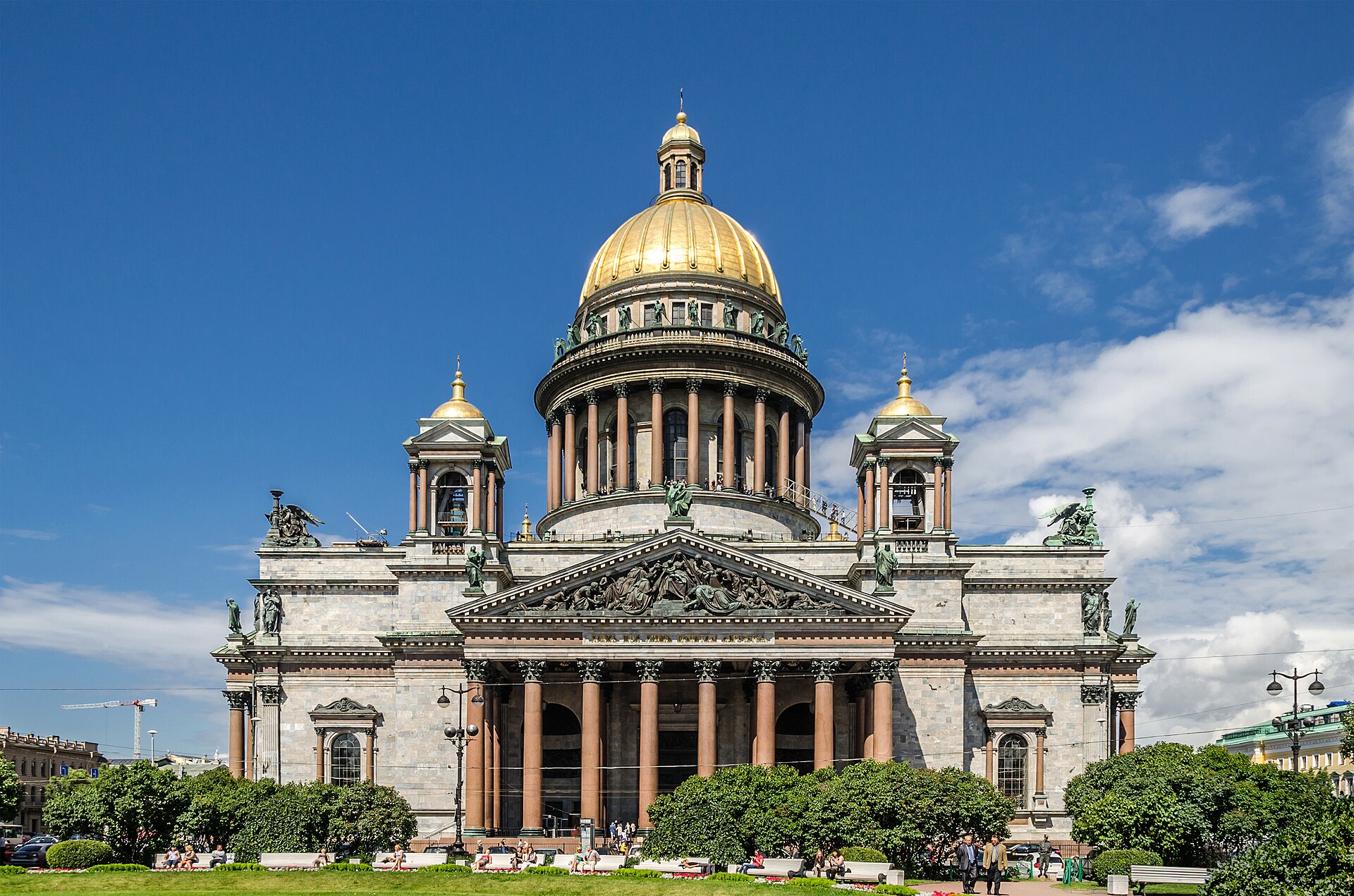
Saint Isaac's Cathedral is the largest Orthodox basilica in Saint Petersburg and one of the most significant architectural landmarks of the Russian Empire. Designed by French architect Auguste de Montferrand and constructed between 1818 and 1858, the cathedral features a massive gilded dome that dominates the city skyline. Its design synthesizes Neoclassical architecture with traditional Byzantine elements, reflecting the imperial grandeur of the 19th-century Russian state.
The structure is renowned for its elaborate interior, which utilizes extensive amounts of malachite, lapis lazuli, and various types of marble. Following the Russian Revolution, the cathedral was converted into a museum of atheism in 1931. Today, it functions as a state museum while also hosting regular religious services in its side chapel, serving as both a cultural monument and an active site of worship.
Key Facts
- Materials
- Granite, Marble, Malachite, Lapis Lazuli, Gold leaf
- Civilization
- Russian Empire
- Accessibility
- Limited; elevator access to the colonnade
- Date(s)
- 1818-1858
- Condition
- Well-preserved, functioning as a museum and church
- Original Function
- Cathedral
- Key Figures
- Auguste de Montferrand, Tsar Alexander I, Tsar Nicholas I
Early Foundations
1710-1800The first wooden church dedicated to Saint Isaac of Dalmatia was commissioned by Peter the Great. Several subsequent stone structures were built on the site, but each suffered from structural issues or fire damage, necessitating the grand design commissioned by Alexander I.
Imperial Construction
1818-1858Auguste de Montferrand was appointed to design the current cathedral. The construction process was a massive engineering undertaking, requiring the reinforcement of the marshy soil with thousands of wooden piles and the transport of massive monolithic granite columns from Finland.
Soviet Era Transformation
1931-1990Following the Bolshevik Revolution, the cathedral was secularized. In 1931, it was opened as the Museum of the History of Religion and Atheism, and a Foucault pendulum was installed in the dome to demonstrate the rotation of the Earth.
Modern Status
1990-PresentSince the fall of the Soviet Union, the cathedral has returned to a dual-purpose status. It remains a state-owned museum, but the side chapel has been consecrated for regular Orthodox liturgical services.
Cultural Significance
Saint Isaac's Cathedral stands as a symbol of the architectural ambition of the Romanov dynasty. Its construction marked the transition of Saint Petersburg into a European-style imperial capital. The cathedral is deeply embedded in the city's identity, serving as a focal point for both historical tourism and the revival of Orthodox religious life in post-Soviet Russia.
Interpretive Notes
Scholarly debates and areas of uncertainty
The primary scholarly debate concerns the management and ownership of the building. There is ongoing tension between the museum administration, which prioritizes the preservation of the structure as a secular cultural heritage site, and the Russian Orthodox Church, which advocates for the full return of the cathedral to religious use.
Visiting Information
Entry Rules
Open daily except Wednesdays. Tickets are required for entry to the museum and the colonnade. Modest dress is recommended for those entering the chapel area.
Best Times to Visit
Early morning or late afternoon to avoid large tour groups. The colonnade offers the best panoramic views of the city during sunset.
Photography
Personal photography is permitted without flash. Professional or commercial photography requires prior authorization from the museum administration.
Preservation Notes
The cathedral is subject to ongoing maintenance due to the city's high humidity and the delicate nature of the interior semi-precious stone inlays. Visitors are requested to remain within designated areas.
Nearby POIs
11 shownSources & Further Reading
- [1]Saint Isaac's Cathedral: The History and Architecture — Auguste de Montferrand. Imperial Academy of Arts (1845)
- [2]The Architecture of St. Petersburg — William Craft Brumfield. Cambridge University Press (1993)
Key Facts
- Materials
- Granite, Marble, Malachite, Lapis Lazuli, Gold leaf
- Civilization
- Russian Empire
- Accessibility
- Limited; elevator access to the colonnade
- Date(s)
- 1818-1858
- Condition
- Well-preserved, functioning as a museum and church
- Original Function
- Cathedral
- Key Figures
- Auguste de Montferrand, Tsar Alexander I, Tsar Nicholas I