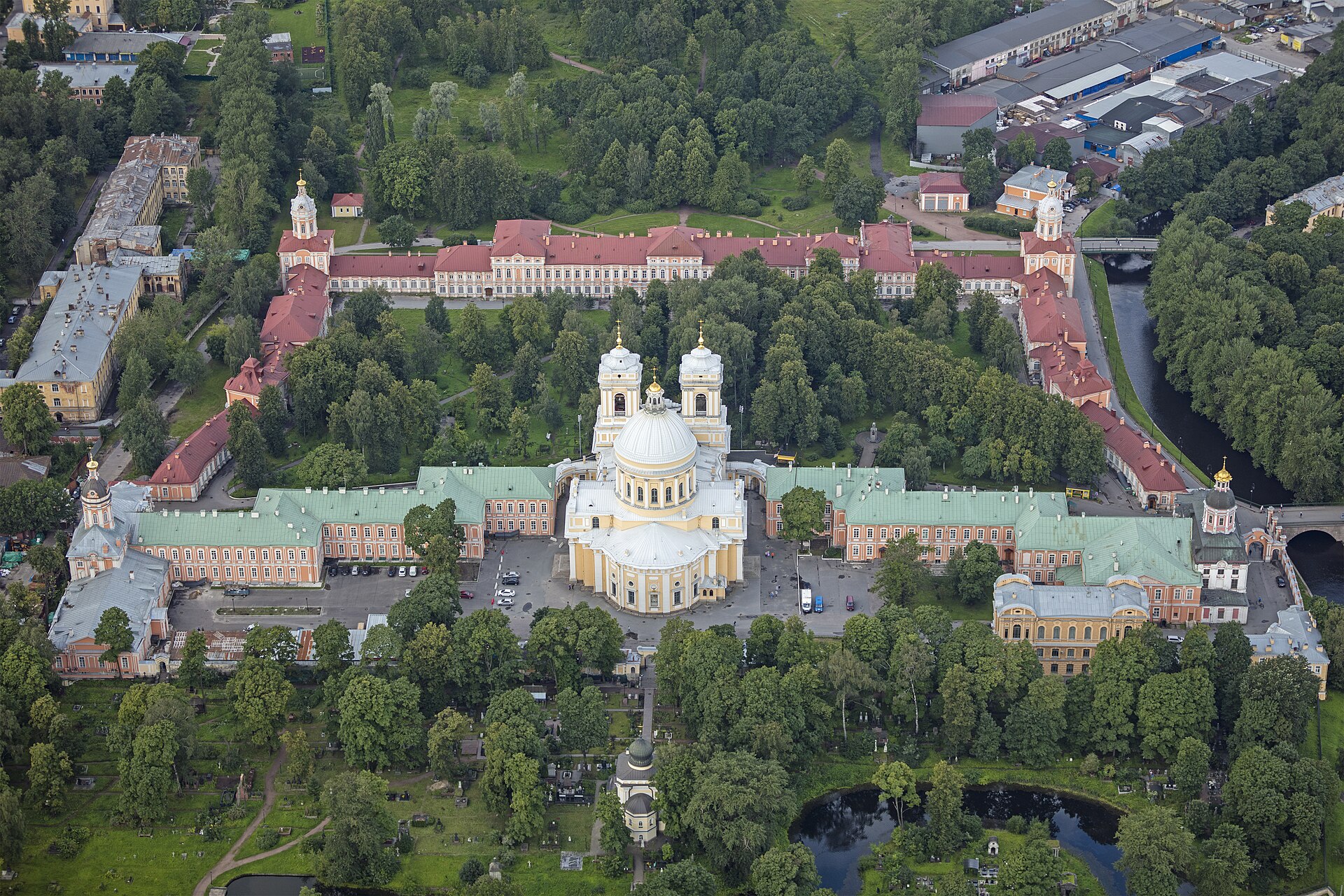
The Alexander Nevsky Lavra is a prominent monastery complex located at the eastern end of Nevsky Prospekt in Saint Petersburg. Founded by Peter the Great in 1710, it was intended to house the relics of Saint Alexander Nevsky, the 13th-century prince and defender of Russia, which were transferred here from Vladimir in 1724.
The site serves as a major center of Russian Orthodox spirituality and is renowned for its architectural ensemble, which blends early Petrine Baroque with later Neoclassical styles. Beyond its religious function, the Lavra is famous for its historic necropolises, which serve as the final resting place for many of Russia's most significant cultural figures, including composers, writers, and scientists.
Key Facts
- Materials
- Brick, Stucco, Granite, Limestone
- Civilization
- Russian Empire
- Accessibility
- Grounds are accessible; some church interiors have steps
- Date(s)
- 1710 - 1790
- Condition
- Active monastery and museum complex
- Original Function
- Monastery and burial site for the Russian nobility
- Key Figures
- Peter the Great, Pyotr Tchaikovsky, Fyodor Dostoevsky, Alexander Nevsky
Founding and Early Years
1710-1724Peter the Great ordered the construction of the monastery on the site where he believed the Battle of the Neva took place. The monastery was established to sanctify the new capital and provide a spiritual anchor for the city.
Imperial Expansion
18th-19th centuryDuring the reign of Empress Elizabeth, the Trinity Cathedral was constructed by architect Ivan Starov. The monastery gained the status of a 'Lavra' in 1797, the highest rank in the Russian Orthodox Church, and became a prestigious burial site for the Russian elite.
Soviet Era and Restoration
1917-1990Following the Russian Revolution, the monastery was closed and its assets were nationalized. Many of its buildings were repurposed for secular use, though the necropolises were preserved as state museums. Religious life was officially restored to the site in the late 1980s.
Cultural Significance
The Alexander Nevsky Lavra is a cornerstone of Russian national identity, bridging the gap between the medieval veneration of Saint Alexander Nevsky and the imperial grandeur of Saint Petersburg. It acts as a pantheon of Russian culture, where the proximity of religious life to the graves of national icons reflects the deep integration of faith and secular achievement in Russian history.
Interpretive Notes
Scholarly debates and areas of uncertainty
There is ongoing academic discussion regarding the exact location of the 1240 Battle of the Neva, with some historians questioning whether the monastery was built on the precise site of the historical conflict or merely in the general vicinity for symbolic purposes.
Visiting Information
Entry Rules
The monastery grounds are open to the public daily. Modest dress is required for entry into the churches, and women are expected to cover their heads. Photography is generally permitted in the grounds but restricted inside active places of worship.
Best Times to Visit
Early morning for a peaceful visit to the necropolises. Weekdays are significantly less crowded than weekends, particularly during the summer tourist season.
Photography
Personal photography is allowed in the gardens and cemeteries. Flash photography and tripods are prohibited inside the cathedral and church buildings.
Preservation Notes
Visitors are requested to remain on designated paths within the necropolises to protect historic tombstones. Please maintain a quiet demeanor as this is an active religious site.
Nearby POIs
11 shownSources & Further Reading
- [1]Saint Petersburg: A Cultural History — Solomon Volkov. Free Press (1997)
- [2]The Alexander Nevsky Monastery in the 18th Century — N. V. Sinitsyna. Russian Academy of Sciences (2005)
Key Facts
- Materials
- Brick, Stucco, Granite, Limestone
- Civilization
- Russian Empire
- Accessibility
- Grounds are accessible; some church interiors have steps
- Date(s)
- 1710 - 1790
- Condition
- Active monastery and museum complex
- Original Function
- Monastery and burial site for the Russian nobility
- Key Figures
- Peter the Great, Pyotr Tchaikovsky, Fyodor Dostoevsky, Alexander Nevsky