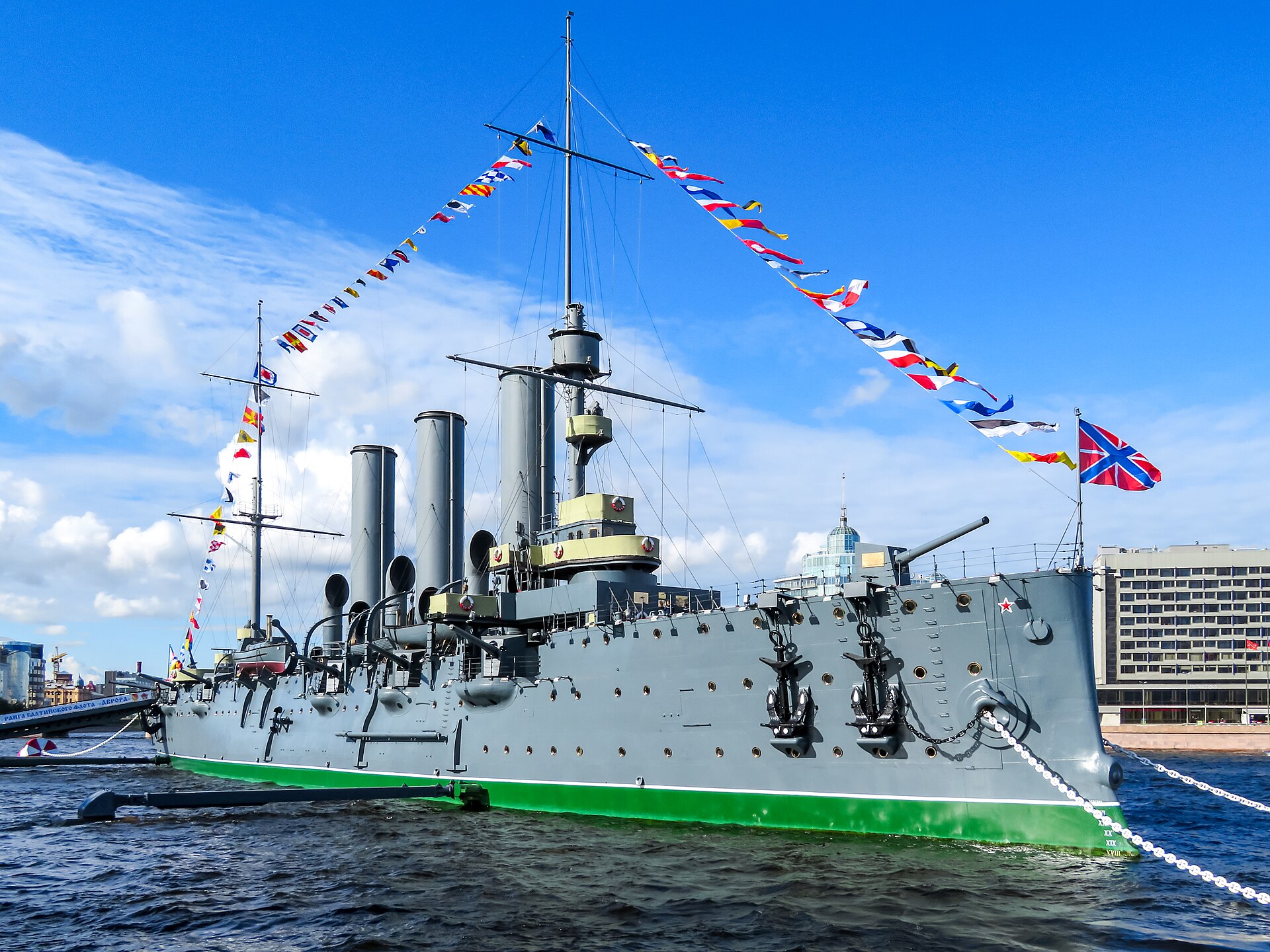
The Cruiser Aurora is a protected cruiser of the Imperial Russian Navy, famously associated with the 1917 October Revolution. Launched in 1900, the vessel participated in the Russo-Japanese War and World War I before becoming a symbol of the Bolshevik uprising. It is permanently moored on the Neva River in Saint Petersburg.
Since 1957, the ship has served as a museum ship. It remains a significant landmark of Soviet history, recognized for its role in signaling the start of the assault on the Winter Palace, which effectively marked the end of the Russian Provisional Government.
Key Facts
- Materials
- Steel, Iron
- Civilization
- Russian Empire
- Accessibility
- Limited due to narrow ship corridors and steep ladders
- Date(s)
- 1897-1903
- Condition
- Restored museum ship
- Original Function
- Protected cruiser
- Key Figures
- Nicholas II of Russia, Vladimir Lenin
Construction and Early Service
1897-1905Built at the New Admiralty Shipyard in Saint Petersburg, the Aurora was one of three Pallada-class cruisers. It saw combat during the Russo-Japanese War, notably surviving the Battle of Tsushima in 1905.
World War I and Revolution
1914-1917During World War I, the ship operated in the Baltic Sea. By 1917, the crew became radicalized by revolutionary sentiment. On October 25, 1917, the ship fired a blank shot from its forecastle gun, which served as the signal for the Red Guards to storm the Winter Palace.
Soviet Era and Museum Conversion
1922-1984After the Civil War, the ship was recommissioned as a training vessel. During World War II, its guns were removed for the defense of Leningrad. In 1957, it was permanently docked and converted into a branch of the Central Naval Museum.
Modern Preservation
1984-PresentThe ship underwent a major restoration in the 1980s and again in 2014-2016. It remains a popular tourist destination and a site of historical commemoration in Saint Petersburg.
Cultural Significance
The Aurora is a potent symbol of the October Revolution, representing the transition from the Russian Empire to the Soviet state. It is deeply embedded in Soviet-era iconography and remains a focal point for historical tourism in Saint Petersburg, representing the naval heritage of the Russian state.
Interpretive Notes
Scholarly debates and areas of uncertainty
There is ongoing historical discussion regarding the exact nature of the 'first shot' fired by the Aurora. While Soviet historiography emphasized the event as a decisive revolutionary act, some modern historians argue the impact was more symbolic than tactical, as the Winter Palace was already largely undefended.
Visiting Information
Entry Rules
Open Wednesday through Sunday. Tickets can be purchased at the pier. Security screening is mandatory for all visitors. Large bags are not permitted on board.
Best Times to Visit
Weekday mornings to avoid large tour groups. The ship is particularly significant during the anniversary of the October Revolution in late October.
Photography
Personal photography is permitted on deck and in public areas. Professional photography requires prior authorization from the museum administration.
Preservation Notes
The ship is a fragile historical artifact. Visitors must follow marked routes and refrain from touching technical equipment or historical displays.
Nearby POIs
11 shownSources & Further Reading
- [1]The Russian Cruiser Aurora — N. A. Kuznetsov. Naval Press (2005)
- [2]A History of the Russian Navy — Gregory P. Votyakov. St. Petersburg Historical Society (2012)
Key Facts
- Materials
- Steel, Iron
- Civilization
- Russian Empire
- Accessibility
- Limited due to narrow ship corridors and steep ladders
- Date(s)
- 1897-1903
- Condition
- Restored museum ship
- Original Function
- Protected cruiser
- Key Figures
- Nicholas II of Russia, Vladimir Lenin