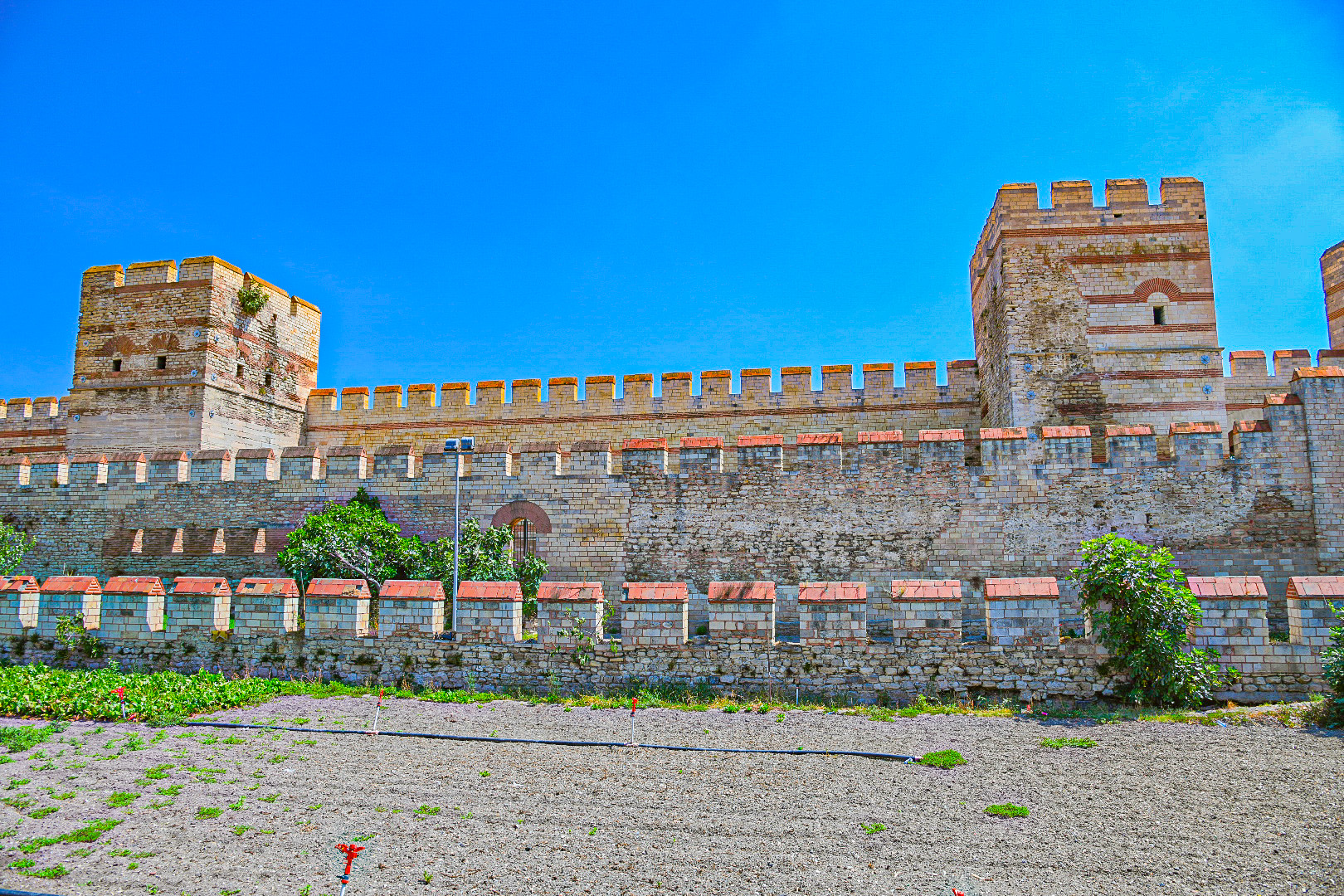
The Walls of Constantinople are a system of defensive fortifications that protected the city of Constantinople (modern-day Istanbul) for over a millennium. The most significant sections, known as the Theodosian Walls, were constructed in the 5th century during the reign of Emperor Theodosius II and consisted of a complex arrangement of triple defensive lines including a moat, outer wall, and massive inner wall. These fortifications played a central role in the city’s ability to withstand numerous sieges, contributing to the longevity of the Byzantine Empire. Although partially damaged during the Ottoman conquest in 1453, large portions of the walls remain standing today and are included within the UNESCO-listed Historic Areas of Istanbul, representing one of the most advanced military architectural systems of the medieval world.
Key Facts
- Materials
- Limestone, Brick
- Dimensions
- Approximately 6.5 km in length (land walls)
- Civilization
- Byzantine
- Date(s)
- 413–447 CE
- Condition
- Partially preserved
- Original Function
- City defensive fortifications
- Key Figures
- Emperor Theodosius II, Emperor Constantine I, Mehmed II
Early Fortifications
4th century CEThe first defensive walls of Constantinople were constructed under Emperor Constantine I when the city was established as the new capital of the Roman Empire. These earlier walls enclosed a smaller urban area and were later expanded as the city grew.
Theodosian Construction
413–447 CEUnder Emperor Theodosius II, a new and more extensive system of fortifications was built to the west of the original walls. This system included a moat, an outer wall, and a towering inner wall reinforced with regularly spaced towers. The walls were further strengthened after earthquake damage in 447 CE.
Byzantine Defense and Sieges
5th–15th centuriesThe walls successfully repelled numerous sieges by various forces, including the Avars, Arabs, and Bulgars. Their design and maintenance were critical to Constantinople’s survival as a major political and cultural center throughout the Byzantine period.
Ottoman Conquest
1453 CEThe walls were breached during the Ottoman siege led by Mehmed II in 1453, marking the fall of Constantinople. The use of large cannons played a decisive role in overcoming the fortifications, which had previously been considered nearly impregnable.
Modern Preservation
19th century–presentFollowing periods of neglect and urban development, restoration efforts have been undertaken to preserve sections of the walls. Today, they remain a prominent historical feature of Istanbul, with varying degrees of conservation across different segments.
Cultural Significance
The Walls of Constantinople were central to the identity and survival of the Byzantine capital, symbolizing both imperial strength and divine protection. Their repeated success in repelling invasions reinforced Constantinople’s reputation as an impregnable city and contributed to its role as a cultural and economic hub between Europe and Asia. In modern Istanbul, the walls serve as a physical reminder of the city’s layered past and are integrated into urban life. They are also a focal point for discussions about heritage preservation, urban development, and the interpretation of historical landscapes within a contemporary city.
Interpretive Notes
Scholarly debates and areas of uncertainty
Scholars continue to debate the exact effectiveness of different sections of the wall system during major sieges, particularly the extent to which structural weaknesses or human factors contributed to breaches. There is also ongoing research into the chronology of repairs and modifications made throughout the Byzantine period, as inscriptions and archaeological evidence sometimes present conflicting timelines.
Visiting Information
Entry Rules
Open daily. Freely accessible along most sections; some restored areas may have controlled entry points.
Best Times to Visit
Morning or late afternoon for easier walking conditions along exposed sections. Spring and autumn provide more comfortable temperatures.
Photography
Photography permitted. Drone use may be restricted in urban and protected heritage areas.
Preservation Notes
Visitors should use designated paths where available and avoid climbing unstable sections. Some areas are in active restoration and may be fenced off.
Nearby POIs
11 shownSources & Further Reading
- [1]The Theodosian Walls of Constantinople — Stephen Turnbull. Osprey Publishing (2004)
- [2]Constantinople: Capital of Byzantium — Jonathan Harris. Bloomsbury (2017)
- [3]
Key Facts
- Materials
- Limestone, Brick
- Dimensions
- Approximately 6.5 km in length (land walls)
- Civilization
- Byzantine
- Date(s)
- 413–447 CE
- Condition
- Partially preserved
- Original Function
- City defensive fortifications
- Key Figures
- Emperor Theodosius II, Emperor Constantine I, Mehmed II