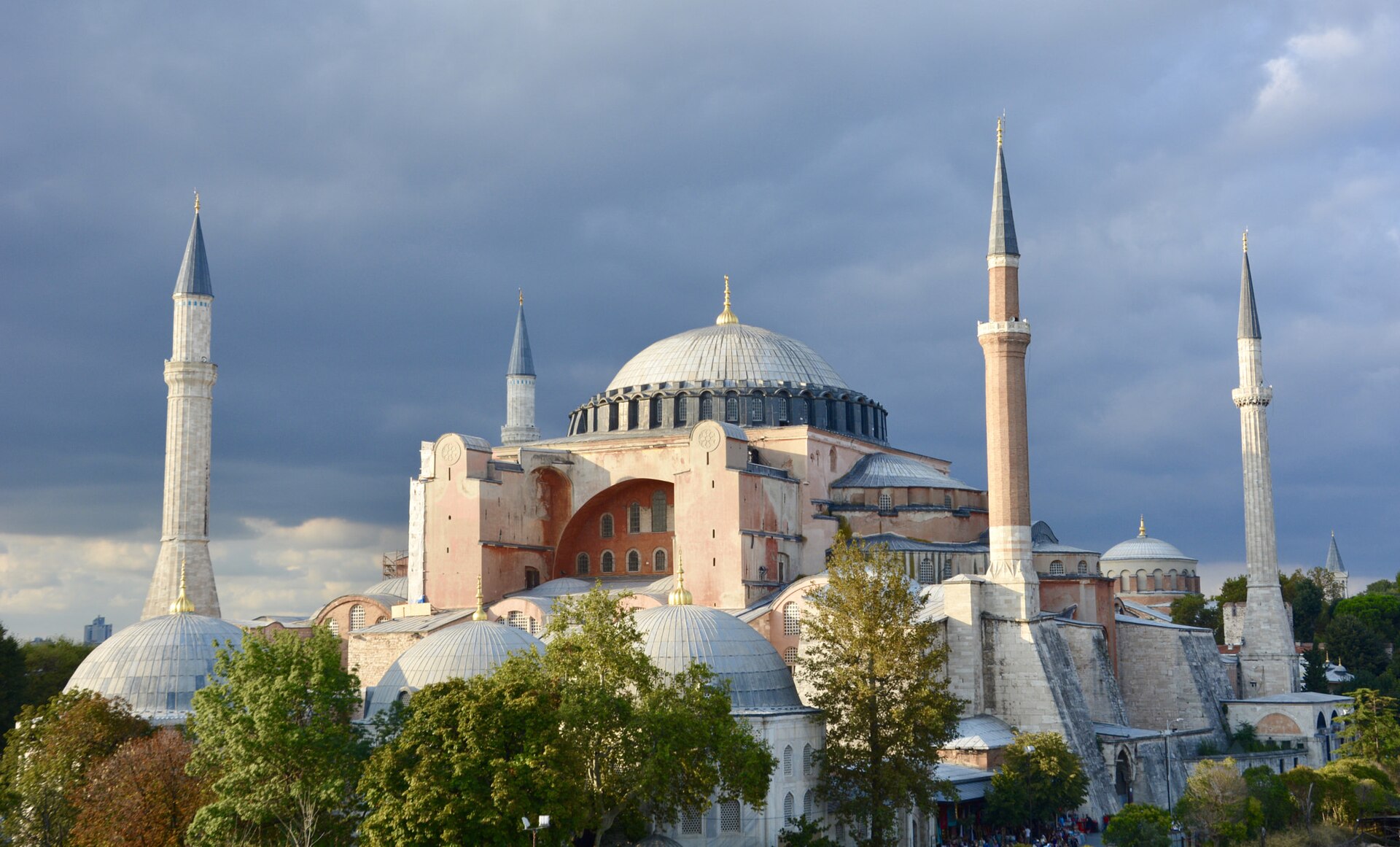
Constructed between 532 and 537 CE under Emperor Justinian I, Hagia Sophia served as the cathedral of Constantinople and the principal church of the Byzantine Empire for nearly a millennium. Designed by Anthemius of Tralles and Isidore of Miletus, the structure introduced a monumental domed basilica form that combined a vast central dome with semi-domes and exedrae, redefining large-scale sacred architecture in the Mediterranean world. Following the Ottoman conquest of Constantinople in 1453, the building was converted into a mosque, with minarets, a mihrab, and other Islamic architectural elements added. In 1935 it became a museum under the Turkish Republic, and in 2020 it was reconverted into an active mosque while remaining open to visitors. The structure reflects successive layers of Byzantine and Ottoman intervention, making it a central monument of both Christian and Islamic architectural history.
Key Facts
- Materials
- Brick, Marble, Stone, Mortar
- Civilization
- Byzantine (Eastern Roman)
- Accessibility
- Ground-level access; upper galleries reached by ramps; security screening required
- Dome Diameter
- Approx. 31 meters
- Date(s)
- 532–537 CE
- Condition
- Standing structure; active mosque with preserved Byzantine and Ottoman elements
- Original Function
- Imperial cathedral of Constantinople
- Key Figures
- Justinian I, Anthemius of Tralles, Isidore of Miletus, Mehmed II, Mustafa Kemal Ataturk
- Architectural Style
- Domed basilica
Earlier Churches on the Site
4th–5th centuries CETwo earlier churches dedicated to Holy Wisdom stood on the site before the present structure. The first, built during the reign of Constantius II, was destroyed during riots in 404 CE. A second basilica, constructed under Theodosius II, burned during the Nika Revolt in 532 CE.
Justinianic Construction
532–537 CEAfter the destruction of the previous church, Emperor Justinian I commissioned a new cathedral on an unprecedented scale. Anthemius of Tralles and Isidore of Miletus employed innovative engineering techniques, including pendentives to support the central dome. The building was inaugurated in 537 CE. Structural failures required partial rebuilding of the dome in 558 CE.
Byzantine Cathedral
6th–15th centuriesHagia Sophia functioned as the ceremonial and ecclesiastical center of the Byzantine Empire. It hosted imperial coronations, major liturgical events, and ecumenical councils. Mosaic programs depicting Christ, the Virgin Mary, emperors, and patriarchs were added and restored over centuries. The building suffered damage during earthquakes and the Fourth Crusade in 1204 but remained the principal cathedral until 1453.
Ottoman Mosque
1453–1935Following the conquest of Constantinople, Sultan Mehmed II ordered the conversion of the cathedral into a mosque. Minarets were erected, Christian liturgical furnishings were removed or plastered over, and Islamic elements such as a mihrab and minbar were installed. Ottoman architects, including Mimar Sinan, reinforced the structure and added buttresses to stabilize the dome.
Museum and Contemporary Status
1935–presentIn 1935 the building was secularized and reopened as a museum by decision of the Turkish Council of Ministers under Mustafa Kemal Ataturk. Conservation campaigns uncovered and restored Byzantine mosaics. In 2020 it was reconverted into a mosque, remaining open to both worshippers and visitors under new administrative arrangements.
Cultural Significance
As the principal cathedral of the Byzantine Empire, Hagia Sophia symbolized the union of imperial authority and Orthodox Christianity. Its scale and engineering were intended to manifest divine order and imperial legitimacy. The building became a model for later Byzantine churches and influenced Islamic mosque architecture after 1453. Under Ottoman rule, Hagia Sophia assumed new religious meaning while retaining its structural core. The coexistence of Byzantine mosaics and Ottoman calligraphic roundels illustrates successive layers of political and spiritual authority. Today it remains central to discussions of heritage, identity, and the management of multi-religious monuments in a modern nation-state.
Interpretive Notes
Scholarly debates and areas of uncertainty
Scholars continue to debate the original decorative scheme of the 6th-century interior, particularly the extent and iconography of early mosaic programs before the period of Iconoclasm. The structural behavior of the dome and the precise engineering calculations used by Anthemius and Isidore are also subjects of ongoing architectural analysis. The building’s modern status—museum versus mosque—has generated legal, political, and heritage debates concerning conservation standards, access, and the interpretation of shared religious history.
Visiting Information
Entry Rules
Open daily. As an active mosque, entry is free outside of prayer times. Visitors must pass security screening and follow posted guidelines. Modest dress required; head coverings provided for visitors if needed.
Best Times to Visit
Arrive early in the morning to avoid peak visitor congestion and to enter before midday prayer closures. Fridays experience higher attendance due to congregational prayer. Major Islamic holidays significantly increase local attendance.
Photography
Personal photography permitted without flash. Tripods and professional equipment require prior authorization. Photography during prayer times should be discreet and respectful.
Preservation Notes
Visitors must remove shoes before entering carpeted prayer areas. Remain within designated visitor zones during prayer times. Ongoing conservation and seismic monitoring work may restrict access to certain galleries.
Nearby POIs
11 shownSources & Further Reading
- [1]Hagia Sophia — Robert S. Nelson. Yale University Press (2004)
- [2]The Architecture of Hagia Sophia — Rowland J. Mainstone. Thames & Hudson (1988)
- [3]Byzantium: The Surprising Life of a Medieval Empire — Judith Herrin. Princeton University Press (2007)
Key Facts
- Materials
- Brick, Marble, Stone, Mortar
- Civilization
- Byzantine (Eastern Roman)
- Accessibility
- Ground-level access; upper galleries reached by ramps; security screening required
- Dome Diameter
- Approx. 31 meters
- Date(s)
- 532–537 CE
- Condition
- Standing structure; active mosque with preserved Byzantine and Ottoman elements
- Original Function
- Imperial cathedral of Constantinople
- Key Figures
- Justinian I, Anthemius of Tralles, Isidore of Miletus, Mehmed II, Mustafa Kemal Ataturk
- Architectural Style
- Domed basilica