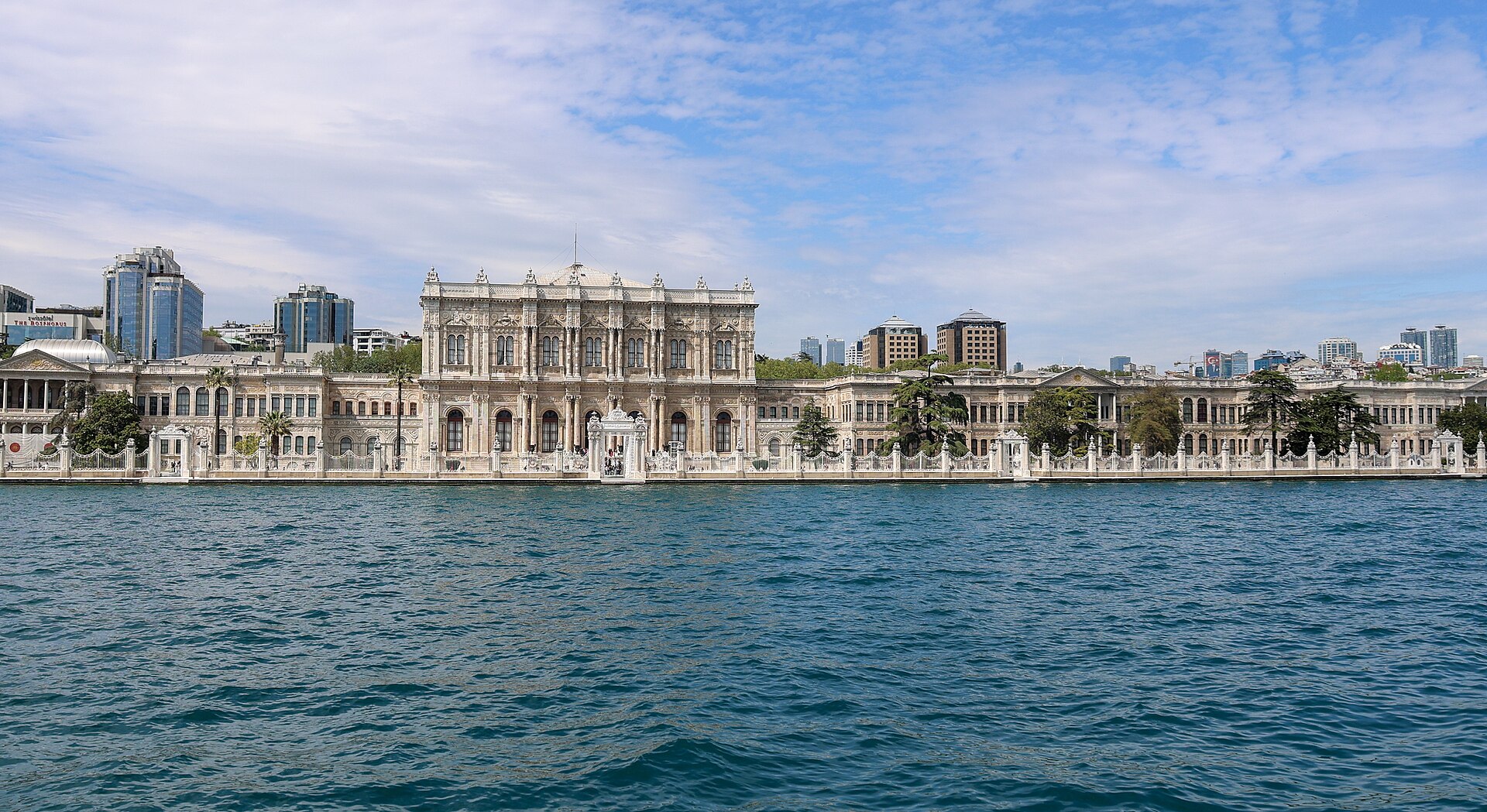
Dolmabahce Sarayi was constructed between 1843 and 1856 under Sultan Abdulmecid I as a new imperial residence on the European shore of the Bosporus. It replaced Topkapi Palace as the primary administrative and ceremonial center of the Ottoman court, reflecting the empire’s 19th-century reforms and engagement with European political and architectural models. The palace was designed by Armenian-Ottoman architects Garabet Balyan and Nigogayos Balyan. Unlike the courtyard-based layout of earlier Ottoman palaces, Dolmabahce adopts a more centralized and monumental plan influenced by Baroque, Rococo, and Neoclassical styles. The complex includes formal reception halls, private residential quarters (the Harem), and administrative spaces. After the establishment of the Turkish Republic, it served as a presidential residence and is closely associated with Mustafa Kemal Ataturk, who died there in 1938. Today it functions as a museum and state monument.
Key Facts
- Materials
- Stone, Marble, Crystal, Gold leaf, Timber
- Civilization
- Ottoman
- Accessibility
- Ground-level access in main sections; guided routes through interior halls; security screening required
- Notable Feature
- Ceremonial Hall with 36-meter-high dome and large crystal chandelier
- Date(s)
- 1843–1856 CE
- Condition
- Preserved palace complex; museum
- Original Function
- Imperial residence and administrative palace
- Key Figures
- Abdulmecid I, Garabet Balyan, Nigogayos Balyan, Mustafa Kemal Ataturk
- Architectural Style
- Baroque, Rococo, Neoclassical (Ottoman synthesis)
Imperial Reform and Construction
1843–1856Sultan Abdulmecid I commissioned Dolmabahce Sarayi during the Tanzimat reform era, a period of administrative modernization and diplomatic realignment with Europe. The palace’s architectural vocabulary reflects Western stylistic influence while retaining Ottoman spatial divisions between ceremonial and private quarters.
Administrative and Ceremonial Role
Mid-19th–early 20th centuriesDolmabahce became the primary residence of the sultans and the site of state receptions, diplomatic audiences, and official ceremonies. The Muayede Salonu (Ceremonial Hall) was used for major imperial gatherings and remains one of the largest palace halls of the period.
Late Ottoman Period
Late 19th–early 20th centuriesSuccessive sultans continued to reside at the palace until the end of the Ottoman Empire. The building witnessed political upheaval, including the empire’s final decades and World War I. Its administrative function declined as the imperial system weakened.
Republican Era and Modern Status
1923–presentAfter the founding of the Turkish Republic, Dolmabahce was used by Mustafa Kemal Ataturk as a presidential residence during visits to Istanbul. He died in the palace on 10 November 1938. The building was later converted into a museum and remains a site of national historical significance.
Cultural Significance
Dolmabahce Sarayi represents a decisive shift in Ottoman court culture toward European-influenced monumental architecture. Its scale, ornamentation, and waterfront placement projected imperial authority in a diplomatic environment increasingly shaped by European powers. The palace illustrates the material dimension of the Tanzimat reforms and the reconfiguration of Ottoman identity in the 19th century. In modern Turkey, the palace holds additional significance due to its association with Ataturk. The room where he died has become a focal point of national memory, and the palace functions both as a preserved imperial residence and as a site of republican commemoration.
Interpretive Notes
Scholarly debates and areas of uncertainty
Architectural historians debate the extent to which Dolmabahce represents a rupture versus a continuation of Ottoman architectural traditions. While stylistically European in many respects, its internal division between Selamlik (state quarters) and Harem reflects earlier courtly organization. Scholars also examine the financial burden of the palace’s construction, as its cost is often cited as emblematic of late Ottoman fiscal strain, though exact figures and long-term economic impact remain subject to analysis.
Visiting Information
Entry Rules
Open daily except designated closure days (commonly Mondays; verify seasonally). Entry is ticketed and typically requires participation in a timed or guided route through interior halls.
Best Times to Visit
Arrive early in the day to secure tickets, especially during summer months. Weekends and national holidays experience higher visitor volume.
Photography
Interior photography is generally restricted in state rooms and ceremonial halls. Exterior photography is permitted. Tripods and commercial filming require official permission.
Preservation Notes
Visitors must follow guided circulation routes through the palace interior. Do not touch gilded surfaces, textiles, or decorative elements. Some staircases and thresholds may be uneven.
Nearby POIs
11 shownSources & Further Reading
- [1]The Ottoman Empire and Early Modern Europe — Daniel Goffman. Cambridge University Press (2002)
- [2]The Ottoman House: Domestic Architecture in the 19th Century — Sibel Bozdogan. University of Washington Press (1987)
- [3]Architecture and the Late Ottoman State — Ahmet Ersoy. Ashgate (2015)
Key Facts
- Materials
- Stone, Marble, Crystal, Gold leaf, Timber
- Civilization
- Ottoman
- Accessibility
- Ground-level access in main sections; guided routes through interior halls; security screening required
- Notable Feature
- Ceremonial Hall with 36-meter-high dome and large crystal chandelier
- Date(s)
- 1843–1856 CE
- Condition
- Preserved palace complex; museum
- Original Function
- Imperial residence and administrative palace
- Key Figures
- Abdulmecid I, Garabet Balyan, Nigogayos Balyan, Mustafa Kemal Ataturk
- Architectural Style
- Baroque, Rococo, Neoclassical (Ottoman synthesis)