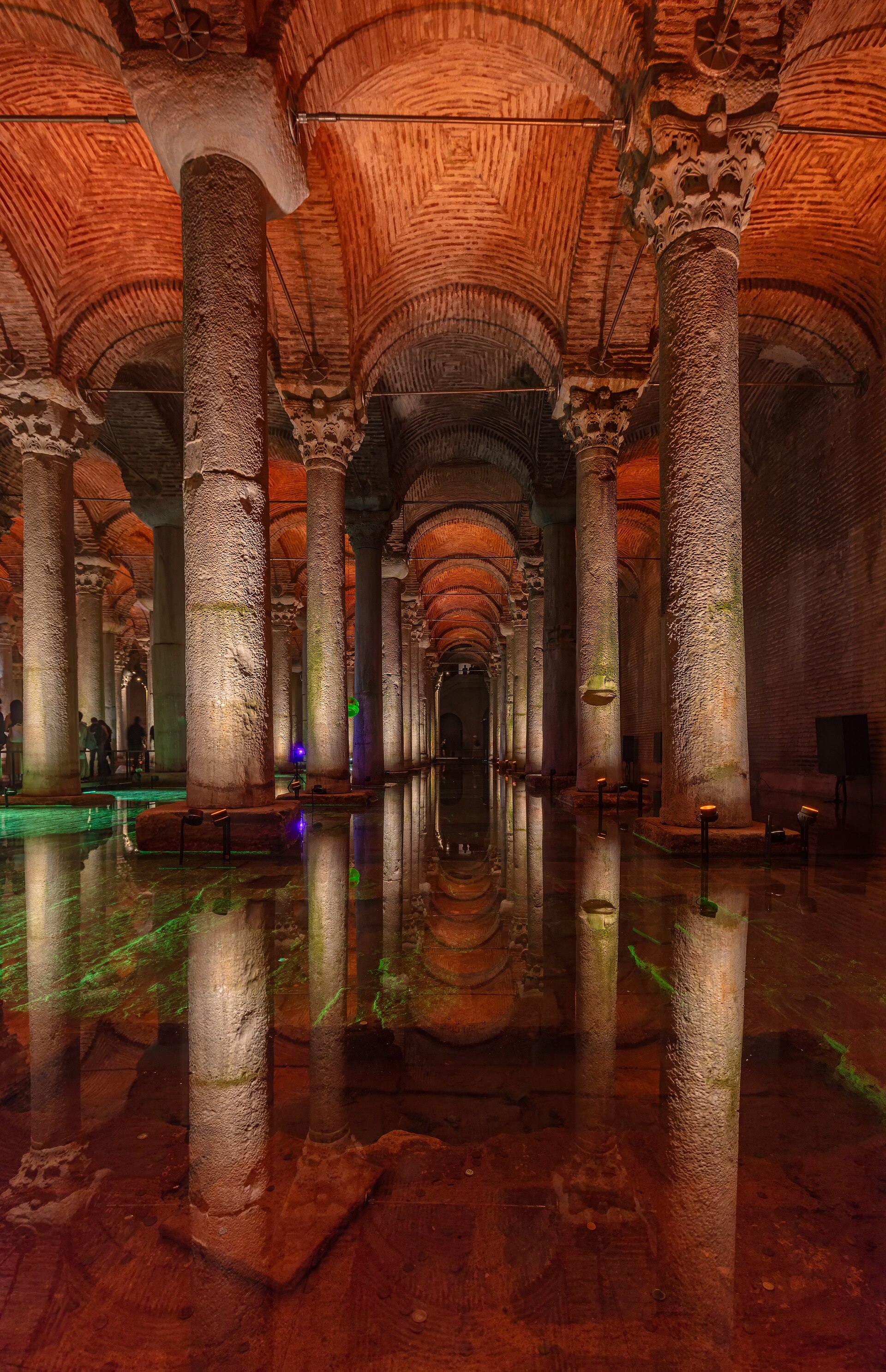
The Basilica Cistern is a large subterranean water reservoir constructed in the 6th century CE beneath the historic peninsula of Constantinople, present-day Istanbul. Commissioned during the reign of Emperor Justinian I (527–565 CE), it formed part of a vast urban water system that supplied the Great Palace and surrounding administrative and ceremonial buildings. The cistern was built using brick vaulting supported by rows of marble columns, many of which were spolia reused from earlier Roman structures. Measuring approximately 138 by 65 meters, the cistern could store an estimated 80,000 cubic meters of water delivered via aqueducts from Thrace. After the Ottoman conquest in 1453, it continued to provide water for nearby buildings before falling into relative obscurity. Rediscovered by European travelers in the 16th century, it was later restored and opened to the public. Today it functions as a conserved historic monument and exhibition space.
Key Facts
- Capacity
- Approx. 80,000 cubic meters
- Materials
- Brick, Marble columns, Mortar, Stone
- Dimensions
- Approx. 138m x 65m
- Civilization
- Byzantine (Eastern Roman)
- Accessibility
- Stair access at entrance; interior walkways with level paths
- Date(s)
- 532 CE
- Condition
- Restored and accessible subterranean structure
- Original Function
- Imperial water storage reservoir
- Key Figures
- Justinian I
Urban Water Infrastructure
4th–6th centuries CEConstantinople depended on an extensive network of aqueducts and reservoirs to supply water to its dense population and imperial institutions. Earlier cisterns existed in the area, but the Basilica Cistern represented a significant expansion of storage capacity during Justinian’s building program.
Justinianic Construction
532 CEThe cistern was constructed shortly after the Nika Revolt, during a broader campaign of rebuilding that included Hagia Sophia. Its vaulted ceiling rests on 336 marble columns arranged in 12 rows of 28 columns. Many columns were repurposed from earlier Roman temples and public buildings, resulting in varied capitals and shaft styles.
Byzantine Use
6th–15th centuriesThe reservoir supplied water to the Great Palace and nearby structures on the First Hill of Constantinople. The system relied on gravity-fed aqueducts bringing water from forests and springs west of the city. Maintenance of the cistern was essential to sustaining court life and ceremonial functions.
Ottoman Period and Rediscovery
15th–19th centuriesAfter 1453, the cistern continued limited use before gradually falling out of primary service. In 1545, the traveler Petrus Gyllius documented its existence after hearing reports of locals drawing water from wells in their basements. Subsequent surveys brought the structure to wider European attention.
Modern Conservation
20th century–presentThe cistern underwent cleaning and restoration campaigns in the 20th century, including structural reinforcement and the installation of visitor walkways. It now operates as a public monument and hosts occasional art installations while remaining part of Istanbul’s preserved Byzantine infrastructure.
Cultural Significance
The Basilica Cistern reflects the administrative sophistication of Constantinople and the central role of hydraulic engineering in sustaining an imperial capital. Its concealed position beneath the urban fabric illustrates how infrastructure operated largely out of sight while enabling palace life, religious ceremony, and public stability. The reuse of architectural elements from earlier pagan structures demonstrates both practical resource management and the layered material history of the city. Today the cistern serves as a tangible reminder of Byzantine urban planning and remains integrated into Istanbul’s broader narrative of continuity between Roman, Byzantine, and Ottoman periods.
Interpretive Notes
Scholarly debates and areas of uncertainty
The origin and symbolic meaning of the two Medusa head column bases remain debated. Some scholars argue they were placed arbitrarily as spolia, while others propose intentional positioning to neutralize apotropaic power through inversion. There is also discussion regarding the precise distribution network supplied by the cistern, as documentary evidence is limited and archaeological confirmation of connected palace structures remains incomplete.
Visiting Information
Entry Rules
Open daily. Timed entry may apply during peak tourist seasons. Tickets are purchased on-site or through the official municipal platform. Security screening at entrance.
Best Times to Visit
Early morning and late afternoon provide lower visitor density. Interior lighting installations can vary seasonally due to exhibitions, affecting visibility for photography and architectural study.
Photography
Personal photography permitted without flash. Tripods and professional equipment require authorization. Commercial filming requires permit approval from municipal authorities.
Preservation Notes
Interior surfaces are humid and may be slippery; follow marked walkways. Do not touch column bases or carved elements. Periodic restoration work may limit access to specific sections.
Nearby POIs
11 shownSources & Further Reading
- [1]Byzantine Water Supply Systems — James Crow, Jonathan Bardill, Richard Bayliss. Society for the Promotion of Roman Studies (2008)
- [2]Constantinople: Capital of Byzantium — Jonathan Harris. Hambledon Continuum (2007)
- [3]Engineering in the Ancient World — J. G. Landels. University of California Press (2000)
Key Facts
- Capacity
- Approx. 80,000 cubic meters
- Materials
- Brick, Marble columns, Mortar, Stone
- Dimensions
- Approx. 138m x 65m
- Civilization
- Byzantine (Eastern Roman)
- Accessibility
- Stair access at entrance; interior walkways with level paths
- Date(s)
- 532 CE
- Condition
- Restored and accessible subterranean structure
- Original Function
- Imperial water storage reservoir
- Key Figures
- Justinian I