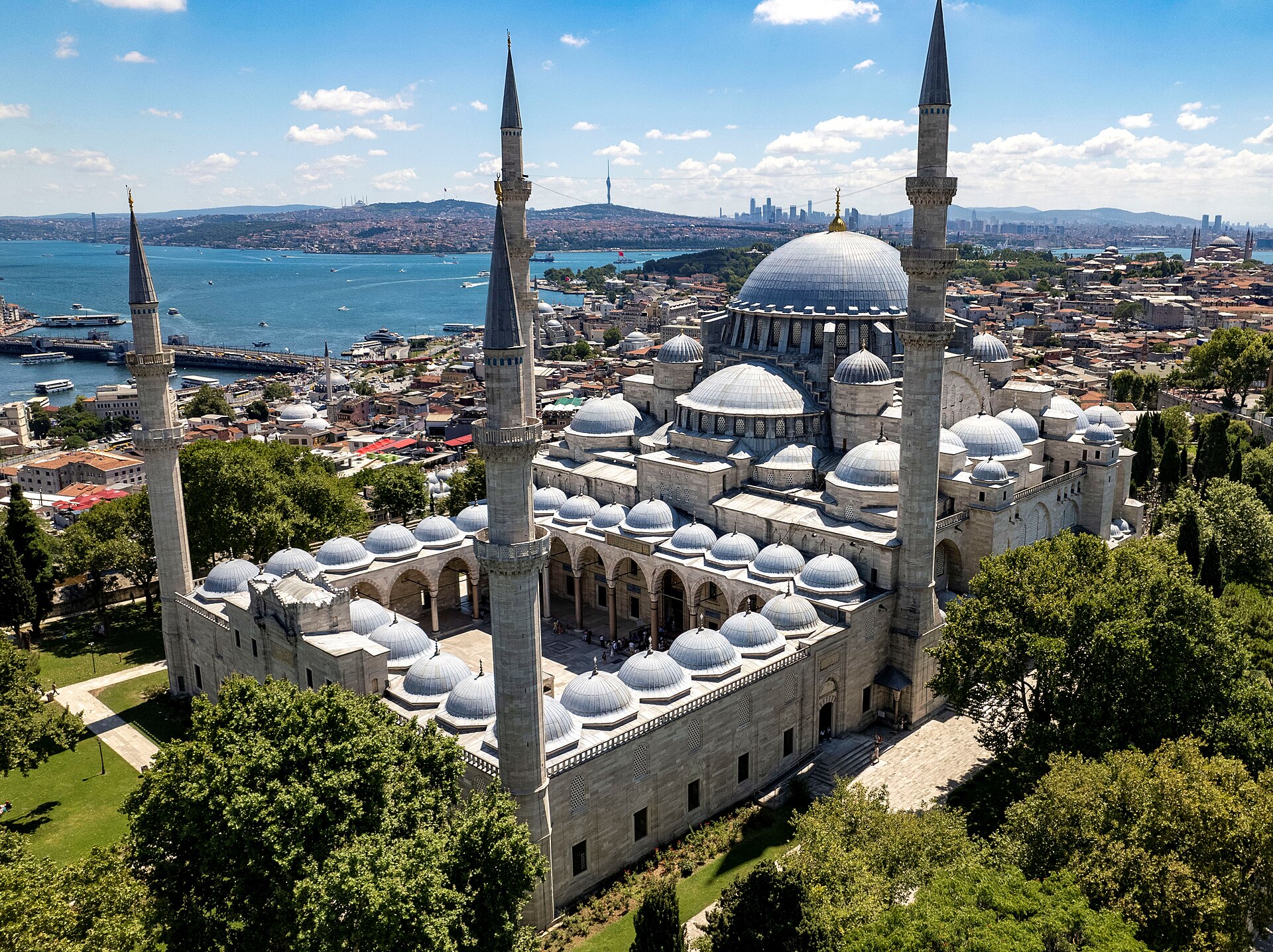
Suleymaniye Camii was constructed between 1550 and 1557 under the patronage of Sultan Suleiman I (Suleiman the Magnificent). Designed by the chief imperial architect Mimar Sinan, the mosque forms the centerpiece of a large külliye (imperial complex) on Istanbul’s Third Hill overlooking the Golden Horn. The complex originally included madrasas, a hospital, a soup kitchen, a bathhouse, and the mausoleums of Suleiman and Hürrem Sultan. The mosque represents the mature phase of classical Ottoman architecture. Its central dome, supported by semi-domes and buttressed walls, reflects Sinan’s structural experimentation and refinement following earlier imperial projects. The interior is characterized by controlled natural light, restrained tile decoration, and calligraphic programs integrated into the architectural framework. It remains an active mosque and a major landmark in Istanbul’s historic skyline.
Key Facts
- Materials
- Stone, Marble, Brick, Iznik tiles
- Civilization
- Ottoman
- Accessibility
- Ground-level entry; security screening required; modest dress enforced
- Date(s)
- 1550–1557 CE
- Condition
- Active mosque; preserved külliye complex
- Original Function
- Imperial congregational mosque
- Key Figures
- Suleiman I, Mimar Sinan, Hürrem Sultan
- Architectural Style
- Classical Ottoman
Imperial Patronage
1550–1557Commissioned at the height of Ottoman territorial expansion, the mosque symbolized the political and religious authority of Sultan Suleiman I. Its elevated position reinforced its visibility across the city and its association with imperial power.
Sinan’s Architectural Development
16th centuryMimar Sinan described the Suleymaniye as his "journeyman" work, marking a critical stage in his architectural career before the Selimiye Mosque in Edirne. The structure demonstrates refined dome engineering, integrated buttressing, and balanced proportions influenced in part by Hagia Sophia.
Külliye and Urban Role
16th–19th centuriesThe surrounding külliye supported educational, charitable, and medical institutions. Revenues from imperial endowments funded the complex, embedding the mosque within the broader Ottoman system of waqf-based social welfare.
Modern Conservation
20th century–presentThe mosque has undergone multiple restoration campaigns addressing structural stress, seismic reinforcement, and conservation of interior decoration. It continues to function as a congregational mosque while accommodating visitors.
Cultural Significance
Suleymaniye Camii embodies the consolidation of Ottoman imperial identity in the 16th century. Its architectural clarity and integration within a multifunctional complex illustrate how religious, educational, and charitable institutions were interlinked through imperial patronage. The mosque’s silhouette became a defining element of Istanbul’s urban landscape. The tombs of Suleiman I and Hürrem Sultan within the complex reinforce its dynastic significance. For contemporary Istanbul, the mosque remains both a living religious institution and a central reference point in discussions of Ottoman architectural achievement.
Interpretive Notes
Scholarly debates and areas of uncertainty
Scholars analyze the extent of Sinan’s engagement with Byzantine architectural precedents, particularly Hagia Sophia, in shaping the mosque’s dome structure. Debate also surrounds Sinan’s own categorization of the mosque within his career trajectory, as described in later autobiographical accounts. Conservation specialists continue to examine the long-term preservation of structural elements in a seismically active region.
Visiting Information
Entry Rules
Open daily outside prayer times. Entry is free. Visitors must remove shoes before entering prayer areas and observe modest dress requirements.
Best Times to Visit
Visit outside the five daily prayer times for uninterrupted access. Friday midday prayers significantly limit tourist entry. Early morning provides lower visitor density.
Photography
Personal photography permitted without flash. Tripods and professional filming require prior authorization. Photography during prayer should remain discreet.
Preservation Notes
Remove shoes before entering carpeted areas. Remain within designated visitor zones during worship. Some courtyard surfaces may be uneven.
Nearby POIs
11 shownSources & Further Reading
- [1]The Age of Sinan: Architectural Culture in the Ottoman Empire — Gülru Necipoglu. Princeton University Press (2005)
- [2]Sinan: Architect of Suleyman the Magnificent and the Ottoman Golden Age — John Freely. Thames & Hudson (1992)
- [3]Ottoman Architecture — Godfrey Goodwin. Thames & Hudson (1992)
Key Facts
- Materials
- Stone, Marble, Brick, Iznik tiles
- Civilization
- Ottoman
- Accessibility
- Ground-level entry; security screening required; modest dress enforced
- Date(s)
- 1550–1557 CE
- Condition
- Active mosque; preserved külliye complex
- Original Function
- Imperial congregational mosque
- Key Figures
- Suleiman I, Mimar Sinan, Hürrem Sultan
- Architectural Style
- Classical Ottoman