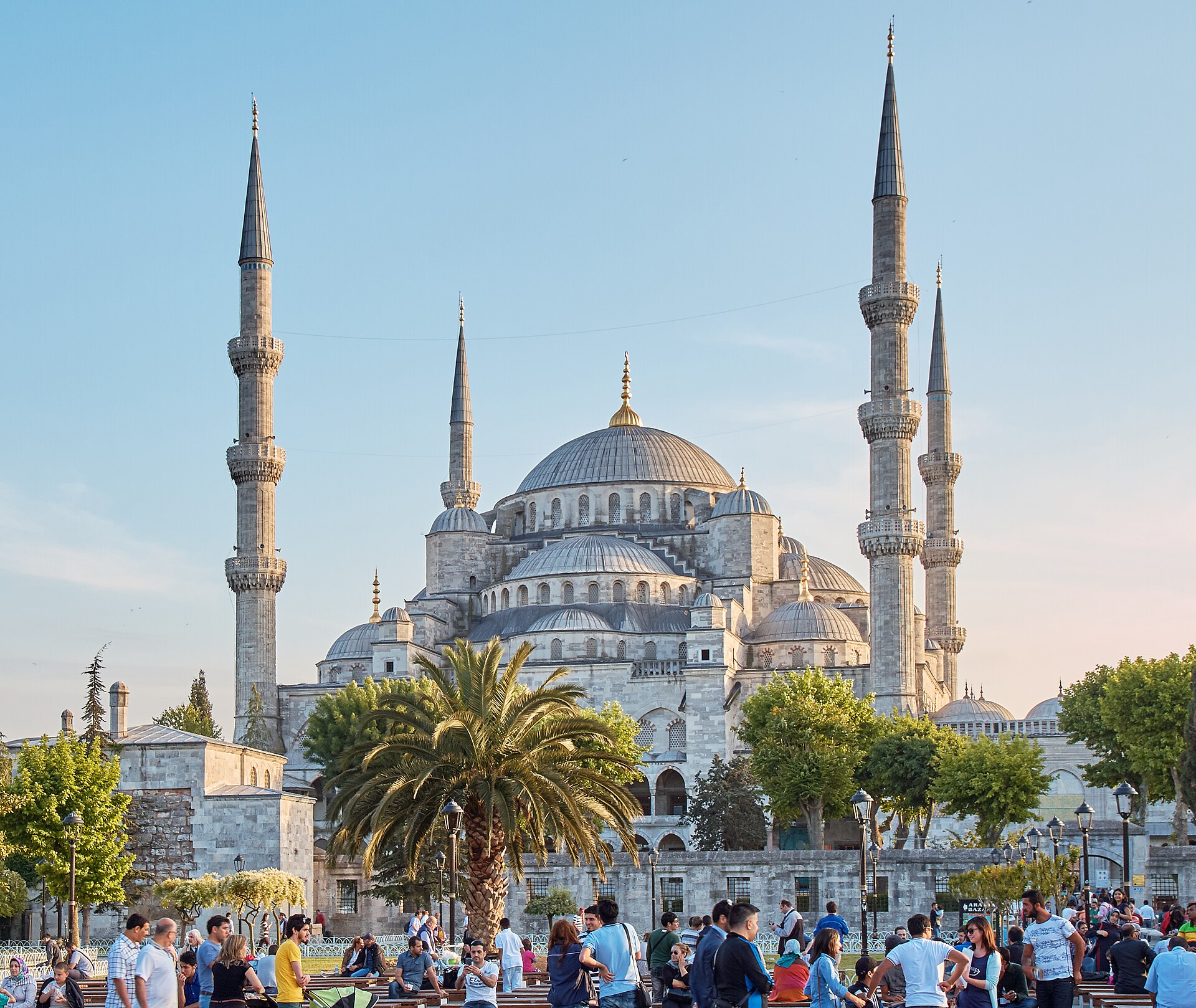
The Sultan Ahmed Mosque was constructed between 1609 and 1616 during the reign of Sultan Ahmed I and remains one of the principal imperial mosques of Istanbul. Designed by the architect Sedefkar Mehmed Agha, a pupil of Mimar Sinan, the mosque forms part of a külliye (imperial complex) that originally included a madrasa, hospice, market structures, and the sultan’s tomb. Its cascading domes and semi-domes extend the classical Ottoman mosque tradition developed in the 16th century. The mosque is widely known for the extensive use of İznik ceramic tiles that line its interior walls, giving rise to the popular name “Blue Mosque.” It was built opposite Hagia Sophia in the historic peninsula, reinforcing the symbolic continuity of imperial authority in the former Byzantine capital. The structure remains an active mosque and major site of worship while accommodating large numbers of visitors.
Key Facts
- Materials
- Stone, Marble, Brick, Iznik tiles
- Civilization
- Ottoman
- Accessibility
- Ground-level entry; security screening required; modest dress enforced
- Date(s)
- 1609–1616 CE
- Condition
- Active mosque; restored and maintained
- Original Function
- Imperial congregational mosque
- Key Figures
- Sultan Ahmed I, Sedefkar Mehmed Agha
- Architectural Style
- Classical Ottoman
Imperial Context
Early 17th centurySultan Ahmed I commissioned the mosque during a period of political and military challenge for the Ottoman Empire. Unlike earlier imperial mosques financed by war spoils, this project was funded from the imperial treasury, which generated criticism at the time. Its prominent placement opposite Hagia Sophia asserted Ottoman sovereignty over the former Byzantine capital.
Construction and Design
1609–1616Architect Sedefkar Mehmed Agha designed the mosque using a central dome flanked by semi-domes, drawing from the architectural vocabulary established by Mimar Sinan. The interior features more than 20,000 handmade İznik tiles with floral and geometric motifs. The six minarets were unusual for an imperial mosque and reportedly prompted controversy due to their parity with the mosque in Mecca at the time.
Religious and Civic Complex
17th–19th centuriesThe mosque formed the center of a külliye that included a madrasa, soup kitchen, market stalls, and the mausoleum of Sultan Ahmed I. These institutions integrated religious worship with social welfare and education, reinforcing the mosque’s civic role within Ottoman urban life.
Modern Restoration and Use
20th century–presentThe mosque has undergone multiple restoration campaigns addressing structural stress, tile conservation, and seismic reinforcement. It remains an active place of worship, particularly during Friday prayers and Ramadan, while functioning as one of Istanbul’s most visited historic monuments.
Cultural Significance
The Sultan Ahmed Mosque represents the continuation and culmination of the classical Ottoman architectural tradition. Its scale, dome hierarchy, and integrated complex reflect the fusion of religious devotion and imperial authority. Positioned within the historic core of Istanbul, it forms part of a monumental urban ensemble that includes Hagia Sophia and the former Hippodrome. For contemporary Istanbul, the mosque remains a functioning religious institution and a symbol of Ottoman heritage. Its ongoing use reinforces the continuity of Islamic worship in the city while its preserved fabric offers insight into early 17th-century artistic production, particularly the İznik ceramic industry.
Interpretive Notes
Scholarly debates and areas of uncertainty
Scholars debate the political motivations behind the construction, particularly the decision to fund the mosque from the treasury rather than war revenues, which departed from established imperial precedent. The symbolic implications of its six minarets have also been discussed, including whether contemporary objections influenced later additions to the mosque in Mecca. Conservation specialists continue to examine the long-term preservation of İznik tiles, as fluctuations in humidity, visitor volume, and seismic activity pose ongoing challenges.
Visiting Information
Entry Rules
Open daily outside prayer times. Entry is free. Visitors must remove shoes before entering prayer areas. Modest dress required; headscarves provided at entrance if needed.
Best Times to Visit
Visit outside of the five daily prayer times for uninterrupted access. Friday midday prayers significantly limit tourist entry. Ramadan evenings increase local attendance.
Photography
Personal photography permitted without flash. Tripods and commercial filming require prior authorization. Photography during prayer should be discreet.
Preservation Notes
Remove shoes before stepping onto carpeted areas. Remain within designated visitor zones during active worship. Ongoing restoration work may temporarily restrict access to certain sections.
Nearby POIs
11 shownSources & Further Reading
- [1]The Blue Mosque — Gülru Necipoğlu. Muqarnas (1985)
- [2]The Age of Sinan: Architectural Culture in the Ottoman Empire — Gülru Necipoğlu. Princeton University Press (2005)
- [3]Ottoman Architecture — Godfrey Goodwin. Thames & Hudson (1992)
Key Facts
- Materials
- Stone, Marble, Brick, Iznik tiles
- Civilization
- Ottoman
- Accessibility
- Ground-level entry; security screening required; modest dress enforced
- Date(s)
- 1609–1616 CE
- Condition
- Active mosque; restored and maintained
- Original Function
- Imperial congregational mosque
- Key Figures
- Sultan Ahmed I, Sedefkar Mehmed Agha
- Architectural Style
- Classical Ottoman