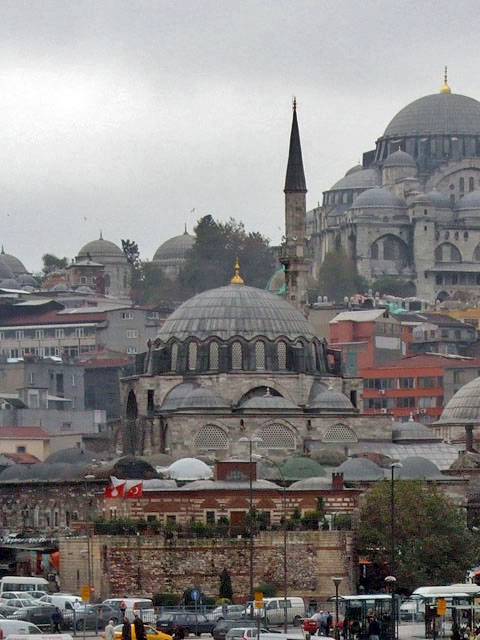
Rüstem Paşa Camii is a 16th-century Ottoman mosque located in the Tahtakale district near the Spice Bazaar in Istanbul. It was commissioned by Grand Vizier Rüstem Paşa, the son-in-law of Sultan Süleyman I, and completed in 1563. The mosque was designed by the chief imperial architect Mimar Sinan during the height of the Ottoman classical architectural period. Built on a raised platform above a commercial complex, the mosque occupies an elevated position within a dense market area. It is particularly noted for its extensive use of İznik tile panels, which cover interior walls, piers, and the mihrab area with floral and geometric designs. The combination of architectural proportion and ceramic ornamentation makes it a significant example of 16th-century Ottoman religious architecture.
Key Facts
- Materials
- Stone, Brick, Iznik tiles, Marble
- Civilization
- Ottoman
- Accessibility
- Access via staircases from street level; shoe removal required; modest dress required
- Notable Feature
- Extensive 16th-century İznik tile decoration
- Date(s)
- 1561–1563 CE
- Condition
- Active mosque; preserved
- Original Function
- Imperial mosque
- Key Figures
- Rüstem Paşa, Mimar Sinan, Süleyman I
- Architectural Style
- Classical Ottoman
Commission and Construction
1561–1563Rüstem Paşa commissioned the mosque as part of a charitable endowment complex. Mimar Sinan designed the structure with a central dome supported by semi-domes and piers, adapting the plan to the constrained urban site.
Tile Production and Decoration
16th centuryThe mosque’s interior was adorned with high-quality İznik tiles featuring floral motifs such as tulips, carnations, and saz leaves. These tiles represent the technical and artistic peak of Ottoman ceramic production.
Later Maintenance and Restoration
19th–21st centuriesThe mosque underwent periodic repairs due to environmental exposure and urban density. Conservation campaigns have focused on stabilizing tile panels and preserving structural integrity.
Cultural Significance
Rüstem Paşa Camii reflects the integration of religious, commercial, and urban functions in Ottoman Istanbul. Its elevated placement above shops demonstrates the economic foundations of charitable endowments (waqf) that financed religious institutions. The mosque is especially significant for its tile program, which illustrates the artistic sophistication of İznik workshops during the reign of Süleyman I. It remains an active place of worship within a historically commercial district.
Interpretive Notes
Scholarly debates and areas of uncertainty
Rüstem Paşa Camii reflects the integration of religious, commercial, and urban functions in Ottoman Istanbul. Its elevated placement above shops demonstrates the economic foundations of charitable endowments (waqf) that financed religious institutions. The mosque is especially significant for its tile program, which illustrates the artistic sophistication of İznik workshops during the reign of Süleyman I. It remains an active place of worship within a historically commercial district.
Visiting Information
Entry Rules
Open daily for worship. Visitors are welcome outside prayer times. Entry is free.
Best Times to Visit
Non-prayer hours, especially early morning, provide quieter viewing conditions. Fridays at midday are busiest.
Photography
Photography without flash is generally permitted outside prayer times. Tripods are not allowed.
Preservation Notes
Modest dress is required. Shoes must be removed before entering the prayer hall. Maintain silence during prayers.
Nearby POIs
11 shownSources & Further Reading
- [1]Sinan: The Architect and His Works — Gülru Necipoğlu. Reaktion Books (2005)
- [2]Iznik: The Pottery of Ottoman Turkey — Julian Raby. Alexandria Press (1989)
- [3]The Age of Sinan: Architectural Culture in the Ottoman Empire — Gülru Necipoğlu. Princeton University Press (2005)
Key Facts
- Materials
- Stone, Brick, Iznik tiles, Marble
- Civilization
- Ottoman
- Accessibility
- Access via staircases from street level; shoe removal required; modest dress required
- Notable Feature
- Extensive 16th-century İznik tile decoration
- Date(s)
- 1561–1563 CE
- Condition
- Active mosque; preserved
- Original Function
- Imperial mosque
- Key Figures
- Rüstem Paşa, Mimar Sinan, Süleyman I
- Architectural Style
- Classical Ottoman