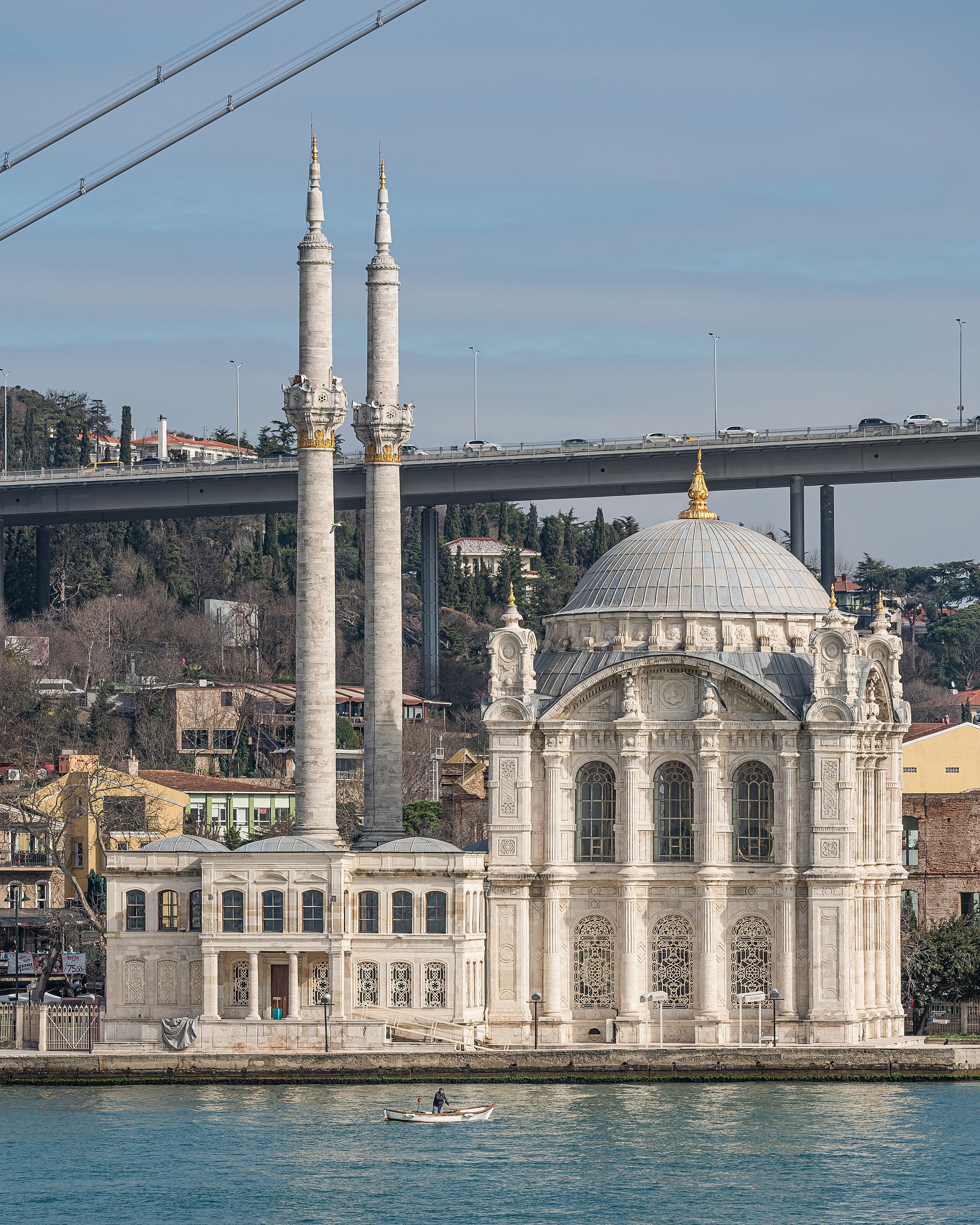
Ortaköy Camii, officially known as Büyük Mecidiye Camii, is a 19th-century Ottoman mosque located on the European shore of the Bosporus in the Ortaköy district of Istanbul. It was commissioned by Sultan Abdülmecid I and completed in 1854, during a period of architectural westernization within the Ottoman Empire. Designed by the Armenian Ottoman architects Garabet Amira Balyan and Nigoğayos Balyan, the mosque reflects a synthesis of Ottoman religious architecture with Baroque and Neoclassical elements. Its prominent waterfront setting and large windows allow natural light to illuminate the interior, emphasizing decorative stucco work and calligraphic panels.
Key Facts
- Materials
- Stone, Marble, Stucco
- Civilization
- Ottoman
- Accessibility
- Ground-level access; prayer hall requires shoe removal; modest dress required
- Notable Feature
- Waterfront location directly on the Bosporus
- Date(s)
- 1853–1854 CE
- Condition
- Active mosque; restored
- Original Function
- Imperial mosque
- Key Figures
- Abdülmecid I, Garabet Amira Balyan, Nigoğayos Balyan
- Architectural Style
- Ottoman Baroque
Imperial Commission
Mid-19th centuryThe mosque was commissioned by Sultan Abdülmecid I as part of broader modernization efforts in the Ottoman capital. Its construction coincided with the Tanzimat reforms, which introduced administrative and architectural changes influenced by European models.
Architectural Context
19th centuryDesigned by members of the Balyan family, the mosque incorporates Baroque ornamentation, curved forms, and expansive windows uncommon in earlier Ottoman mosques. The structure includes a single dome supported by large windows and twin minarets flanking the façade.
Restoration and Preservation
20th–21st centuriesDue to its waterfront exposure, the mosque has undergone multiple restoration campaigns addressing structural stability and environmental wear. Conservation efforts have aimed to preserve its decorative elements and structural integrity.
Cultural Significance
Ortaköy Camii represents the 19th-century transformation of Ottoman architectural identity under European influence. Its Baroque stylistic vocabulary reflects a period in which imperial patronage embraced eclectic design while maintaining Islamic liturgical functions. The mosque’s highly visible waterfront position has made it a visual emblem of the Bosporus skyline and a focal point of the Ortaköy neighborhood’s historical identity.
Interpretive Notes
Scholarly debates and areas of uncertainty
Scholars discuss the mosque within the broader context of Ottoman westernization and the role of the Balyan family in redefining imperial architectural language. Debate centers on how European stylistic elements were adapted to Islamic religious architecture without altering core liturgical requirements. Architectural historians also examine structural challenges posed by its shoreline foundations and subsequent restoration methodologies.
Visiting Information
Entry Rules
Open daily for worship. Visitors are welcome outside prayer times. Entry is free.
Best Times to Visit
Non-prayer hours, particularly early morning, provide quieter conditions. Fridays at midday are busiest due to congregational prayers.
Photography
Photography without flash is generally permitted outside prayer times. Tripods and commercial filming require permission.
Preservation Notes
Modest dress is required. Shoes must be removed before entering the prayer hall. Maintain silence during worship.
Nearby POIs
11 shownSources & Further Reading
- [1]The Ottoman Empire and Early Modern Europe — Daniel Goffman. Cambridge University Press (2002)
- [2]Architecture and Power in the Ottoman Empire — Gülru Necipoğlu. Cambridge University Press (1991)
- [3]The Balyan Family and Ottoman Architecture — Pars Tuğlacı. Istanbul Research Institute (1993)
Key Facts
- Materials
- Stone, Marble, Stucco
- Civilization
- Ottoman
- Accessibility
- Ground-level access; prayer hall requires shoe removal; modest dress required
- Notable Feature
- Waterfront location directly on the Bosporus
- Date(s)
- 1853–1854 CE
- Condition
- Active mosque; restored
- Original Function
- Imperial mosque
- Key Figures
- Abdülmecid I, Garabet Amira Balyan, Nigoğayos Balyan
- Architectural Style
- Ottoman Baroque