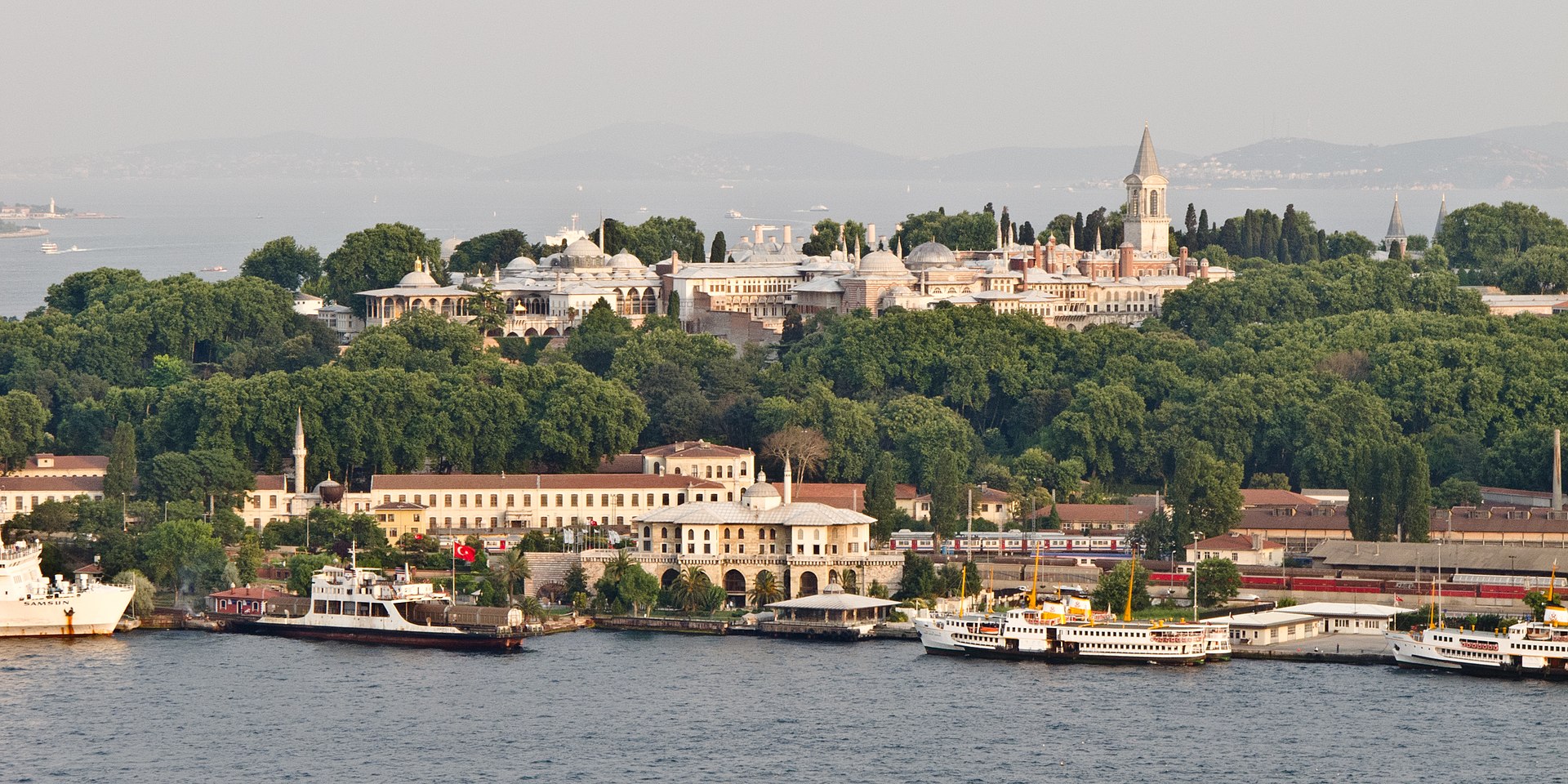
Topkapi Palace was constructed shortly after the Ottoman conquest of Constantinople and served as the primary imperial residence and administrative center of the Ottoman sultans from the late 15th century until the mid-19th century. Commissioned by Sultan Mehmed II beginning in 1459, the complex was built on the promontory overlooking the Bosporus, the Golden Horn, and the Sea of Marmara, occupying part of the former Byzantine acropolis. Rather than a single monumental structure, the palace developed as a series of courtyards, pavilions, administrative halls, and residential quarters enclosed within fortified walls. It functioned simultaneously as royal residence, seat of government, ceremonial court, and treasury. After the Ottoman court moved to Dolmabahce Palace in the 19th century, Topkapi gradually transitioned into a museum and today preserves imperial collections, religious relics, and architectural elements spanning four centuries of Ottoman rule.
Key Facts
- Materials
- Stone, Brick, Marble, Timber, Iznik tiles
- Civilization
- Ottoman
- Accessibility
- Multiple courtyards with level paths; some pavilions have steps; security screening required
- Complex Features
- Four main courtyards, Imperial Council Chamber, Harem, Treasury
- Date(s)
- From 1459 CE; expanded 15th–19th centuries
- Condition
- Preserved palace complex; museum
- Original Function
- Imperial residence and administrative palace
- Key Figures
- Mehmed II, Suleiman the Magnificent, Hürrem Sultan
- Architectural Style
- Ottoman court architecture
Foundation after the Conquest
15th centuryFollowing the conquest of Constantinople in 1453, Sultan Mehmed II initiated the construction of a new imperial palace on the city’s First Hill. The location held symbolic significance as the former Byzantine acropolis. The earliest structures established the first and second courtyards, administrative buildings, and core residential areas.
Expansion under the Classical Sultans
16th centuryDuring the reigns of Selim I and Suleiman the Magnificent, the palace expanded substantially. The Imperial Council Chamber was formalized, the sacred relics collection was established, and the Harem developed into a complex residential and political space. Architectural additions reflected the consolidation of Ottoman imperial power.
Administrative and Ceremonial Center
15th–18th centuriesTopkapi functioned as the seat of imperial governance. The Divan (Imperial Council) met within the second courtyard, while the sultan presided indirectly from a screened chamber. Ceremonial processions, diplomatic receptions, and state rituals were staged within the courtyards, reinforcing hierarchical order and imperial authority.
Shift to Dolmabahce and Transformation
19th–20th centuriesIn the mid-19th century, the Ottoman court relocated to Dolmabahce Palace, reflecting changing tastes and administrative reforms. Topkapi lost its function as the primary residence but retained symbolic value. In 1924, under the Turkish Republic, it was converted into a museum, preserving imperial collections and architecture.
Cultural Significance
Topkapi Palace embodied the structure of Ottoman governance and courtly life. Its spatial organization reflected a graduated hierarchy: from the publicly accessible outer courtyards to the restricted inner court and Harem. Movement through the complex reinforced political order and the sultan’s authority. The palace also functioned as a repository of imperial memory. Its treasury, manuscripts, ceremonial objects, and sacred relics linked the Ottoman dynasty to earlier Islamic and imperial traditions. Today the complex remains central to interpretations of Ottoman statecraft, court culture, and architectural development in Istanbul.
Interpretive Notes
Scholarly debates and areas of uncertainty
Scholars debate the internal political dynamics of the Harem, particularly the extent to which royal women exercised formal versus informal power within imperial governance. Architectural historians also examine how Topkapi’s pavilion-based layout contrasts with contemporary European centralized palace designs. There is ongoing discussion regarding conservation strategies, especially balancing museum display requirements with preservation of original architectural fabric.
Visiting Information
Entry Rules
Open daily except designated closure days (typically Tuesdays; confirm seasonally). Separate tickets required for general palace entry and the Harem section. Security screening at entrance.
Best Times to Visit
Arrive at opening time to avoid long queues, particularly during peak summer months. The Treasury and Harem sections experience the highest congestion by late morning.
Photography
Personal photography permitted in outdoor courtyards. Photography is restricted or prohibited in certain interior galleries, including the Treasury and Sacred Relics section. Tripods require authorization.
Preservation Notes
Follow marked visitor routes through the courtyards. Do not touch tiled surfaces, manuscripts, or display cases. Some pavilions have narrow passages and uneven flooring.
Nearby POIs
11 shownSources & Further Reading
- [1]Topkapi Palace: An Illustrated Guide to Its Life and Personalities — Ilber Ortayli. Republic of Turkey Ministry of Culture and Tourism (2012)
- [2]The Imperial Harem: Women and Sovereignty in the Ottoman Empire — Leslie P. Peirce. Oxford University Press (1993)
- [3]Architecture, Ceremonial, and Power: The Topkapi Palace in the Fifteenth and Sixteenth Centuries — Gülru Necipoglu. MIT Press (1991)
Key Facts
- Materials
- Stone, Brick, Marble, Timber, Iznik tiles
- Civilization
- Ottoman
- Accessibility
- Multiple courtyards with level paths; some pavilions have steps; security screening required
- Complex Features
- Four main courtyards, Imperial Council Chamber, Harem, Treasury
- Date(s)
- From 1459 CE; expanded 15th–19th centuries
- Condition
- Preserved palace complex; museum
- Original Function
- Imperial residence and administrative palace
- Key Figures
- Mehmed II, Suleiman the Magnificent, Hürrem Sultan
- Architectural Style
- Ottoman court architecture