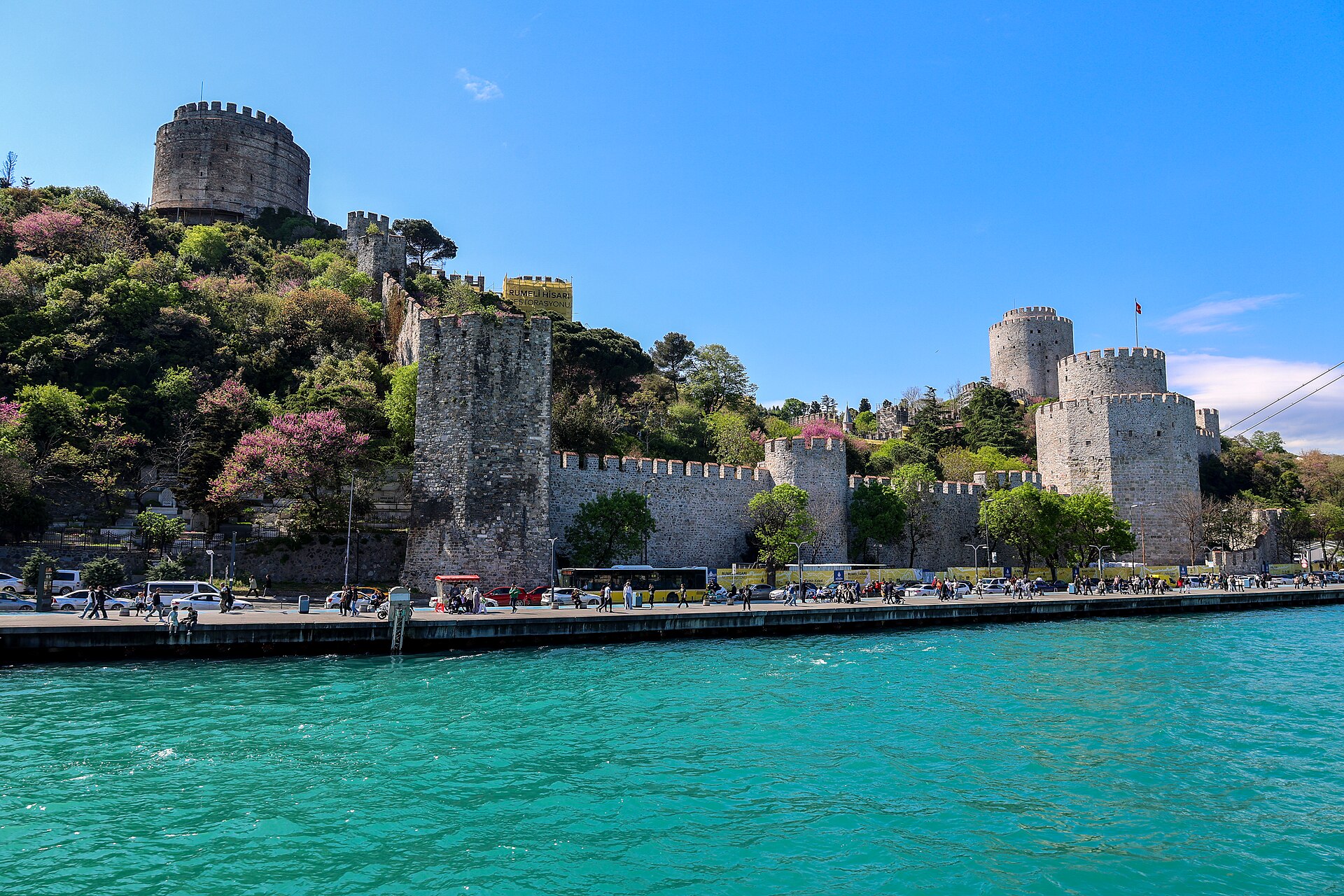
Rumelihisari is a 15th-century Ottoman fortress built on the European shore of the Bosporus in 1452 under the आदेश of Sultan Mehmed II. Constructed in preparation for the conquest of Constantinople, it was strategically positioned at the narrowest point of the strait, directly opposite Anadolu Hisari on the Asian shore. Its purpose was to control naval traffic and prevent aid from reaching the Byzantine capital via the Black Sea. The fortress was completed in a remarkably short period, reportedly within a few months. It consists of massive curtain walls, three large main towers named after leading Ottoman commanders, and multiple smaller towers reinforcing the fortifications. Following the Ottoman conquest in 1453, Rumelihisari continued to serve military and administrative functions before gradually losing strategic importance.
Key Facts
- Materials
- Stone, Brick, Timber
- Civilization
- Ottoman
- Accessibility
- Steep pathways and stairs; uneven stone surfaces; limited accessibility for mobility-impaired visitors
- Notable Feature
- Three large defensive towers connected by curtain walls along the Bosporus
- Date(s)
- 1452 CE
- Condition
- Preserved fortress; open-air museum
- Original Function
- Military fortress controlling Bosporus traffic
- Key Figures
- Mehmed II
- Architectural Style
- Ottoman military architecture
Construction Before the Conquest
1452Mehmed II ordered the rapid construction of Rumelihisari to secure the Bosporus ahead of his campaign against Constantinople. The fortress worked in tandem with Anadolu Hisari to control maritime passage and restrict Byzantine resupply efforts.
Role in the 1453 Siege
1453During the siege of Constantinople, the fortress enforced Ottoman naval dominance in the strait. Its artillery and garrison deterred or intercepted ships attempting to reach the city from the Black Sea.
Post-Conquest Use
15th–19th centuriesAfter the conquest, the fortress functioned as a customs checkpoint, military outpost, and occasionally a prison. Over time, its defensive role diminished as Ottoman territorial control expanded.
Modern Restoration
20th century–presentRestoration efforts in the 20th century stabilized the structure and adapted it as an open-air museum. At various times, the interior courtyard has also been used for cultural events and performances.
Cultural Significance
Rumelihisari is closely associated with the Ottoman conquest of Constantinople and symbolizes Mehmed II’s strategic planning and military ambition. Its commanding position on the Bosporus reflects the geopolitical importance of controlling maritime chokepoints between the Black Sea and the Mediterranean. Today, it remains one of the most prominent surviving examples of Ottoman military architecture in Istanbul and provides expansive views of the Bosporus, reinforcing its historic strategic value.
Interpretive Notes
Scholarly debates and areas of uncertainty
Historians debate the exact logistical organization and workforce scale that enabled the fortress’s rapid construction. The structure is often examined in conjunction with Ottoman artillery development and siege strategy. Scholarly discussion also addresses the fortress’s symbolic dimension, interpreting it as both a military installation and a statement of imperial authority immediately prior to the fall of Constantinople.
Visiting Information
Entry Rules
Open daily except designated closure days (commonly Mondays; verify seasonally). Ticketed entry required.
Best Times to Visit
Morning visits offer cooler temperatures and fewer crowds, especially during summer. The site involves climbing steep staircases.
Photography
Photography is permitted. Tripods and commercial filming require official authorization.
Preservation Notes
Wear sturdy footwear due to uneven stone steps and steep inclines. Exercise caution when climbing towers and walls.
Nearby POIs
11 shownSources & Further Reading
- [1]The Ottoman Empire: The Classical Age 1300–1600 — Halil Inalcik. Phoenix Press (2000)
- [2]The Fall of Constantinople 1453 — Steven Runciman. Cambridge University Press (1965)
- [3]Ottoman Fortifications and Military Architecture — Gabor Agoston. Brill (2014)
Key Facts
- Materials
- Stone, Brick, Timber
- Civilization
- Ottoman
- Accessibility
- Steep pathways and stairs; uneven stone surfaces; limited accessibility for mobility-impaired visitors
- Notable Feature
- Three large defensive towers connected by curtain walls along the Bosporus
- Date(s)
- 1452 CE
- Condition
- Preserved fortress; open-air museum
- Original Function
- Military fortress controlling Bosporus traffic
- Key Figures
- Mehmed II
- Architectural Style
- Ottoman military architecture