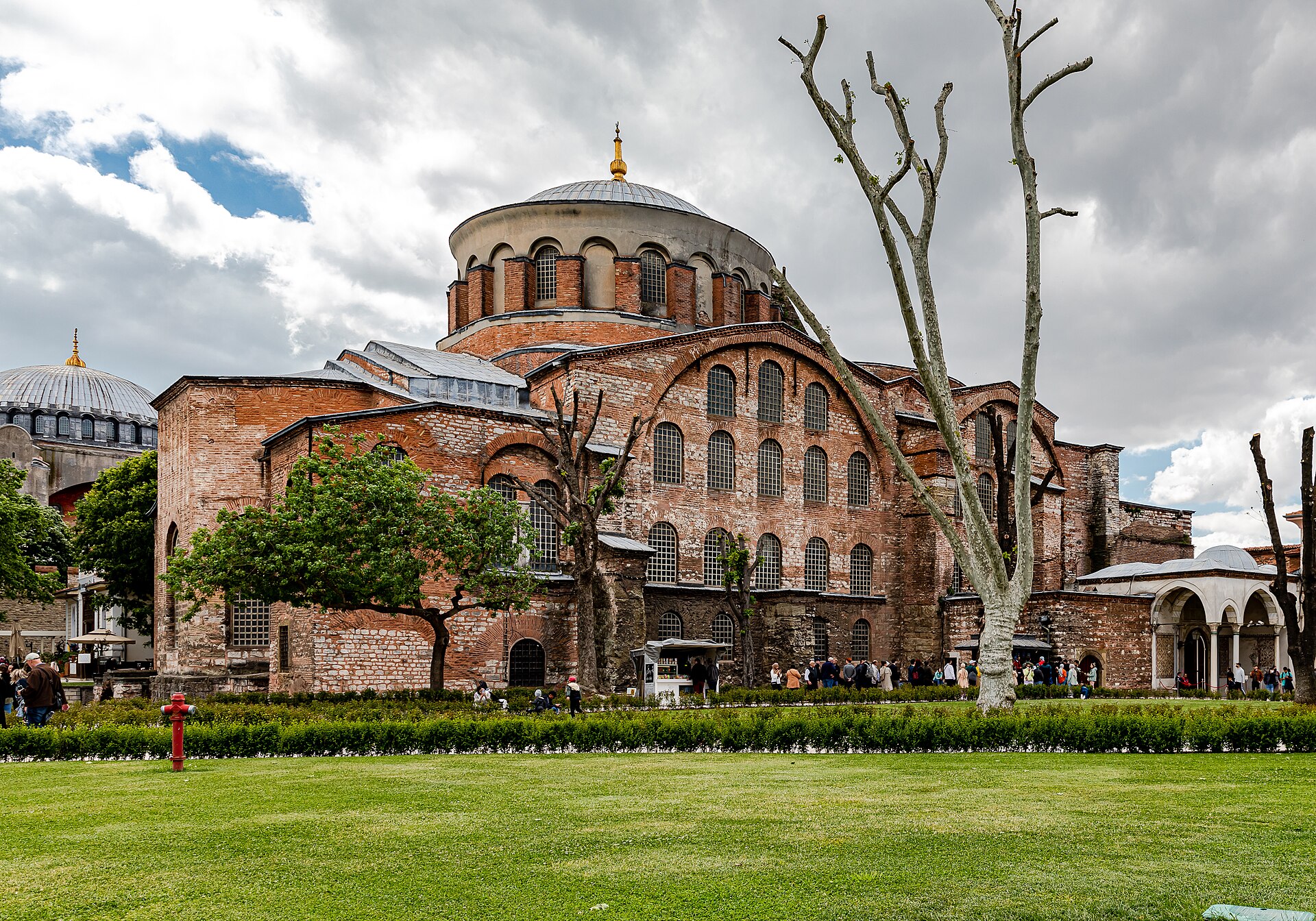
Hagia Irene is a Byzantine church located within the outer courtyard of Topkapı Palace in Istanbul. Originally constructed in the 4th century under Emperor Constantine I, it is one of the oldest surviving churches in the city and predates the more famous Hagia Sophia. The structure was rebuilt in the 6th century by Emperor Justinian I following damage from the Nika Revolt. Unlike many other Byzantine churches in Constantinople, Hagia Irene was not converted into a mosque after the Ottoman conquest. Instead, it was used for military and storage purposes, preserving much of its original architectural form. Today, it functions as a museum and concert venue, notable for its austere interior and early example of a domed basilica layout.
Key Facts
- Materials
- Brick, Stone
- Civilization
- Byzantine
- Current Function
- Museum and concert hall
- Date(s)
- 4th century CE; rebuilt 532 CE
- Condition
- Well-preserved
- Original Function
- Church
- Key Figures
- Emperor Constantine I, Emperor Justinian I
Early Construction
4th century CEHagia Irene was commissioned during the reign of Emperor Constantine I as one of the first Christian churches in Constantinople. It served as the cathedral of the city before the construction of Hagia Sophia and was a central site for early Christian worship.
Destruction and Reconstruction
6th centuryThe church was damaged during the Nika Revolt in 532 CE and subsequently rebuilt by Emperor Justinian I. The reconstruction introduced a domed basilica plan, combining longitudinal and centralized architectural forms characteristic of early Byzantine experimentation.
Byzantine Use
6th–15th centuriesHagia Irene continued to function as a church throughout the Byzantine period, though it was overshadowed by Hagia Sophia. It hosted ecclesiastical councils and maintained a role in the religious life of the capital.
Ottoman Period
15th–19th centuriesAfter the Ottoman conquest of Constantinople in 1453, the building was incorporated into the Topkapı Palace complex and repurposed as an armory and military storehouse. Its non-conversion into a mosque contributed to the preservation of its original structure and decoration.
Modern Use
20th century–presentIn the modern era, Hagia Irene has been conserved as a historic monument and adapted for cultural use. It now serves as a museum and concert venue, valued for its acoustics and as a rare example of an early Byzantine church that retains its original spatial character.
Cultural Significance
Hagia Irene occupies a unique place in the religious history of Constantinople as one of the earliest churches established after the city became the capital of the Roman Empire. Its dedication to “Holy Peace” reflects theological themes central to early Christianity and imperial ideology. The building is also significant for preserving aniconic decoration, most notably the large cross mosaic in the apse, which is associated with the Iconoclast period. This distinguishes it from later Byzantine churches and provides insight into theological debates and artistic practices of the time.
Interpretive Notes
Scholarly debates and areas of uncertainty
The dating and interpretation of the apse cross mosaic remain subjects of scholarly debate. While many scholars associate it with the Iconoclast period of the 8th–9th centuries, others argue for a later restoration or reinterpretation based on stylistic analysis. There is also ongoing discussion about the extent of structural changes made during Justinian’s reconstruction, particularly regarding the transition from a traditional basilica to a domed basilica plan.
Visiting Information
Entry Rules
Open on select days as part of the Topkapı Palace complex. Entry typically requires a museum ticket.
Best Times to Visit
Weekday mornings for smaller crowds. Check concert schedules, as access may be limited during events.
Photography
Photography generally permitted without flash. Tripods and professional equipment may require permission.
Preservation Notes
Visitors should remain within designated areas. The structure is sensitive to vibration and wear due to its age and use as a performance space.
Nearby POIs
11 shownSources & Further Reading
- [1]Hagia Irene — Robert Ousterhout. The Oxford Handbook of Byzantine Studies (2008)
- [2]Byzantine Churches of Istanbul — Thomas F. Mathews. Pennsylvania State University Press (1976)
- [3]Topkapı Palace and Hagia Irene — Republic of Turkey Ministry of Culture and Tourism (2020)
Key Facts
- Materials
- Brick, Stone
- Civilization
- Byzantine
- Current Function
- Museum and concert hall
- Date(s)
- 4th century CE; rebuilt 532 CE
- Condition
- Well-preserved
- Original Function
- Church
- Key Figures
- Emperor Constantine I, Emperor Justinian I