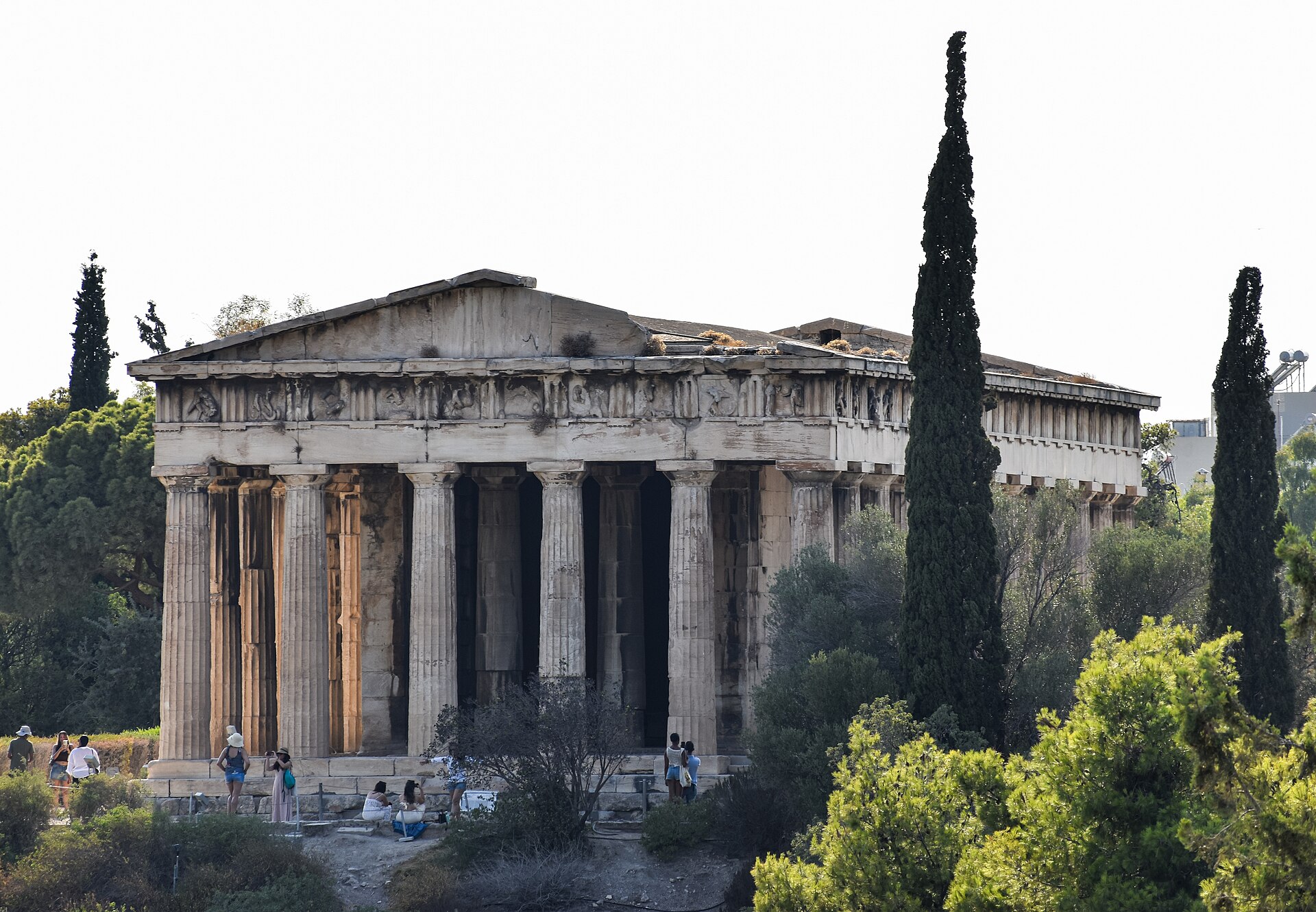
The Temple of Hephaestus is one of the best-preserved ancient Greek temples in the world. Located on the northwest side of the Ancient Agora of Athens, it was dedicated to Hephaestus, god of metalworking, craftsmanship, and fire, and possibly also to Athena Ergane. Constructed in the mid-5th century BCE during the Periclean building program, the temple is a Doric peripteral structure made primarily of Pentelic marble. Its exceptional state of preservation is due in part to its later conversion into a Christian church, which ensured continued maintenance throughout the Byzantine period.
Key Facts
- Material
- Pentelic marble
- Architect
- Unknown (possibly associated with the Parthenon workshop)
- Later Use
- Church of Saint George Akamates (7th century–1834)
- Civilization
- Classical Athens
- Date(s)
- c. 449–415 BCE
- Condition
- Extremely well-preserved
- Original Function
- Temple dedicated to Hephaestus (and possibly Athena Ergane)
- Architectural Style
- Doric peripteral temple
Construction in the Age of Pericles
5th century BCEThe temple was built during the height of Athenian power following the Persian Wars. Its construction coincided with the Parthenon and other major civic projects on the Acropolis, reflecting the wealth and ambition of Classical Athens.
Religious Function in the Agora
Classical–Hellenistic periodsSituated near workshops and metalworking districts, the temple honored Hephaestus, patron of craftsmen. Cult statues once stood inside the cella, possibly sculpted by Alcamenes.
Conversion to a Christian Church
7th century CE–1834The temple was converted into the Church of Saint George Akamates during the Byzantine era. This transformation helped preserve the structure, as it remained in active religious use for over a millennium.
Modern Archaeological Preservation
19th century–presentAfter Greek independence, the building ceased functioning as a church and became part of the protected archaeological site of the Ancient Agora. Conservation efforts have maintained its structural integrity with minimal reconstruction.
Cultural Significance
The Temple of Hephaestus is one of the finest surviving examples of Doric architecture from Classical Greece. Its preservation allows scholars to study proportional systems, sculptural programs, and construction techniques with minimal later alteration. Its presence within the Ancient Agora situates it within the civic and commercial heart of Athens, linking religious practice directly to daily economic life. The temple serves as a key reference point for understanding the architectural language of the 5th century BCE.
Interpretive Notes
Scholarly debates and areas of uncertainty
Debate continues over whether the temple was dedicated solely to Hephaestus or jointly to Hephaestus and Athena Ergane. Literary sources suggest dual dedication, though inscriptions are limited. Scholars also discuss the identity of the architect and workshop connections to the Parthenon, based on stylistic similarities in sculptural decoration and architectural proportions.
Visiting Information
Entry Rules
Included in the combined ticket for the Ancient Agora archaeological site. Visitors must remain on designated paths and may not enter the cella interior.
Best Times to Visit
Morning or late afternoon for optimal lighting and reduced heat. Spring and autumn offer more comfortable conditions than peak summer months.
Photography
Photography permitted without flash. Tripods and professional equipment require prior authorization.
Preservation Notes
Climbing on the structure is strictly prohibited. Visitors must not touch columns or architectural elements. Respect site boundaries and conservation signage.
Nearby POIs
11 shownSources & Further Reading
- [1]The Athenian Agora: A Guide to the Excavations — American School of Classical Studies at Athens. ASCSA (2010)
- [2]Greek Architecture — A. W. Lawrence. Yale University Press (1996)
Key Facts
- Material
- Pentelic marble
- Architect
- Unknown (possibly associated with the Parthenon workshop)
- Later Use
- Church of Saint George Akamates (7th century–1834)
- Civilization
- Classical Athens
- Date(s)
- c. 449–415 BCE
- Condition
- Extremely well-preserved
- Original Function
- Temple dedicated to Hephaestus (and possibly Athena Ergane)
- Architectural Style
- Doric peripteral temple