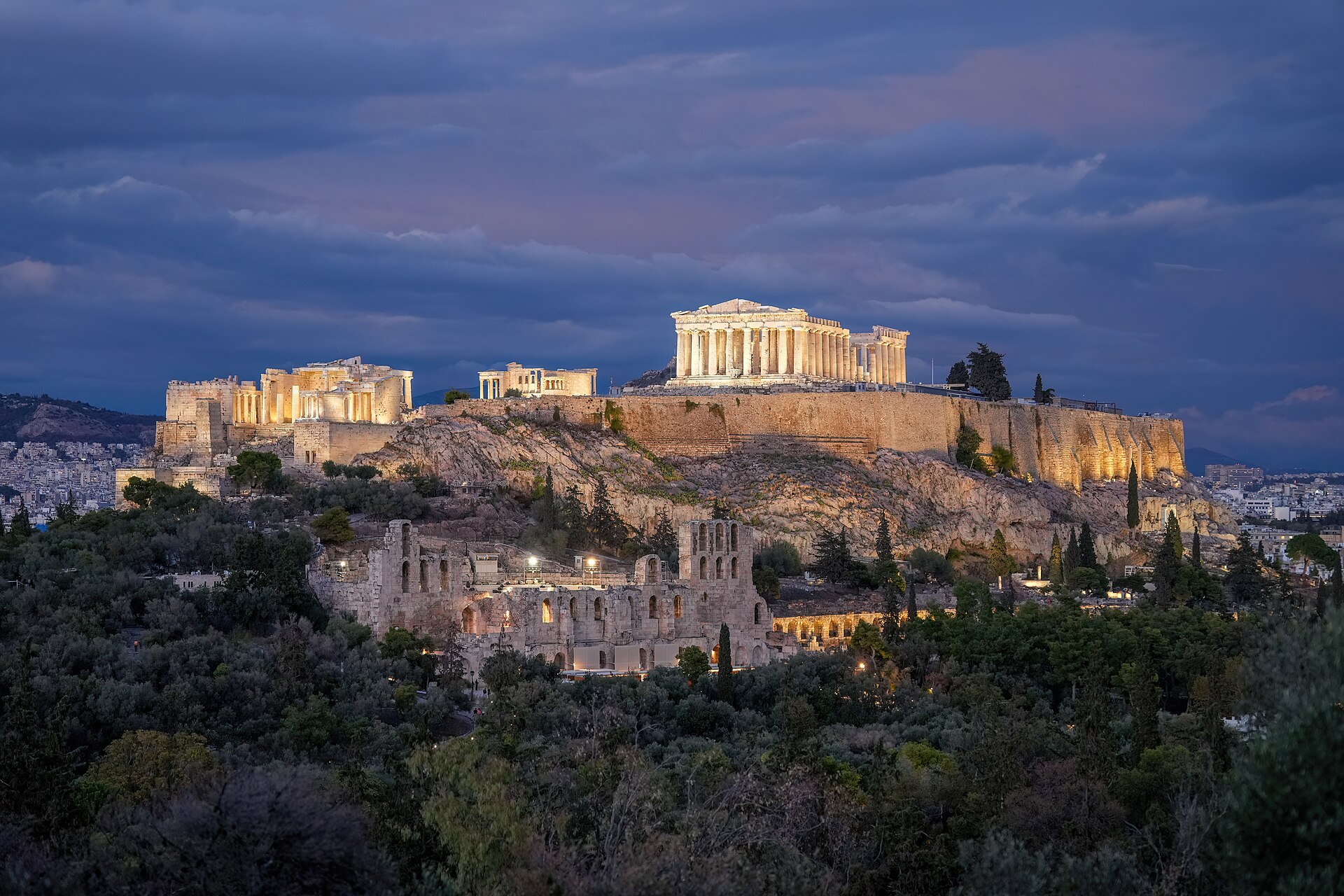
The Acropolis of Athens is a fortified limestone hill rising approximately 150 meters above sea level in central Athens. Occupied since the Neolithic period, it developed into a major Mycenaean citadel in the Late Bronze Age before becoming the principal religious sanctuary of the city dedicated to Athena. During the 5th century BCE, under the leadership of Pericles, the plateau was transformed into a monumental sacred complex including the Parthenon, Propylaea, Erechtheion, and Temple of Athena Nike. The site continued to function through Hellenistic, Roman, Byzantine, and Ottoman periods, undergoing successive religious and structural transformations. Today it represents one of the most studied architectural and political landscapes of the ancient Mediterranean.
Key Facts
- Elevation
- Approximately 150 m above sea level
- Civilization
- Mycenaean; Classical Athens
- Major Structures
- Parthenon, Propylaea, Erechtheion, Temple of Athena Nike
- Date(s)
- Mycenaean period (c. 13th century BCE); major Classical rebuilding 447–406 BCE
- Condition
- Archaeological complex under active conservation
- Original Function
- Fortified citadel; later primary religious sanctuary of Athena
- Key Figures
- Pericles, Phidias, Ictinus, Callicrates, Mnesicles
Prehistoric and Mycenaean Citadel
Neolithic – 12th century BCEArchaeological evidence indicates habitation on the Acropolis hill as early as the Neolithic period. By the 13th century BCE, it had been fortified as a Mycenaean citadel, surrounded by cyclopean walls. A palace complex likely stood near the later Erechtheion.
Archaic Sanctuary
8th–6th century BCEFollowing the collapse of the Mycenaean system, the Acropolis evolved into a religious center. Early temples dedicated to Athena Polias were constructed, including the so-called 'Older Parthenon.' Many votive statues from this period were buried after the Persian destruction of 480 BCE.
Classical Reconstruction Program
447–406 BCEAfter the Persian Wars, Athens initiated an extensive rebuilding program under Pericles. The Parthenon (447–432 BCE), Propylaea (437–432 BCE), Temple of Athena Nike, and Erechtheion (421–406 BCE) were constructed, redefining the plateau as a monumental architectural ensemble that reflected Athenian imperial ambition.
Hellenistic and Roman Periods
323 BCE – 4th century CEThe Acropolis retained its sacred function under Macedonian and later Roman rule. Roman emperors, including Augustus and Hadrian, contributed dedications and restorations. The architectural core remained largely intact during this period.
Christian and Ottoman Transformations
5th–19th centuryIn Late Antiquity, major temples were converted into Christian churches. Following the Ottoman conquest in 1458, structures were adapted for Islamic use, and new buildings were added. In 1687, a Venetian bombardment caused severe damage, particularly to the Parthenon, which was being used as an ammunition store.
Modern Archaeology and Conservation
19th century – presentAfter Greek independence in 1830, Ottoman-era additions were removed as part of a national restoration effort emphasizing the Classical phase. Systematic excavation and conservation began in the 19th century and continue today under the Acropolis Restoration Service, focusing on structural stabilization and anastylosis using original materials where possible.
Cultural Significance
The Acropolis functioned as the religious and symbolic center of Athens, embodying the city’s political authority, civic identity, and relationship with the goddess Athena. Its 5th-century BCE rebuilding program projected Athenian power across the Aegean world and visually reinforced the ideology of democracy and imperial leadership. In modern Greece, the Acropolis serves as a foundational symbol of national heritage and classical antiquity. It plays a central role in debates about cultural patrimony, conservation ethics, and the global legacy of ancient Greek civilization.
Interpretive Notes
Scholarly debates and areas of uncertainty
Scholars continue to debate the interpretation of the Parthenon frieze and the ideological messaging of the Periclean building program. Questions remain regarding the degree to which the reconstruction served religious devotion versus imperial propaganda. Restoration methodology has also generated debate. Earlier 20th-century interventions using iron clamps caused structural stress, leading to modern reassessment of conservation practices and the development of reversible titanium reinforcement systems.
Visiting Information
Entry Rules
Admission via unified Acropolis ticket. Timed entry slots apply. Open daily; seasonal hour variations. Last entry generally 30 minutes before closing.
Best Times to Visit
Arrive at opening time for lower visitor density and reduced heat exposure. Avoid midday in summer due to limited shade and high temperatures. Visiting during national holidays or late July may coincide with events referencing the ancient Panathenaic tradition.
Photography
Personal photography permitted without tripods or drones. Commercial photography requires prior authorization from the Hellenic Ministry of Culture.
Preservation Notes
Remain on designated pathways and do not touch architectural surfaces. Marble is vulnerable to erosion and pollution. Active restoration work may restrict access to certain areas, and scaffolding may be present.
Nearby POIs
11 shownSources & Further Reading
- [1]The Acropolis in the Age of Pericles — Jeffrey M. Hurwit. Cambridge University Press (2004)
- [2]The Complete Acropolis of Athens — John Travlos. Thames & Hudson (1971)
- [3]Acropolis Restoration Project: Annual Reports. Hellenic Ministry of Culture (2022)
Key Facts
- Elevation
- Approximately 150 m above sea level
- Civilization
- Mycenaean; Classical Athens
- Major Structures
- Parthenon, Propylaea, Erechtheion, Temple of Athena Nike
- Date(s)
- Mycenaean period (c. 13th century BCE); major Classical rebuilding 447–406 BCE
- Condition
- Archaeological complex under active conservation
- Original Function
- Fortified citadel; later primary religious sanctuary of Athena
- Key Figures
- Pericles, Phidias, Ictinus, Callicrates, Mnesicles