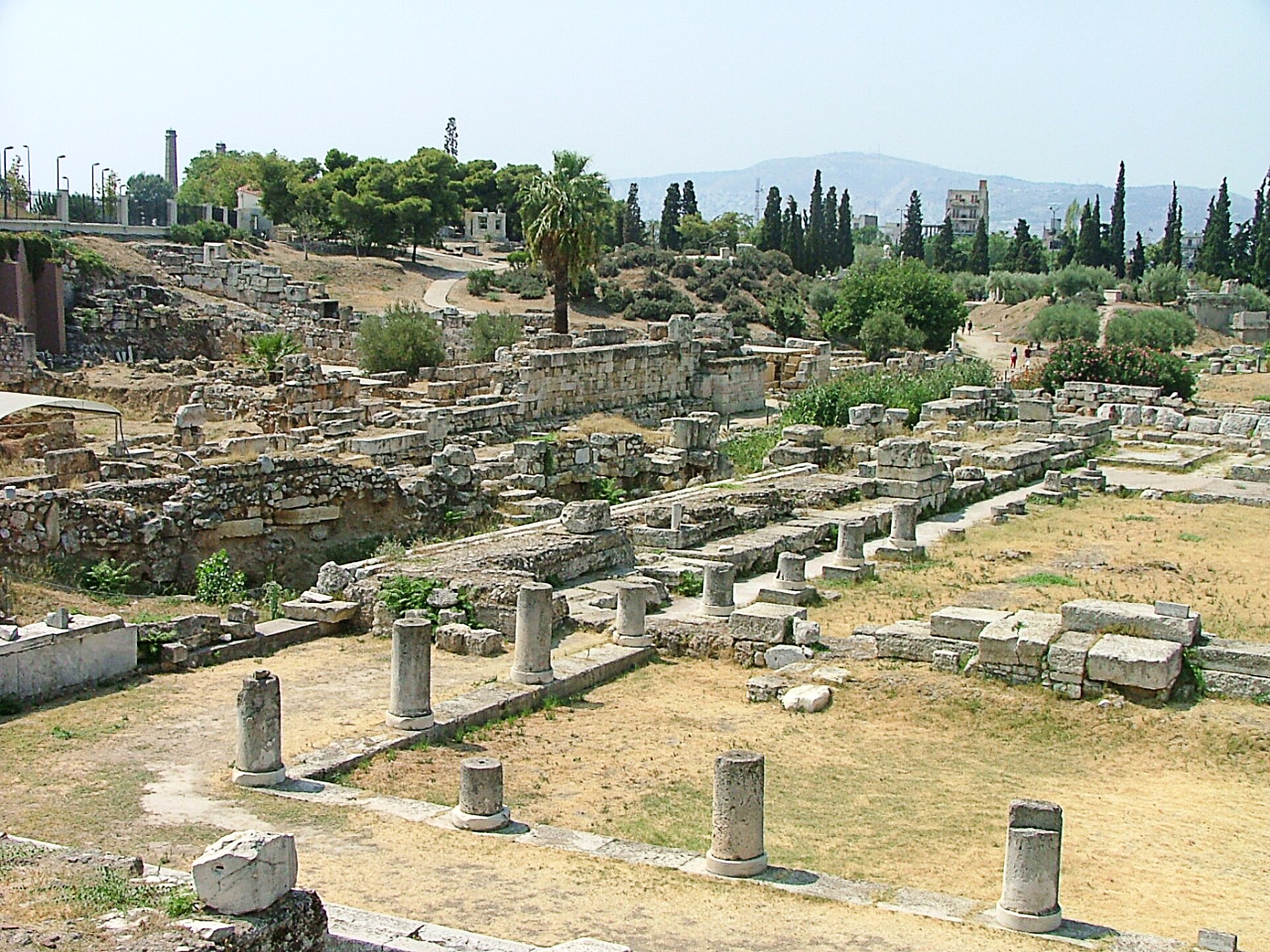
The Ancient Agora of Athens served as the principal civic, political, and commercial center of the city from the 6th century BCE onward. Located northwest of the Acropolis, it functioned as the focal point of Athenian democracy, hosting assemblies, law courts, religious festivals, and daily economic exchange. The space evolved architecturally over centuries, incorporating stoas, administrative buildings, temples, and monuments. Major surviving structures include the Temple of Hephaestus, the Stoa of Attalos (reconstructed in the 20th century), and the Bouleuterion. The site reflects successive phases of Athenian political development, Roman intervention, and later transformation during Late Antiquity.
Key Facts
- Area
- Approximately 12 hectares
- Civilization
- Classical Athens
- Major Structures
- Temple of Hephaestus, Stoa of Attalos, Old and New Bouleuterion, Tholos
- Date(s)
- Established 6th century BCE; major Classical development 5th–4th century BCE
- Condition
- Archaeological complex with partial reconstructions
- Original Function
- Civic, political, commercial, and religious center
- Key Figures
- Solon, Cleisthenes, Pericles, Socrates
Archaic Formation
6th century BCEThe Agora began to take form during the reforms of Solon and later Cleisthenes, who reorganized Athenian political institutions. Public buildings were constructed to house magistrates and councils, establishing the space as the administrative heart of the polis.
Classical Democratic Center
5th–4th century BCEDuring the Classical period, the Agora became the center of Athenian democratic life. The Bouleuterion housed the Council of 500, while law courts and stoas accommodated civic functions. Philosophers such as Socrates taught and debated in its open spaces. Monumental stoas provided sheltered walkways and spaces for commerce and political gathering.
Hellenistic Expansion
323–146 BCEUnder Macedonian influence and subsequent Hellenistic rulers, new stoas and dedications were added. Foreign benefactors contributed buildings that reflected broader Mediterranean political networks while preserving the Agora’s civic identity.
Roman Reconfiguration
146 BCE – 3rd century CEFollowing the Roman sack of Athens in 86 BCE by Sulla, parts of the Agora were rebuilt. Roman emperors, including Augustus and Hadrian, sponsored additional monuments. Commercial functions increasingly shifted toward the nearby Roman Agora, altering the political centrality of the original site.
Late Antiquity and Abandonment
4th–7th century CEHerulian invasions in 267 CE damaged much of the complex. Defensive walls were constructed using spolia from earlier monuments. By the 7th century CE, the Agora ceased functioning as a civic center and gradually transitioned into a residential area.
Modern Excavation and Reconstruction
19th century – presentLarge-scale excavations began in the 1930s under the American School of Classical Studies at Athens. Extensive clearance of later structures revealed the Classical layout. The Stoa of Attalos was reconstructed between 1953 and 1956 and now houses the Agora Museum.
Cultural Significance
The Ancient Agora embodied the institutional framework of Athenian democracy. It was the physical setting for legislative preparation, public trials, civic announcements, and philosophical discourse. Political reforms enacted in this space shaped concepts of citizenship and governance that influenced later republican systems. The Agora also functioned as a social and economic hub, integrating commerce with civic life. Its architectural evolution demonstrates how democratic institutions were embedded in public space, reinforcing transparency and participation within the polis.
Interpretive Notes
Scholarly debates and areas of uncertainty
Scholars continue to debate the precise spatial organization of certain civic functions, particularly the locations of specific law courts and administrative offices. Literary sources do not always align clearly with archaeological remains. The reconstruction of the Stoa of Attalos has also generated discussion regarding the balance between educational reconstruction and preservation authenticity. While the building provides valuable interpretive context, it represents a modern intervention within an ancient landscape.
Visiting Information
Entry Rules
Admission via unified Acropolis ticket. Open daily with seasonal hours. Separate ticketing for entry to the Agora Museum inside the Stoa of Attalos may apply.
Best Times to Visit
Early morning for lower visitor density and moderate temperatures. The site offers limited shade in open areas. Visiting in conjunction with the Acropolis provides contextual understanding of civic and religious topography.
Photography
Personal photography permitted without tripods or drones. Commercial photography requires authorization from the Hellenic Ministry of Culture.
Preservation Notes
Stay on marked walkways and avoid climbing on ruins. Some areas contain fragile foundations and ongoing conservation zones. The Temple of Hephaestus remains one of the best-preserved structures but should not be touched.
Nearby POIs
11 shownSources & Further Reading
- [1]The Athenian Agora: A Short Guide to the Excavations — John McK. Camp II. American School of Classical Studies at Athens (2010)
- [2]The Athenian Agora: Excavations in the Heart of Classical Athens — John McK. Camp II. Thames & Hudson (1986)
- [3]The Athenian Democracy in the Age of Demosthenes — Mogens Herman Hansen. University of Oklahoma Press (1991)
Key Facts
- Area
- Approximately 12 hectares
- Civilization
- Classical Athens
- Major Structures
- Temple of Hephaestus, Stoa of Attalos, Old and New Bouleuterion, Tholos
- Date(s)
- Established 6th century BCE; major Classical development 5th–4th century BCE
- Condition
- Archaeological complex with partial reconstructions
- Original Function
- Civic, political, commercial, and religious center
- Key Figures
- Solon, Cleisthenes, Pericles, Socrates