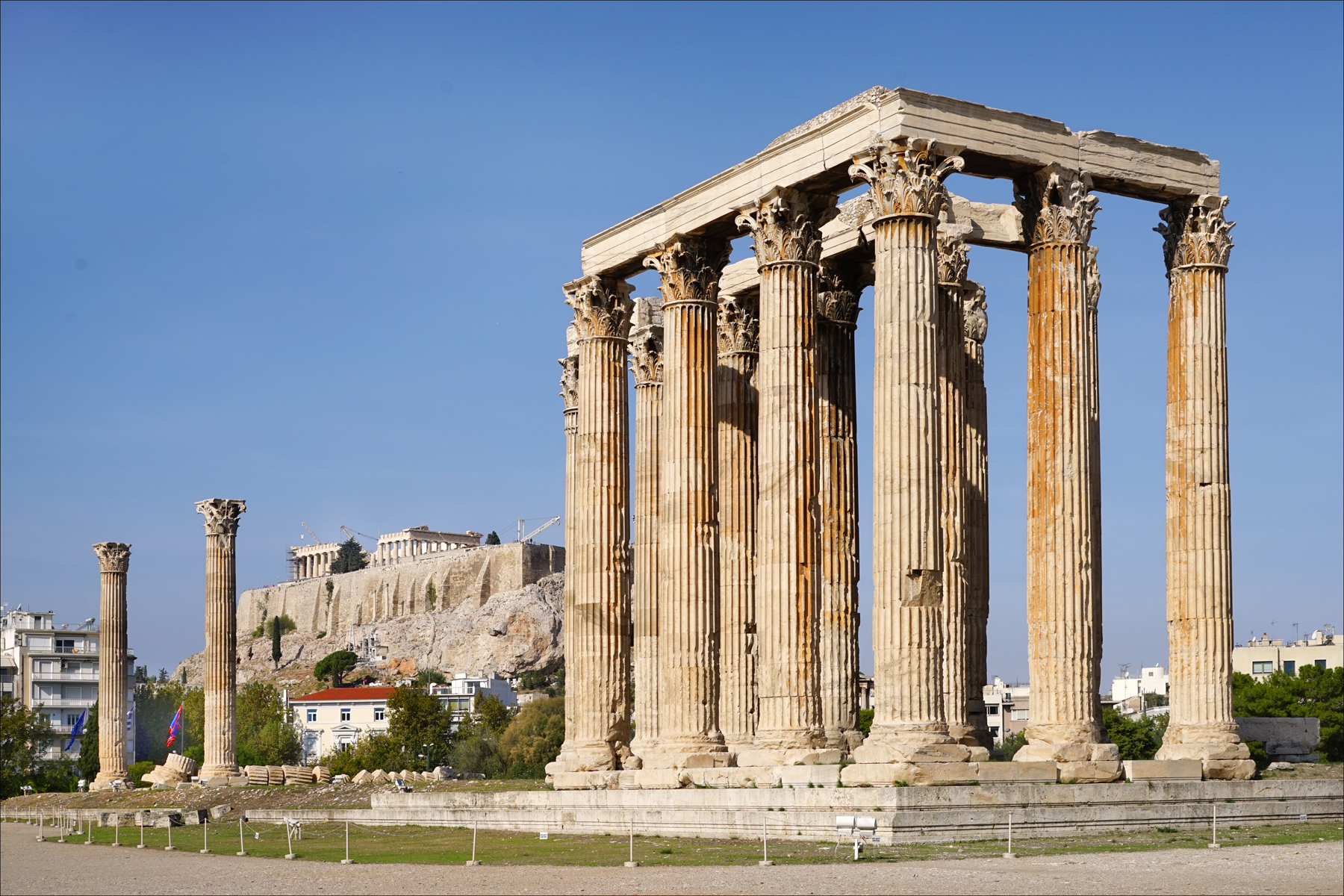
The Temple of Olympian Zeus (Olympieion) was one of the largest temples of the ancient world. Located southeast of the Acropolis in Athens, it was dedicated to Zeus Olympios, king of the Olympian gods. Construction began in the 6th century BCE under the Peisistratid tyrants but was left incomplete for centuries. The project was revived during the Hellenistic period and finally completed in the 2nd century CE under the Roman emperor Hadrian. The temple was designed in the Corinthian order and originally featured 104 massive columns, of which 15 remain standing today.
Key Facts
- Civilization
- Archaic Athens; completed under Roman Empire
- Column Height
- Approximately 17 meters
- Columns Remaining
- 15
- Date(s)
- Begun c. 520 BCE; completed 131 CE
- Condition
- Ruins with standing columns
- Original Function
- Temple dedicated to Zeus Olympios
- Associated Emperor
- Hadrian
- Architectural Style
- Corinthian
- Total Columns Original
- 104
Archaic Foundations
6th century BCEThe temple was initiated by the Peisistratid tyrants in an ambitious effort to create the largest temple in Greece. Political upheaval and the fall of the tyranny halted construction before completion.
Hellenistic Revival
2nd century BCEThe Seleucid king Antiochus IV Epiphanes briefly revived the project, commissioning Roman architect Decimus Cossutius to redesign it in the Corinthian order. Work again ceased before completion.
Completion Under Hadrian
131–132 CERoman Emperor Hadrian completed the temple during his extensive building program in Athens. A colossal cult statue of Zeus was installed inside, along with a statue of Hadrian himself, emphasizing the emperor’s association with the city.
Decline and Spoliation
Late Antiquity–Ottoman periodThe temple fell into disuse after Late Antiquity. Over centuries, many columns were dismantled for building materials. In 1852, one column collapsed during a storm and remains lying where it fell.
Cultural Significance
The Temple of Olympian Zeus illustrates the political ambitions of successive regimes in Athens, from Archaic tyrants to Roman emperors. Its prolonged construction history reflects shifting power dynamics in the eastern Mediterranean. Architecturally, it is one of the most monumental examples of the Corinthian order in the ancient Greek world. The temple symbolized both divine authority and imperial patronage, especially under Hadrian, who sought to align himself with classical Greek heritage.
Interpretive Notes
Scholarly debates and areas of uncertainty
Scholars debate the exact appearance and dimensions of the colossal cult statue of Zeus housed within the temple. Limited surviving evidence leaves much of its reconstruction speculative. There is also discussion regarding the ideological motivations behind Hadrian’s completion of the temple, particularly whether it functioned primarily as a religious monument or as a political symbol of Roman authority in Greece.
Visiting Information
Entry Rules
Included in the combined Athens archaeological site ticket. Visitors must remain behind protective barriers and are not permitted to climb or touch the columns.
Best Times to Visit
Early morning or late afternoon to avoid strong midday sun. Clear days provide striking photographic views with the Acropolis visible in the background.
Photography
Photography permitted without flash. Professional filming requires official authorization.
Preservation Notes
The remaining columns are structurally fragile. Visitors must respect designated paths and avoid leaning on ancient stonework.
Nearby POIs
11 shownSources & Further Reading
- [1]The Architecture of Ancient Greece — William Bell Dinsmoor. Batsford (1975)
- [2]Hadrian and the Cities of the Roman Empire — Mary T. Boatwright. Princeton University Press (2000)
Key Facts
- Civilization
- Archaic Athens; completed under Roman Empire
- Column Height
- Approximately 17 meters
- Columns Remaining
- 15
- Date(s)
- Begun c. 520 BCE; completed 131 CE
- Condition
- Ruins with standing columns
- Original Function
- Temple dedicated to Zeus Olympios
- Associated Emperor
- Hadrian
- Architectural Style
- Corinthian
- Total Columns Original
- 104