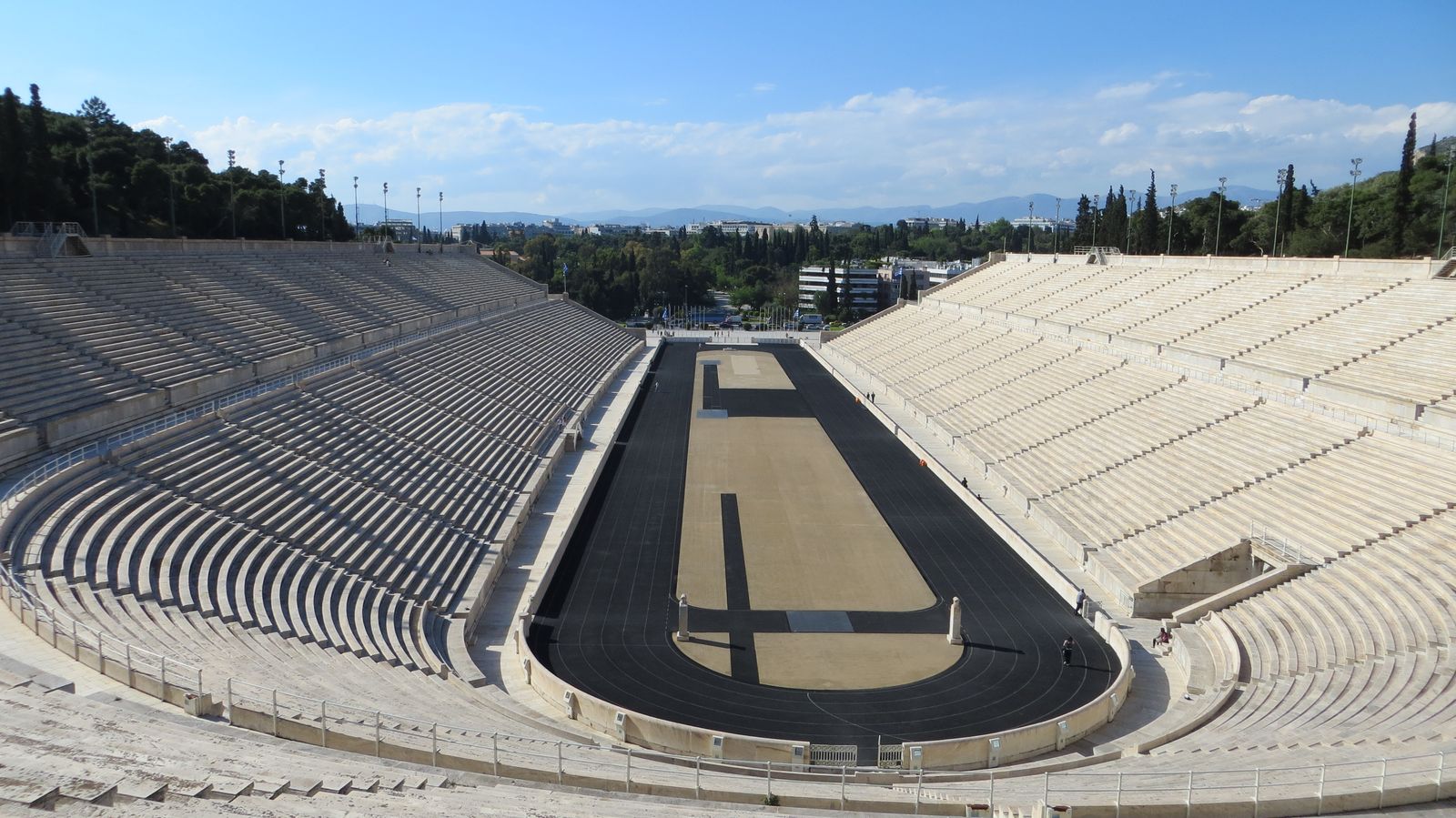
The Panathenaic Stadium, also known as Kallimarmaro (“beautiful marble”), is a historic stadium in Athens constructed entirely of marble. Originally built in the 4th century BCE for the Panathenaic Games, it was later reconstructed in marble during the Roman period and restored in the 19th century to host the first modern Olympic Games in 1896. Located in a natural ravine between the hills of Ardettos and Agra, the stadium preserves the elongated U-shaped design typical of ancient Greek athletic venues. Its modern restoration closely follows Roman-period dimensions and remains one of the few ancient stadiums still in active ceremonial use.
Key Facts
- Founder
- Lycurgus of Athens
- Notable Event
- First modern Olympic Games (1896)
- Capacity Current
- Approximately 50,000 spectators
- Primary Material
- Pentelic marble
- Modern Restoration
- 1895–1896
- Roman Reconstruction
- c. 144 CE under Herodes Atticus
- Original Construction
- c. 330 BCE
Classical Origins
4th century BCEThe stadium was initially constructed under the statesman Lycurgus to host athletic contests of the Panathenaic Games, a major religious festival honoring Athena. The early structure was built primarily of earth and wood.
Roman Marble Reconstruction
2nd century CEHerodes Atticus rebuilt the stadium entirely in Pentelic marble, significantly enlarging its scale and enhancing its architectural grandeur. The reconstruction reflected both Roman wealth and reverence for Greek traditions.
Decline and Rediscovery
Late Antiquity–19th centuryThe stadium gradually fell into disuse and was partially buried over time. Excavations in the 19th century uncovered its remains as Greece prepared to revive the Olympic Games.
Revival for the Modern Olympics
1895–1896Financed by benefactor George Averoff, the stadium was restored to host the first modern Olympic Games in 1896. It later served as a venue for ceremonies during the 2004 Athens Olympics.
Cultural Significance
The Panathenaic Stadium connects ancient athletic tradition with the modern Olympic movement. It symbolizes the revival of classical ideals in the 19th century and the emergence of international sport culture. Architecturally, it is unique as the only major stadium in the world constructed entirely of marble. Its continued ceremonial use reinforces Athens’ role in both ancient and modern global heritage.
Interpretive Notes
Scholarly debates and areas of uncertainty
Scholars discuss the degree to which the 19th-century restoration reflects the exact Roman-period configuration versus an idealized reconstruction. There is also debate over the scale and seating arrangements of the original Classical-era stadium before its Roman marble rebuilding.
Visiting Information
Entry Rules
Ticket required for entry and avaliable only on-site. Visitors may walk on designated areas of the track and seating sections. Museum exhibits within the stadium complex are included in admission.
Best Times to Visit
Morning visits offer cooler temperatures and fewer crowds. Late afternoon provides dramatic lighting across the marble seating.
Photography
Photography permitted without flash. Drone use prohibited without official authorization.
Preservation Notes
Visitors should avoid running on the marble seating steps and must not climb on restricted areas. Proper footwear is recommended due to smooth stone surfaces.
Nearby POIs
11 shownSources & Further Reading
- [1]The Panathenaic Stadium: Its History and Restoration — Hellenic Olympic Committee. HOC Publications (2004)
- [2]The Olympics: A History of the Modern Games — Allen Guttmann. University of Illinois Press (2002)
Key Facts
- Founder
- Lycurgus of Athens
- Notable Event
- First modern Olympic Games (1896)
- Capacity Current
- Approximately 50,000 spectators
- Primary Material
- Pentelic marble
- Modern Restoration
- 1895–1896
- Roman Reconstruction
- c. 144 CE under Herodes Atticus
- Original Construction
- c. 330 BCE