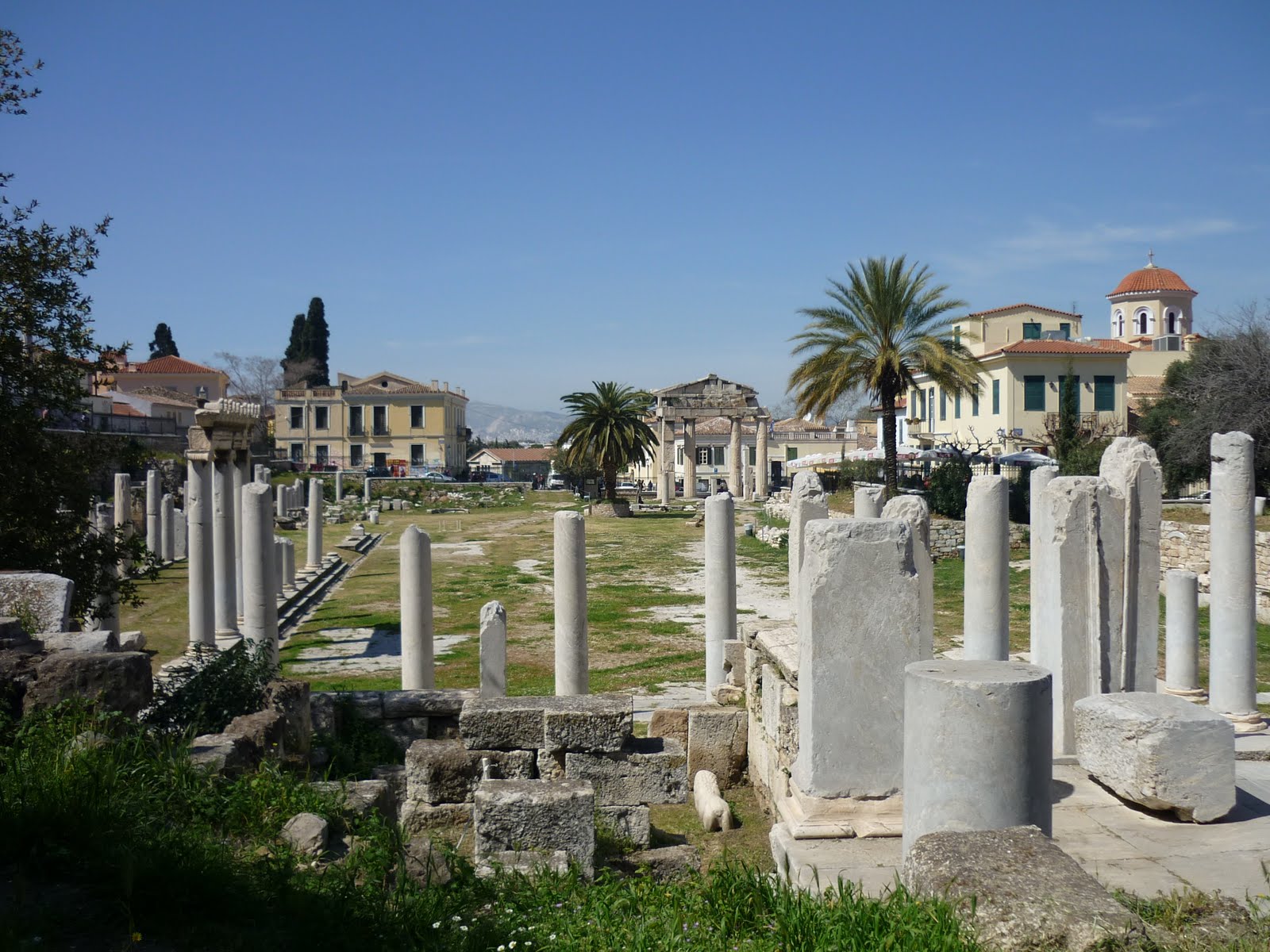
The Roman Agora is an archaeological complex located east of the Ancient Agora in Athens, Greece. Constructed in the late 1st century BCE with funding from Julius Caesar and completed under Augustus, it functioned as the city's primary commercial and administrative center during the Roman Imperial period. The rectangular courtyard was enclosed by colonnades and included shops, storage rooms, fountains, and public latrines. Prominent surviving structures include the Gate of Athena Archegetis at the western entrance and the Tower of the Winds at the eastern edge. The site continued to evolve through the Byzantine and Ottoman periods, when churches and later domestic buildings were constructed within the former marketplace.
Key Facts
- Materials
- Pentelic marble, Limestone
- Dimensions
- Approximately 111m x 98m rectangular courtyard
- Civilization
- Roman
- Date(s)
- Late 1st century BCE
- Condition
- Archaeological ruins with standing monuments
- Original Function
- Commercial marketplace and civic center
- Key Figures
- Julius Caesar, Augustus
Foundation and Augustan Patronage
Late 1st century BCEThe Roman Agora was constructed to relieve congestion in the older Classical Agora. Funded initially by Julius Caesar and completed under Augustus, the complex reflected Rome’s administrative and economic reorganization of Athens.
Imperial Modifications
1st–3rd centuries CEAdditional structures were added during the Roman Imperial period, including fountains and commercial facilities. The nearby Tower of the Winds, built slightly earlier in the Hellenistic period, functioned as a combined water clock and weather station.
Late Antique Transformation
4th–6th centuries CEFollowing the Heruli invasion of 267 CE, defensive walls incorporated portions of the site. In Late Antiquity, parts of the agora were repurposed for Christian religious structures and workshops.
Ottoman and Modern Phases
15th century–presentDuring the Ottoman period, domestic buildings and small industries occupied the area. Systematic archaeological excavations in the 19th and 20th centuries cleared later additions and revealed the Roman-period layout visible today.
Cultural Significance
The Roman Agora illustrates the administrative restructuring of Athens under Roman rule. While the Classical Agora remained symbolically important, commercial and bureaucratic functions shifted to this new complex, reflecting integration into the Roman imperial system. Its later reuse in Byzantine and Ottoman periods demonstrates the continuity of urban occupation in Athens and the adaptive transformation of civic space across successive political regimes.
Interpretive Notes
Scholarly debates and areas of uncertainty
Scholars debate the precise functional division between the Roman Agora and the older Classical Agora during the early Imperial period. While traditionally described as primarily commercial, some evidence suggests continued civic and administrative roles. There is also discussion regarding the extent to which Augustan urban planning in Athens aimed to preserve Greek architectural identity versus impose Roman spatial organization.
Visiting Information
Entry Rules
Included in the unified Athens archaeological site ticket. Open daily with seasonal hours set by the Hellenic Ministry of Culture. Last entry typically 30 minutes before closing.
Best Times to Visit
Early morning for reduced visitor numbers and cooler temperatures. The site is fully exposed with limited shade during summer months.
Photography
Personal photography permitted without tripods or drones. Commercial filming requires authorization from the Hellenic Ministry of Culture.
Preservation Notes
Visitors must remain on marked pathways and avoid climbing on masonry. Portions of the site are under ongoing conservation.
Nearby POIs
11 shownSources & Further Reading
- [1]The Athenian Agora: A Guide to the Excavations — John McK. Camp II. American School of Classical Studies at Athens (2003)
- [2]Roman Athens — Ian Jenkins. British Museum Press (2006)
Key Facts
- Materials
- Pentelic marble, Limestone
- Dimensions
- Approximately 111m x 98m rectangular courtyard
- Civilization
- Roman
- Date(s)
- Late 1st century BCE
- Condition
- Archaeological ruins with standing monuments
- Original Function
- Commercial marketplace and civic center
- Key Figures
- Julius Caesar, Augustus