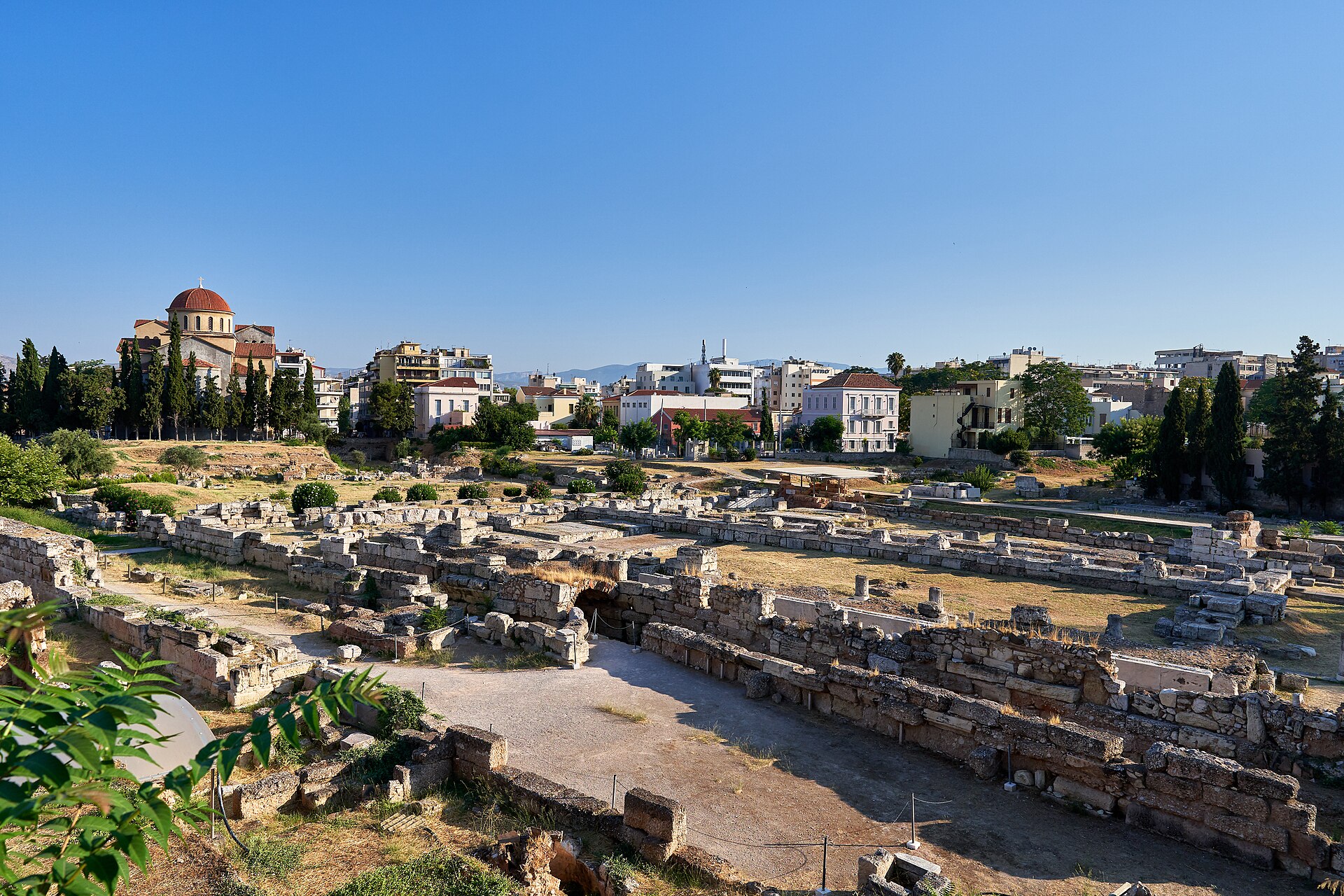
Kerameikos is an ancient cemetery and sacred precinct located northwest of the Acropolis in Athens. It served as the main burial ground of the city from the 12th century BCE through the Roman period, containing both elaborate family tombs and simpler grave markers. In addition to its funerary function, Kerameikos included sacred altars and enclosures associated with the cult of the dead, and a gate—known as the Dipylon Gate—that controlled access to the city. Excavations have revealed steles, sculptures, and inscriptions that provide valuable insight into Athenian funerary practices, civic organization, and artistic development.
Key Facts
- Materials
- Marble, Stone, Terracotta
- Civilization
- Ancient Greek
- Accessibility
- Wheelchair accessible in main paths
- Date(s)
- 12th century BCE - 3rd century CE
- Condition
- Partially excavated ruins and open-air museum
- Original Function
- Cemetery and sacred precinct
- Key Figures
- Pericles, Cleisthenes
Early Settlement
12th-7th century BCEKerameikos began as a modest burial site during the Geometric period. Early graves were simple pit burials with occasional grave goods, reflecting the social hierarchy and customs of the emerging city-state of Athens.
Classical Expansion
5th-4th century BCEDuring the Classical period, Kerameikos expanded significantly. The construction of the Dipylon Gate and adjoining walls defined the precinct as both a funerary and sacred civic space. Steles and monuments became increasingly elaborate, reflecting wealth and civic identity.
Hellenistic and Roman Periods
4th century BCE - 3rd century CEKerameikos remained an important necropolis under Hellenistic and Roman rule. Roman-style tombs and inscriptions appeared alongside traditional Greek funerary architecture, illustrating cultural blending and continued civic importance.
Rediscovery and Excavation
19th-20th century CESystematic excavations began in the late 19th century, uncovering graves, steles, and the remains of the Dipylon Gate. Archaeological efforts continue to document and preserve the site, with the open-air museum providing context for visitors.
Cultural Significance
Kerameikos functioned as both a burial ground and a civic space reflecting Athenian social, political, and religious identity. Funerary monuments served as markers of wealth, status, and family legacy, while the Dipylon Gate connected the city to sacred rituals, including funeral processions. For modern Athens, Kerameikos provides critical insight into classical urban planning and religious practices. Its steles and inscriptions remain key sources for understanding ancient Greek society and continue to contribute to cultural heritage education.
Interpretive Notes
Scholarly debates and areas of uncertainty
Debates persist over the interpretation of the steles’ iconography, particularly whether certain depictions represent actual funerary customs or idealized civic virtues. Scholars also dispute the exact function of some enclosures within the precinct, with some suggesting ritual use while others argue for purely commemorative purposes.
Visiting Information
Entry Rules
Open daily 8:00-17:00. Last entry 30 minutes before closing. Tickets available at the on-site office.
Best Times to Visit
Morning hours (8:00-10:00) to avoid crowds and midday heat. Weekdays are generally less busy than weekends. Spring and fall offer cooler temperatures and less congestion.
Photography
Personal photography allowed. Tripods and drones require prior permission from the Greek Ministry of Culture. Commercial photography must be authorized in advance.
Preservation Notes
Do not touch or lean on ancient structures or steles. Remain on designated pathways. Some areas may be under excavation or restoration. Follow all posted signage.
Nearby POIs
11 shownSources & Further Reading
- [1]Kerameikos: The Athenian Necropolis — Jeffrey M. Hurwit. Thames & Hudson (1999)
- [2]
- [3]Athenian Funerary Practices — John Camp. University of Michigan Press (2001)
Key Facts
- Materials
- Marble, Stone, Terracotta
- Civilization
- Ancient Greek
- Accessibility
- Wheelchair accessible in main paths
- Date(s)
- 12th century BCE - 3rd century CE
- Condition
- Partially excavated ruins and open-air museum
- Original Function
- Cemetery and sacred precinct
- Key Figures
- Pericles, Cleisthenes