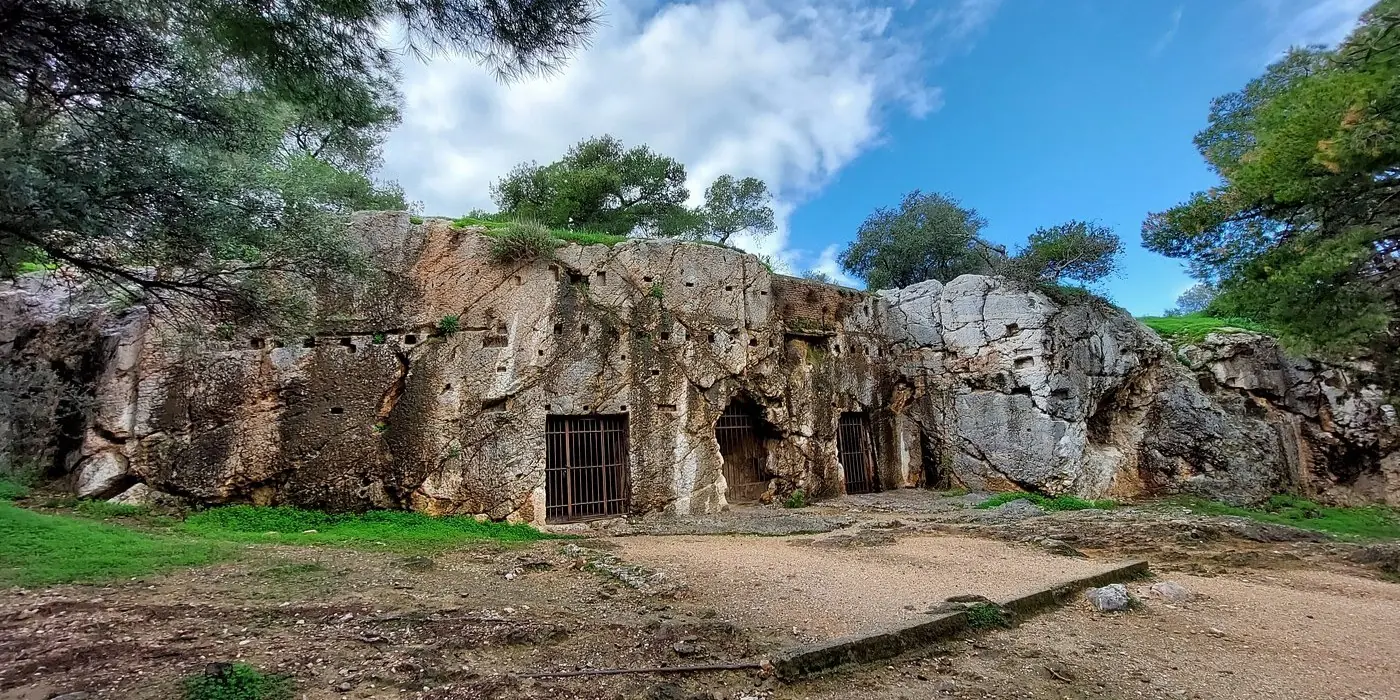
The so-called Prison of Socrates is a rock-cut complex located on the southwest slope of Philopappos Hill in Athens. The site consists of carved chambers and niches cut into the bedrock, traditionally associated with the imprisonment of the philosopher Socrates before his execution in 399 BCE. Although the identification remains uncertain, the structure likely served as a Hellenistic or Roman storage or utility space rather than a formal prison. Its association with Socrates developed in later tradition and has become embedded in the cultural memory of Athens.
Key Facts
- Materials
- Natural bedrock
- Civilization
- Ancient Greek
- Accessibility
- Accessible via uphill walking path; uneven terrain
- Date(s)
- 4th century BCE (traditional association); current remains likely Hellenistic or Roman
- Condition
- Rock-cut chambers preserved; partially fenced
- Original Function
- Uncertain; possibly storage or guard post
- Key Figures
- Socrates
Historical Context of Socrates’ Trial
399 BCESocrates was tried and sentenced to death by the Athenian court on charges of impiety and corrupting the youth. According to Plato’s dialogues, he was held in custody before drinking hemlock. The exact location of his imprisonment is not definitively recorded in ancient sources.
Construction of the Rock-Cut Chambers
Hellenistic-Roman periodThe existing rock-cut chambers likely date to the Hellenistic or Roman era. Architectural features suggest utilitarian purposes such as storage, guard quarters, or possibly a small shrine. There is no conclusive archaeological evidence linking the structure directly to Socrates.
Modern Identification
19th century - presentIn the 19th century, the site began to be identified in local tradition as the Prison of Socrates. Despite scholarly skepticism, the name persisted and is now widely used in tourist maps and cultural references.
Cultural Significance
The site’s association with Socrates connects it to one of the most influential figures in Western philosophy. Even if the archaeological identification remains uncertain, the location serves as a symbolic reminder of Athenian democracy, civic justice, and philosophical inquiry. For modern visitors, the site embodies the tension between historical evidence and cultural tradition. Its continued identification as the Prison of Socrates reflects how memory and narrative shape the interpretation of archaeological remains.
Interpretive Notes
Scholarly debates and areas of uncertainty
Most scholars question whether the rock-cut chambers are genuinely connected to Socrates’ imprisonment. Ancient texts do not provide a precise location for the prison, and the architectural characteristics suggest a later date. The debate highlights the broader issue of how historical figures become attached to archaeological sites without firm evidence.
Visiting Information
Entry Rules
Open access; no ticket required. Located on Philopappos Hill. No staffed entrance.
Best Times to Visit
Early morning or late afternoon to avoid midday heat. The uphill walk offers limited shade. Combine with visits to Philopappos Monument and Acropolis viewpoints.
Photography
Personal photography permitted. Tripods and commercial photography may require municipal permission.
Preservation Notes
Do not climb or carve into the rock surfaces. The chambers are part of an archaeological zone and subject to erosion. Use caution on uneven stone steps.
Nearby POIs
11 shownSources & Further Reading
- [1]Plato: Phaedo — Plato. Various editions
- [2]The Trial of Socrates — I.F. Stone. Little, Brown and Company (1988)
- [3]
Key Facts
- Materials
- Natural bedrock
- Civilization
- Ancient Greek
- Accessibility
- Accessible via uphill walking path; uneven terrain
- Date(s)
- 4th century BCE (traditional association); current remains likely Hellenistic or Roman
- Condition
- Rock-cut chambers preserved; partially fenced
- Original Function
- Uncertain; possibly storage or guard post
- Key Figures
- Socrates