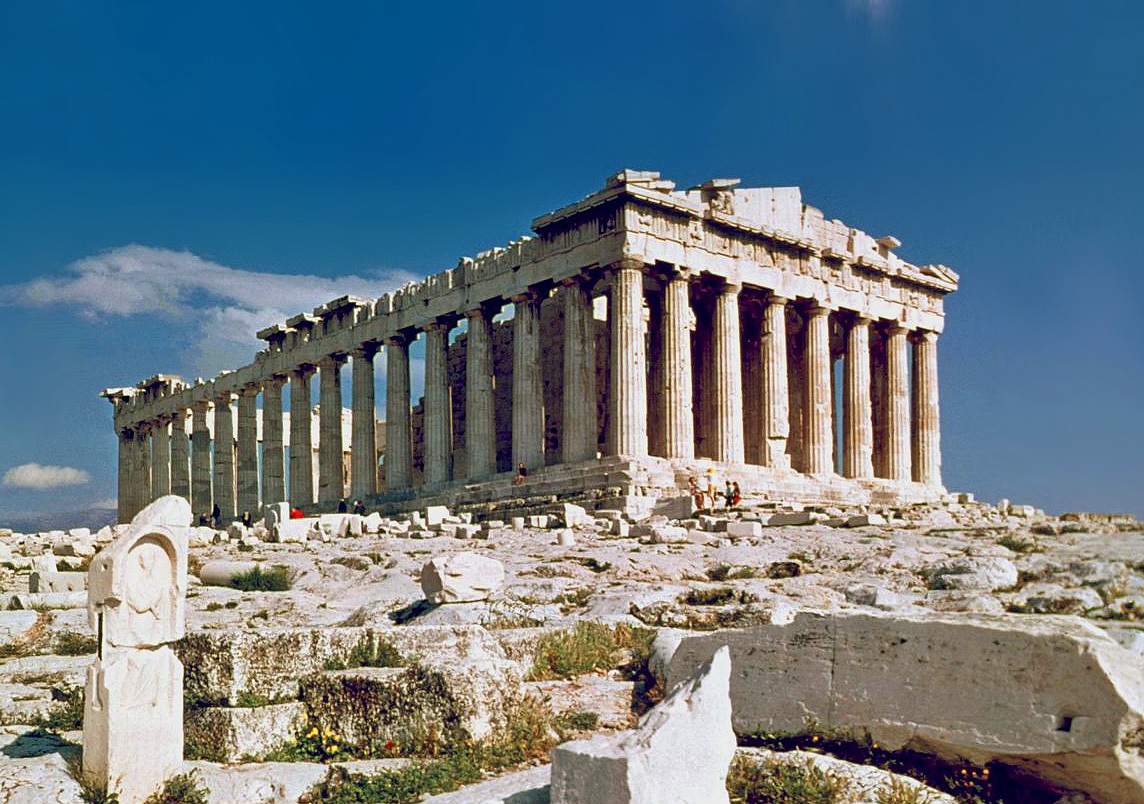
The Parthenon was constructed between 447 and 432 BCE on the Acropolis of Athens under the political leadership of Pericles. Dedicated to Athena Parthenos, the city’s patron goddess, it formed the architectural centerpiece of a broader rebuilding program following the Persian Wars. The temple was designed by Ictinus and Callicrates, with sculptural direction by Phidias. Built primarily of Pentelic marble, the structure is a Doric peripteral temple with Ionic elements incorporated into its interior frieze. Although partially damaged in 1687 during a Venetian bombardment, the Parthenon remains a defining monument of Classical Greek architecture and continues to shape global architectural and political symbolism.
Key Facts
- Materials
- Pentelic marble
- Dimensions
- 69.5 m x 30.9 m
- Civilization
- Classical Athens
- Date(s)
- 447–432 BCE
- Condition
- Partially ruined; undergoing long-term restoration
- Original Function
- Temple dedicated to Athena Parthenos
- Key Figures
- Pericles, Phidias, Ictinus, Callicrates
- Architectural Style
- Doric peripteral with Ionic frieze
Pre-Classical Foundations
6th century BCEAn earlier temple dedicated to Athena stood on the Acropolis before the Persian invasion of 480 BCE. This structure, sometimes referred to as the 'Older Parthenon,' was destroyed during the sack of Athens by Persian forces under Xerxes.
Classical Construction Program
447–432 BCEThe Parthenon was commissioned as part of Pericles’ ambitious rebuilding program financed in part by the Delian League treasury. Architects Ictinus and Callicrates designed the structure, while Phidias oversaw the sculptural program, including the chryselephantine statue of Athena Parthenos housed within the cella.
Hellenistic and Roman Adaptations
323 BCE – 4th century CEThe temple retained its religious function through the Hellenistic and Roman periods. Roman emperors, including Nero and Hadrian, engaged with the monument symbolically, though its core architectural form remained largely intact.
Christian and Ottoman Transformations
5th–17th centuryIn the 5th century CE, the Parthenon was converted into a Christian church dedicated to the Virgin Mary. Following the Ottoman conquest of Athens in 1458, it was converted into a mosque. These adaptations altered interior features but preserved the main structural shell.
Explosion and Modern Restoration
1687 – presentDuring the Venetian siege of Athens in 1687, an Ottoman ammunition store housed inside the temple was struck by artillery, causing a major explosion that destroyed much of the roof and central structure. Systematic archaeological study began in the 19th century. Since 1975, the Acropolis Restoration Service has conducted extensive conservation using original materials and reversible techniques.
Cultural Significance
The Parthenon functioned as both a religious sanctuary and a political statement of Athenian power during the height of the city’s imperial influence. Funded in part by allied tribute, its construction symbolized Athens’ leadership within the Delian League and its assertion of cultural authority across the Greek world. In modern Greece, the monument remains central to national identity and heritage policy. It is frequently invoked in discussions about cultural patrimony, particularly regarding the Parthenon Sculptures removed in the early 19th century. International debates over their repatriation continue to shape diplomatic and scholarly discourse.
Interpretive Notes
Scholarly debates and areas of uncertainty
The original polychromy of the Parthenon remains a subject of scholarly debate. While pigment traces confirm that the temple was painted, reconstructions vary in intensity and color schemes. The precise interpretation of the sculptural program, particularly the meaning of the Panathenaic procession depicted in the frieze, continues to generate discussion. Scholars differ on whether it represents a historical event, a mythological narrative, or a symbolic synthesis of civic and divine order. The removal and ownership of the Parthenon Sculptures, taken by Lord Elgin in the early 19th century, remains a contested issue involving legal, ethical, and diplomatic arguments.
Visiting Information
Entry Rules
Admission via unified Acropolis ticket. Timed entry system in place. Open daily; hours vary seasonally. Last entry typically 30 minutes before closing.
Best Times to Visit
Early morning entry (opening hour) for reduced crowd density and lower temperatures. Avoid midday during summer due to heat exposure on the Acropolis plateau. Late July coincides with the modern Panathenaic Festival commemorations, referencing the ancient procession associated with the temple.
Photography
Personal photography permitted without tripods or drones. Commercial photography requires prior authorization from the Hellenic Ministry of Culture.
Preservation Notes
Stay on marked pathways and do not touch marble surfaces. Ongoing restoration may restrict access to certain sections. The site is exposed to full sun; carry water. Scaffolding may be visible as part of conservation work.
Nearby POIs
11 shownSources & Further Reading
- [1]The Parthenon — Mary Beard. Profile Books (2002)
- [2]The Parthenon and Its Sculptures — Michael B. Cosmopoulos. Cambridge University Press (2004)
- [3]Acropolis Restoration Project: Annual Reports. Hellenic Ministry of Culture (2022)
Key Facts
- Materials
- Pentelic marble
- Dimensions
- 69.5 m x 30.9 m
- Civilization
- Classical Athens
- Date(s)
- 447–432 BCE
- Condition
- Partially ruined; undergoing long-term restoration
- Original Function
- Temple dedicated to Athena Parthenos
- Key Figures
- Pericles, Phidias, Ictinus, Callicrates
- Architectural Style
- Doric peripteral with Ionic frieze