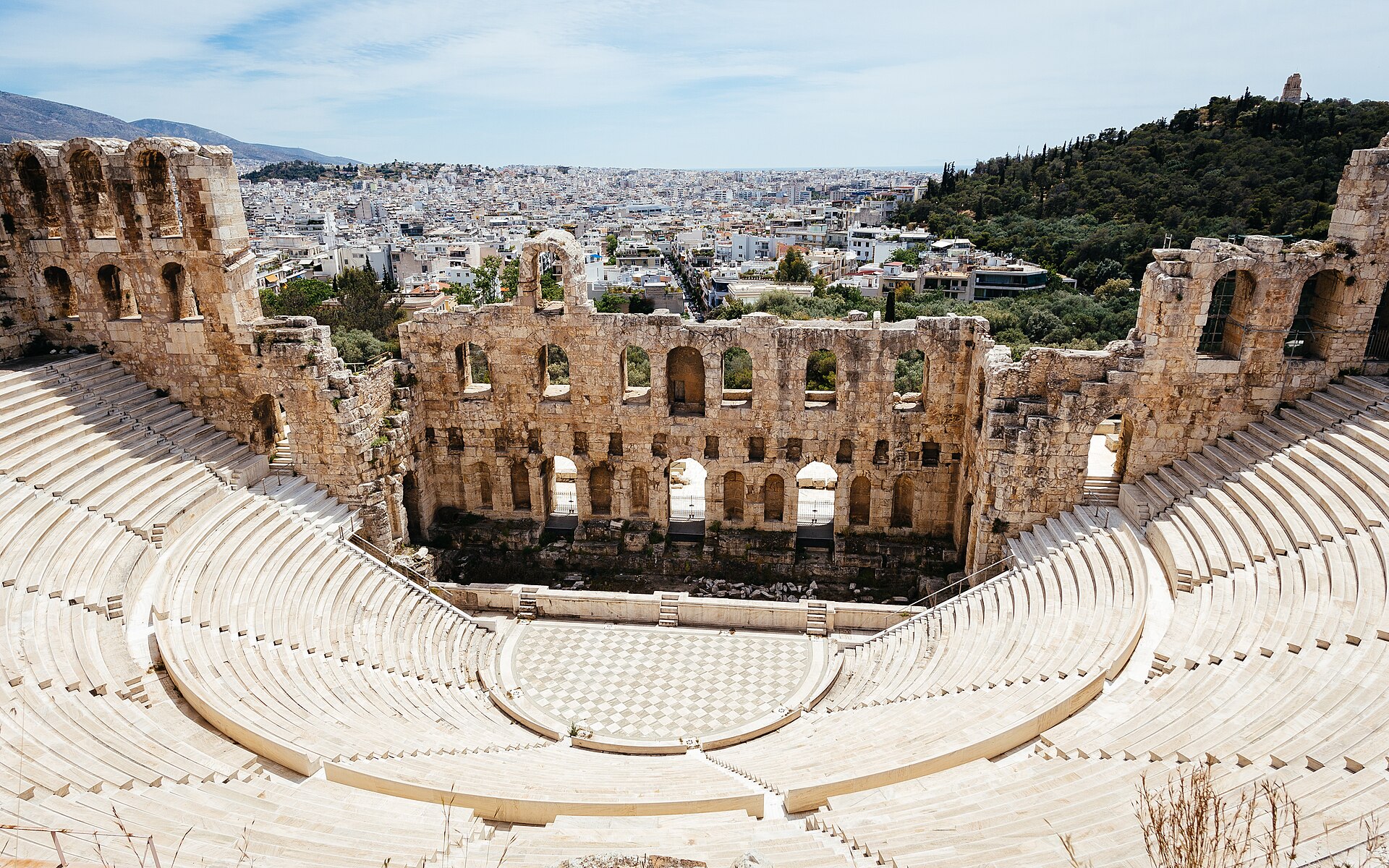
The Odeon of Herodes Atticus is a monumental Roman stone theatre located on the southwest slope of the Acropolis of Athens. Built in 161 CE by the wealthy Athenian benefactor Herodes Atticus in memory of his wife Regilla, it was designed primarily for musical performances. The structure originally featured a steeply tiered auditorium (cavea), a three-story stage building (skene), and a wooden roof made of cedar. Destroyed by the Heruli invasion in 267 CE, the odeon lay in ruins for centuries before major restoration in the 1950s. Today it functions as one of Greece’s premier open-air performance venues.
Key Facts
- Patron
- Herodes Atticus
- Dedication
- In memory of Regilla
- Restoration
- Major reconstruction 1950–1961
- Civilization
- Roman Greece
- Current Function
- Open-air performance venue
- Capacity Original
- Approximately 5,000 spectators
- Date(s)
- 161 CE
- Original Function
- Covered odeon for musical performances
Roman Patronage and Construction
2nd century CEHerodes Atticus, a prominent Roman senator of Greek origin, financed the odeon as part of a broader program of civic benefaction in Athens. The building reflected Roman engineering techniques combined with traditional Greek theatre design.
Destruction in Late Antiquity
267 CEThe odeon was severely damaged during the invasion of the Heruli, a Germanic tribe that attacked Athens. The roof and much of the upper structure were destroyed, and the site fell into long-term disuse.
Modern Restoration
1950–1961Extensive restoration funded by the Greek state reconstructed the cavea using Pentelic marble. While the roof was not rebuilt, the theatre regained its functionality as an open-air venue.
Contemporary Cultural Role
20th century–presentThe odeon hosts performances as part of the Athens and Epidaurus Festival and other major cultural events, including concerts, opera, and classical drama.
Cultural Significance
The Odeon of Herodes Atticus represents the fusion of Roman imperial patronage and Athenian cultural identity. Its construction demonstrates the continued prestige of Athens as a center of arts and education during the Roman period. Today, the venue maintains a direct link between antiquity and contemporary performance culture, serving as a rare example of an ancient theatre still used for its original purpose.
Interpretive Notes
Scholarly debates and areas of uncertainty
Scholars debate the precise reconstruction of the original wooden roof, which was considered a significant engineering achievement. Its span and structure remain partially speculative. There is also discussion about the degree to which the 20th-century restoration reflects the Roman-era appearance versus a modern interpretive reconstruction.
Visiting Information
Entry Rules
Access generally permitted only during scheduled performances. Visitors may view the exterior from Acropolis pathways. Tickets required for events.
Best Times to Visit
Evening performances offer the most atmospheric experience, particularly during the summer festival season. Daytime viewing is limited to exterior observation.
Photography
Photography policies vary during performances and may be restricted. Exterior photography is permitted.
Preservation Notes
Visitors attending performances must follow seating regulations and avoid standing on ancient masonry. Food and drink restrictions may apply during events.
Nearby POIs
11 shownSources & Further Reading
- [1]Roman Athens — Ian Jenkins. British Museum Press (2006)
- [2]Herodes Atticus and the City of Athens — Jennifer Tobin. Gieben (1997)
Key Facts
- Patron
- Herodes Atticus
- Dedication
- In memory of Regilla
- Restoration
- Major reconstruction 1950–1961
- Civilization
- Roman Greece
- Current Function
- Open-air performance venue
- Capacity Original
- Approximately 5,000 spectators
- Date(s)
- 161 CE
- Original Function
- Covered odeon for musical performances