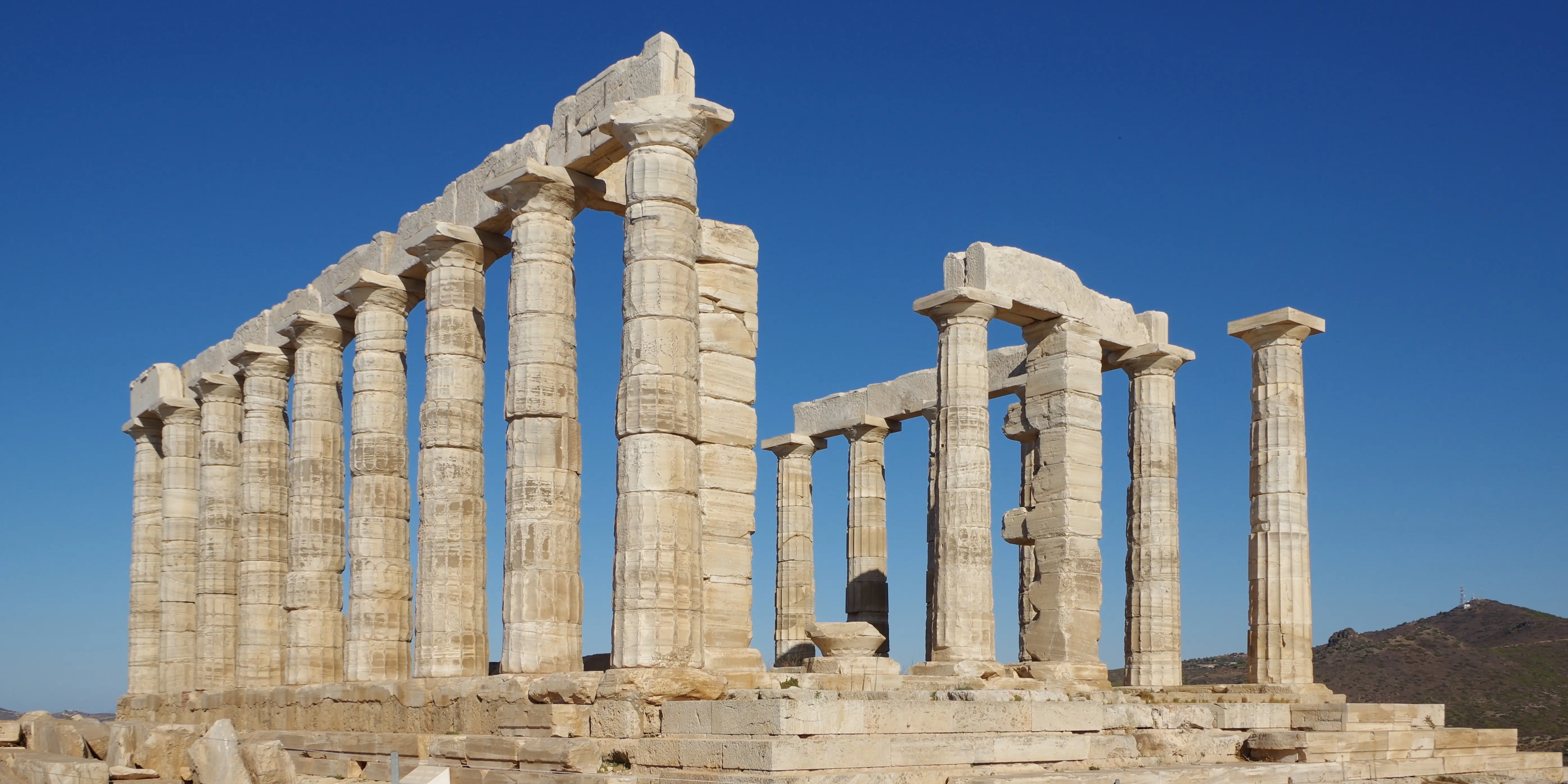
The Temple of Poseidon is an ancient Greek temple located at Cape Sounion, approximately 70 km southeast of Athens. Built in the 5th century BCE, it was dedicated to Poseidon, god of the sea, and served both religious and navigational purposes for sailors approaching the Aegean coastline. The temple sits on a promontory overlooking the Aegean Sea, with 34 Doric columns originally surrounding the peristyle. Its ruins remain an important example of Classical Greek temple architecture, providing insight into ancient religious practices and coastal worship rituals.
Key Facts
- Materials
- Marble, Stone
- Civilization
- Ancient Greek
- Accessibility
- Accessible via walking paths, partial wheelchair access
- Date(s)
- c. 440 BCE
- Condition
- Ruined, partially reconstructed columns remain
- Original Function
- Temple dedicated to Poseidon
- Key Figures
- Pericles
Early Worship at Sounion
7th-6th century BCEBefore the current Classical temple, the site hosted earlier sanctuaries to Poseidon dating back to the Archaic period. These were simple structures used primarily by sailors seeking safe passage.
Construction of the Classical Temple
c. 440 BCEThe current temple was built during the height of Athenian power under Pericles. Constructed in Doric style with 34 columns, it functioned as a center for maritime worship and as a landmark for ships navigating the Aegean Sea.
Roman and Later Periods
1st century BCE - 5th century CEThe temple remained an active cult site during Roman rule, though maintenance declined. Earthquakes and looting gradually reduced its structural integrity.
Modern Rediscovery and Preservation
19th century - presentExcavations and preservation efforts began in the 19th century. Today, the temple is a protected archaeological site and popular tourist destination, with ongoing work to stabilize and preserve its remaining columns.
Cultural Significance
The Temple of Poseidon symbolized Athens’ maritime power and religious devotion, serving as both a sacred site for offerings to the god of the sea and a navigational marker for sailors. Its location atop Cape Sounion emphasized the link between religion, geography, and civic identity in Classical Athens. Today, it continues to represent the cultural heritage of ancient Greece, drawing attention to Classical architecture and ancient maritime traditions. The temple is also an iconic element in modern Greek tourism and cultural memory.
Interpretive Notes
Scholarly debates and areas of uncertainty
Scholars debate the precise layout and number of decorative elements, as erosion and loss of architectural fragments obscure the original configuration. The extent to which the temple functioned as a ceremonial site versus a symbolic coastal marker is also discussed in recent research.
Visiting Information
Entry Rules
Open daily 8:00-19:00. Tickets purchased at the entrance. Last entry 30 minutes before closing.
Best Times to Visit
Late afternoon (16:00-18:00) offers cooler temperatures and historically inspired timing for observing the sunset. Weekdays are less crowded than weekends. Spring and autumn provide favorable weather for walking and photography.
Photography
Personal photography allowed. Tripods, drones, or commercial photography require prior permission from the Greek Ministry of Culture. Flash photography is discouraged to preserve the marble surfaces.
Preservation Notes
Remain on marked pathways. Do not touch or climb the columns. The site is partially exposed to wind and erosion. Follow all posted signage and guidelines from site staff.
Nearby POIs
11 shown- Panathenaic Stadium43.4 km
- National Museum of Contemporary Art Αthens43.6 km
- Athens War Museum43.7 km
- Byzantine and Christian Museum43.7 km
- Olympieion43.8 km
- Goulandris Museum of Cycladic Art43.9 km
- Acropolis Museum43.9 km
- Benaki Museum44 km
- Philopappos Monument44.2 km
- Parthenon44.3 km
- Acropolis of Athens44.3 km
Sources & Further Reading
- [1]Sounion and the Temple of Poseidon — Jeffrey M. Hurwit. Cambridge University Press (2004)
- [2]The Archaeology of Sounion — John Camp. University of Michigan Press (2001)
- [3]
Key Facts
- Materials
- Marble, Stone
- Civilization
- Ancient Greek
- Accessibility
- Accessible via walking paths, partial wheelchair access
- Date(s)
- c. 440 BCE
- Condition
- Ruined, partially reconstructed columns remain
- Original Function
- Temple dedicated to Poseidon
- Key Figures
- Pericles
Nearby POIs
11 shown- Panathenaic Stadium43.4 km
- National Museum of Contemporary Art Αthens43.6 km
- Athens War Museum43.7 km
- Byzantine and Christian Museum43.7 km
- Olympieion43.8 km
- Goulandris Museum of Cycladic Art43.9 km
- Acropolis Museum43.9 km
- Benaki Museum44 km
- Philopappos Monument44.2 km
- Parthenon44.3 km
- Acropolis of Athens44.3 km