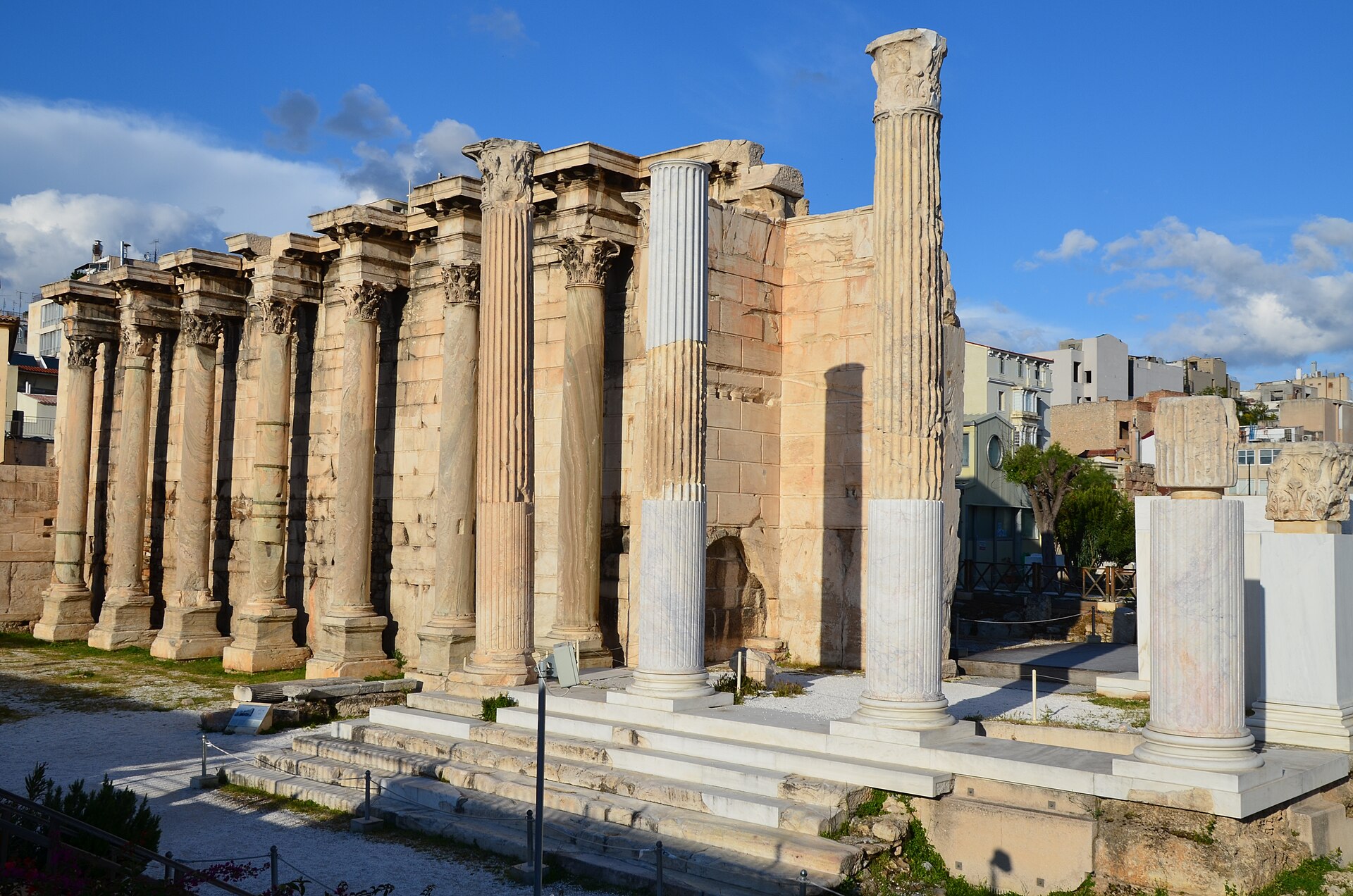
Hadrian's Library was a monumental cultural complex constructed in 132 CE by the Roman Emperor Hadrian in the heart of Athens, near the Roman Agora. Despite its name, the structure functioned not only as a library but also as a multifunctional intellectual and civic center. The complex included a large rectangular courtyard surrounded by colonnades, reading rooms, lecture halls, and administrative spaces. It served as a major symbol of Roman patronage in Athens, reinforcing Hadrian’s efforts to associate himself with Greek cultural traditions.
Key Facts
- Layout
- Peristyle courtyard with surrounding rooms
- Patron
- Emperor Hadrian
- Civilization
- Roman Empire
- Date(s)
- 132 CE
- Condition
- Ruins with standing façade wall
- Original Function
- Library and cultural complex
- Later Transformations
- Early Christian church complex
Foundation Under Hadrian
2nd century CEEmperor Hadrian commissioned the library as part of his extensive building program in Athens. The complex reflected Roman architectural planning combined with traditional Greek urban placement.
Destruction and Reconstruction
267 CEThe building suffered severe damage during the Heruli invasion. Portions of the structure were later incorporated into defensive fortifications of the city.
Christian Transformation
5th–7th centuries CEIn Late Antiquity, churches were constructed within the ruins of the complex, including a large basilica, marking the transition of the space from classical civic use to Christian religious function.
Modern Excavation
19th–20th centuriesArchaeological excavations uncovered the site and clarified its layout. Today, visitors can see sections of the monumental western façade and interior foundations.
Cultural Significance
Hadrian's Library symbolizes the intellectual and cultural ambitions of Roman Athens. It reflects the emperor’s philhellenism and his desire to position Athens as a leading center of learning within the Roman Empire. The later Christian adaptation of the site illustrates the transformation of urban space in Late Antiquity, as pagan civic institutions gave way to Christian religious structures.
Interpretive Notes
Scholarly debates and areas of uncertainty
Scholars debate the precise internal organization of the library’s reading rooms and the scale of its book collections, as no physical scrolls survive. There is also discussion regarding how the complex functioned socially—whether primarily as a repository of texts or more broadly as a public gathering and lecture space.
Visiting Information
Entry Rules
Included in the combined Athens archaeological site ticket. Visitors must remain on designated walkways.
Best Times to Visit
Morning visits provide clearer views and cooler temperatures. The site is centrally located and easily combined with visits to the Roman Agora and Monastiraki area.
Photography
Photography permitted without flash. Commercial filming requires authorization.
Preservation Notes
Do not climb on standing walls or foundations. Respect barriers protecting fragile masonry.
Nearby POIs
11 shownSources & Further Reading
- [1]Roman Athens — Ian Jenkins. British Museum Press (2006)
- [2]Hadrian and the Cities of the Roman Empire — Mary T. Boatwright. Princeton University Press (2000)
Key Facts
- Layout
- Peristyle courtyard with surrounding rooms
- Patron
- Emperor Hadrian
- Civilization
- Roman Empire
- Date(s)
- 132 CE
- Condition
- Ruins with standing façade wall
- Original Function
- Library and cultural complex
- Later Transformations
- Early Christian church complex